
Tags
guardianship, Julie Lary, Rajalary, regency-assisted-living, regency-harbor-care, Richard Lary, tzuki
Note: All characters and events depicted in this essay are entirely fictitious. Any similarity to actual persons, living or dead, or to actual events is purely coincidental.
At the core of this hearing is the need to ensure Rich’s well-being, which includes medical care, proper nutrition, socialization, 24-hour oversight, and dignity.
The key word is well-being.
Here’s a quick summary of what’s taken place: On Memorial Day 2019, Rich and I were riding his vintage Harley-Davidson. On the way home, a driver turned left into our motorcycle. Rich’s left leg was amputated and he suffered from traumatic brain injury. Doctors also discovered a severe aneurysm in the front of his brain. Its remediation likely started his dementia.
I broke all the bones in my left leg in five places.
With both of us in wheelchairs, we depended on each other to get through the days. While I was able to return to work, within a few weeks of the accident, Rich’s memory, cognition, and personality, impacted his ability to confidently and proficiently do routine tasks.
Over the course of the next 6.5 years, by myself, I took on more responsibilities, becoming a full-time caregiver while also juggling work, cooking, cleaning, gardening, finances, household maintenance, appointments, and more
Just three days, during this time, I had a full-day respite from taking care of Rich. Three to five times per year we saw Rich’s children, Patsy and Petey. Often—to accommodate their schedules and needs—we had to travel to Olympia, Tacoma, Camas, Bremerton, or elsewhere to visit.
Over-and-over again, I asked for help. I never hid the reality I was having difficulties. Routinely, I shared Rich’s medical reports with them. Both Patsy and Petey were aware that Rich wasn’t wearing his hearing aids and was still driving, even after losing his license in January 2025. And they knew Rich could get argumentative, angry, and aggressive within minutes.
Nevertheless, my pleas fell on deaf ears. For instance, after a long weekend of partying with her girlfriends on Whidbey Island in 2024, Patsy visited. I said I was overwhelmed. She said, “everyone is overwhelmed.” I explained my situation, and she dismissed it, saying she was also overwhelmed, coordinating an upcoming holiday get-together.
Click to enlarge the pictures


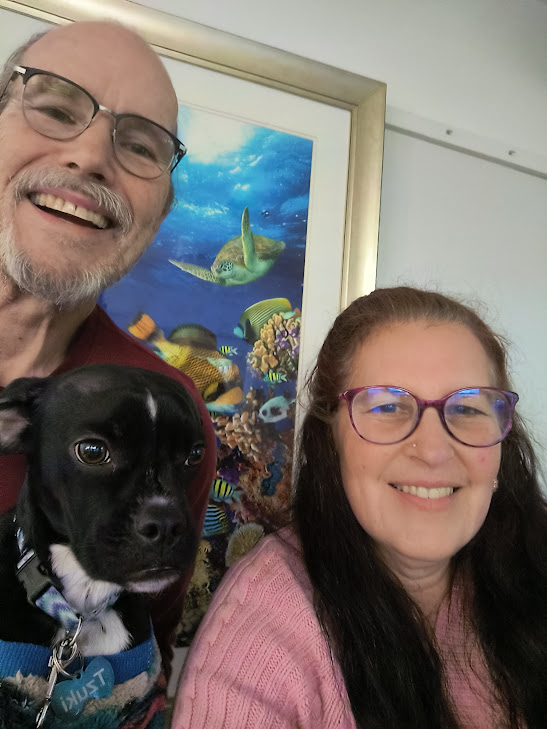
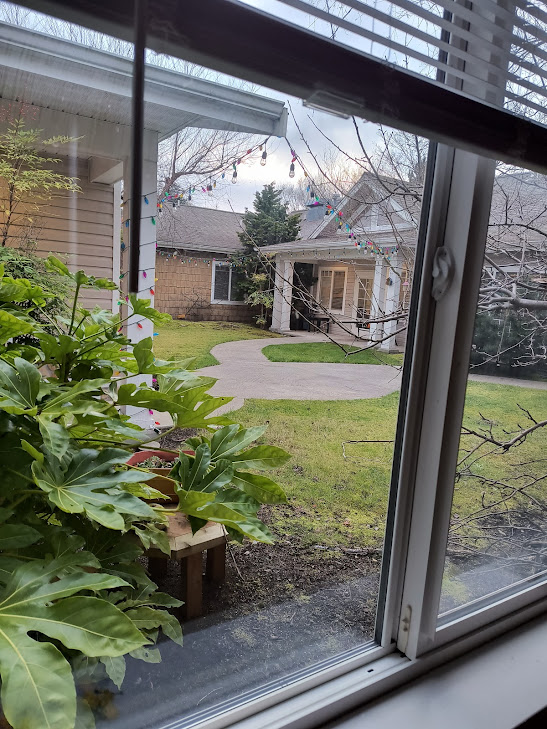
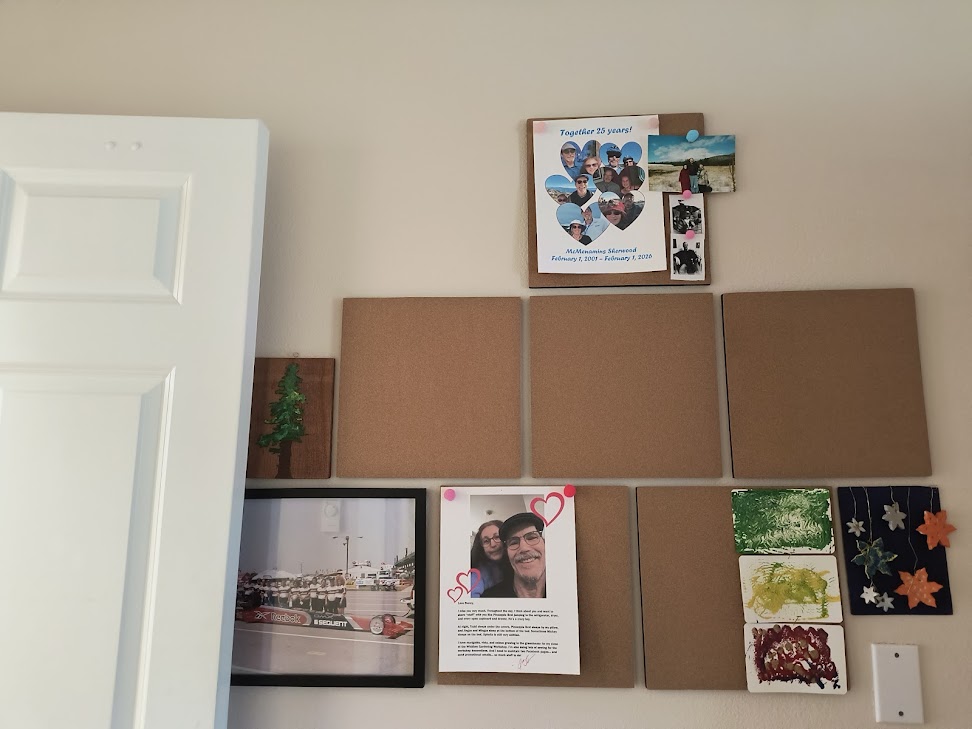
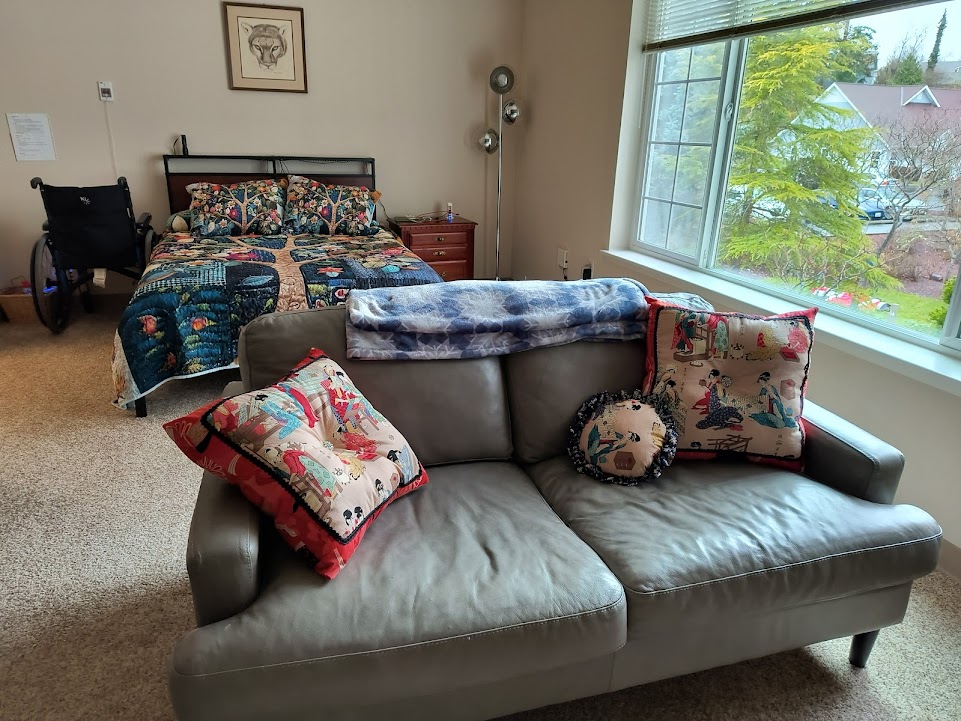
Rich’s room
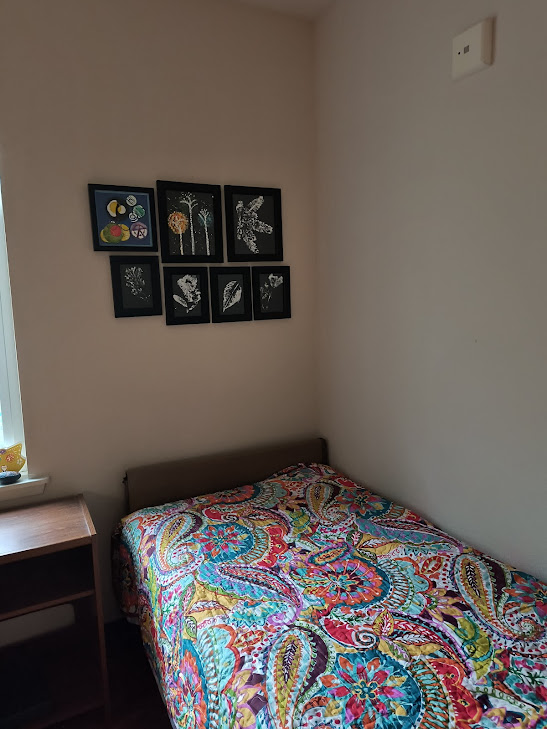
(has two matching pillow)

At Thanksgiving 2024, when Rich’s family was gathered, I tried to initiate conversations about Rich’s long-term care, but was repeatedly disregarded. In March 2025, during a trip to Bullhead City, Arizona to distribute Rich’s parent’s ashes, I once again broached the subject, and received similar responses of “that’s hard” and “you’re just doing wifey stuff.”
When I told Patsy that I didn’t feel she was hearing me and acknowledging Rich’s neurocognitive decline, she said that they didn’t like discussing serious issues when visiting. Instead, I should schedule a dedicated meeting to discuss. When I got upset, she’d call me a bitch, loose cannon, and other derogatory words.
While the words and treatment stung, I remained focused on Rich’s well-being.
# # #
In September 2025, realizing I was struggling emotionally, mentally, and physically as Rich’s full-time caregiver, I started the process of obtaining guardianship.
My intention was to place Rich in assisted living. I recognized that I was no longer effective as a caregiver. Dementia affects not only the individual living with the condition, but also the caregiver who experiences stress, isolation, and exhaustion, and in my case, the daily anguish of watching Rich cascade downhill. After being assessed by Island Senior Resources, it was determined I had severe caregiver burnout.
I was also anxious to obtain guardianship because of what had occurred to my mother. Over the course of a year, she was conned out of $325,000. If I’d had guardianship, I could have legally intervened.
In August 2025, Patsy and I toured Regency Assisted Living. We both agreed that a studio apartment on the second floor would be perfect for Rich. I never hid my intention of moving him to Regency recognizing it would prevent him from driving. Regency would also provide Rich with an opportunity to socialize with others, take weekly trips, and have a more varied diet.
Two weeks before the initial guardianship hearing, Patsy, her husband Bubba, Rich and I were in Lake Tahoe to visit Rich’s younger brother. It was a marvelous trip and the final item on my “bucket list” for Rich.
On Saturday October 18, Rich and I met with Ms. Sesgos, the court visitor. Rich became very agitated and ran out of the house. I was used to these incidents since a slightest comment—such as asking him not to use a dirty towel to wipe dishes or put kitty litter on the deck instead of birdseed—would set him off.
Ms. Sesgos returned Monday morning, October 20 to interview Rich and he was significantly calmer. She also wrote that Patsy and I should be co-guardians. I was already aware that Patsy and Petey were going to hire a lawyer to oppose me since Rich indicated he wanted to continue living at home.
I articulated numerous times to Patsy and Petey how Rich living at home impacted my health and ability to continue working full-time to pay for our house and expenses. I shared how Rich needed more stimulation than I could provide at home and how our continual arguing wasn’t healthy for either one of us.
Nothing I said made any difference, Patsy and Petey have historically sided with Rich, marginalizing, doubting, and discarding what I said. Their short visits over the years didn’t provide them with a comprehensive picture of what it’s like to care for Rich 24/7, week-after-week, month-after-month, year-after-year with scarcely a break.
After Rich spoke with a neutral lawyer, Christopher Lyons, Ms. Sesgos’s second report mentioned Rich wanted me as his sole guardian and conservator. The rest of Ms. Sesgos’s report was verbatim Washington statues 11.130.330, restricting a guardian from changing the residential placement of an individual. No doubt, her point of view was influenced by Patsy and Petey and not the realization Rich needed a higher level of care and oversight than I could provide.
Unexpectedly, on Monday, November 17, Rich told me that he wanted to move into Regency Assisted Living. There was no single event leading up to this decision. I’d like to think that Rich finally recognized I wanted the best for him, and the best wasn’t continuing to live at home with me and my deteriorating emotional stability.
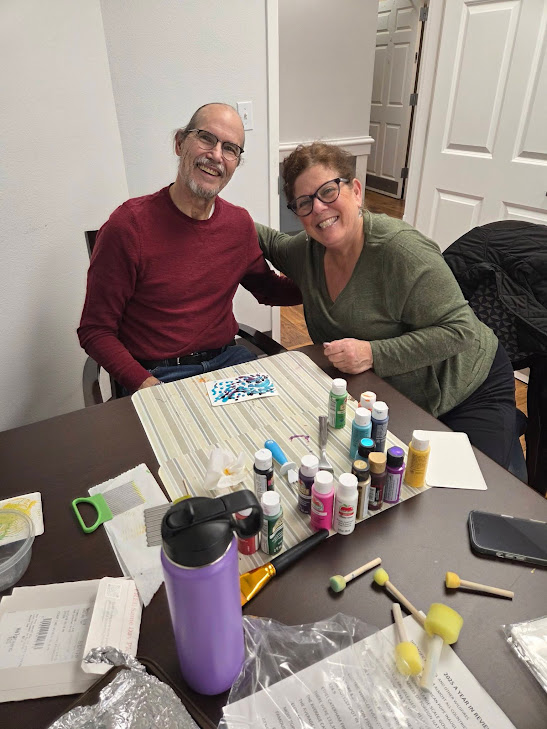
On Wednesday, November 19, Rich, Julia Neely, an art therapist who’d been working with Rich since May 2025, and me had lunch and toured Regency.
Rich had previously toured Regency. Five days before the initial guardianship hearing, Patsy was visiting Whidbey Island for another three-day girls-getaway. Friday morning, she said she was taking Rich to breakfast. Afterward, without notifying anyone, including the administrator, she took Rich to Regency. She felt it was her obligation to show Rich what I “planned to do with him.” She was flummoxed as to why I was upset with her scheming. Two days later, Sunday, instead of letting her further influence Rich, I took him on an excursion to La Connor for breakfast, art show, and of course, ice cream.
# # #
In November, after touring Regency a second time, Rich was enthusiastic about moving and could see the advantages. I immediately scrambled to purchase furniture for his new apartment, completed the necessary paperwork, arranged doctor visits, and more.
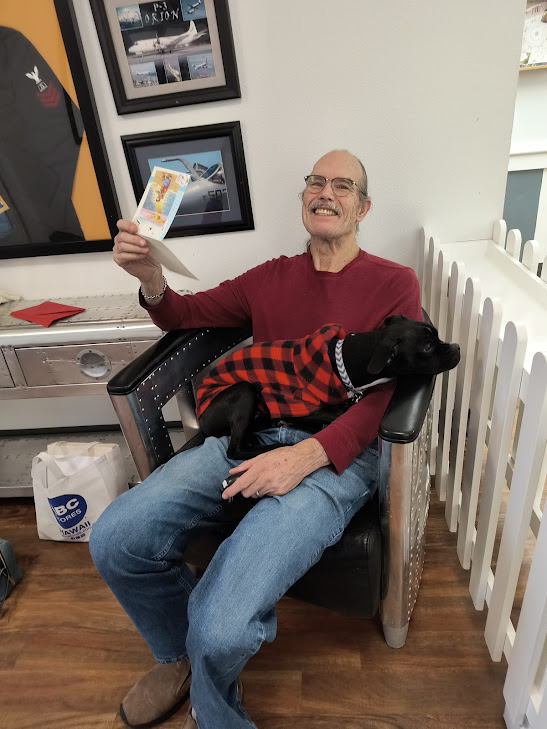
Following the hearing on December 8, Rich was officially admitted to Regency. While he seemed to being doing well, enjoying the meals, socializing with others, attending events, getting personalized care, and hanging out in his studio apartment with Mickey, his giant Siamese, on Tuesday, December 22, Patsy visited him.
I don’t exactly know what she said to him, but he started calling me every few hours, crying, saying he’d messed up, needed to fix things, and had done “something wrong.” Her visit triggered the start of sundowner syndrome, in which he’d get agitated at night and refused to sleep.
A few days after Christmas, Rich was found outside at 3:45 a.m. I was also told that he’d been wandering outside during the day without a coat or sense of direction. Feeling his behavior was a liability, Regency recommended he be transferred to memory care, their Harbor Care facility. He moved there on January 6.
As expected, this move was traumatizing for him. I informed Patsy the day before he was scheduled to move, which precipitated numerous calls from her and Ms. Sesgos to Harbor Care to check on Rich. I informed both that Rich wasn’t allowed calls or visitors—including me—until he calmed down, started to sleep at night, and got used to the routine at the facility. As soon as I received news about Rich, I shared it with Patsy via text. She’d subsequently contact Ms. Sesgos, perhaps distrusting the legitimacy of what I wrote.
On January 16, I wrote a lengthy, friendly email to Petey and Patsy, letting them know about Rich’s status at Harbor Care. I asked them to drop their objections to my becoming Rich’s guardian and conservator, writing “Recognizing what’s best for Rich, I’m optimistic Petey and you will drop your objections. Having Rich appear in court again will impact his wellbeing. He needs stability, not a hearing on which is best qualified to oversee welfare and portion of the Rajalary estate. Out of respect for your father and the contributions I’ve made across the breadth of Rich’s and my 23-year marriage, most notably, these past few months when he’s transitioned from assisted living to memory care, please allow me to become Rich’s guardian and conservator.”
Neither one responded.
Ms. Sesgos, still determined to evaluate Rich, succeeded on Friday, January 26, less than three weeks after Rich became a resident at Harbor Care. Ms. Sesgos insisted on interviewing Rich in his room with the door closed. There’s no way to precisely know what was discussed, but Rich became so agitated that he attempted to choke the head nurse and attacked the medical director when they checked on him. The police were called when Ms. Sesgos refused to leave.
Within a day, Ms. Sesgos asked the court to appoint an attorney—Jeff Waller—to represent Rich, believing he was being held against his will and his aggressive behavior was a symptom of this right’s being violated and not the reality that he needed a higher level of care in a secure environment.
Instead of being neutral and simply investigating and reporting the facts, Ms. Sesgos sided with Patsy, believing I was harming Rich. In reality, Rich not only has significant neurocognitive issues—as confirmed by a neuropsychologist and forensic psychologist—but anosognosia, a neurological condition in which he’s unaware of his health condition.
It took over a week until Rich settled down. During this time, he tried to escape and was very belligerent. He somewhat returned to normal, but had a slight step back when Mr. Waller met with him on Thursday, February 12, While Mr. Waller was very professional, his chat reintroduced the distressing topic of Patsy and Petey interfering in his life for no apparent reason or value.
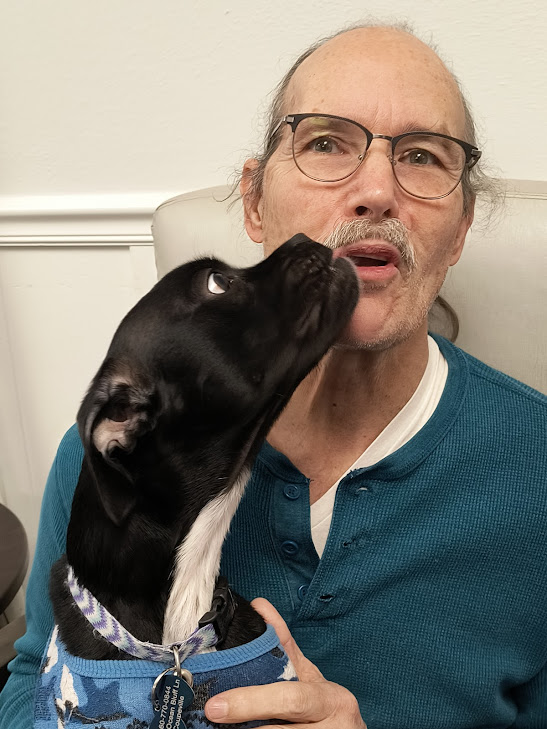
Rich started to improve, especially after Julia and I were cleared to see him. I’d take Tzuki, our dog, and visit on weekday evenings and weekends. Starting in late March, Rich would follow me to the door, wanting me to let him out. As soon as the door closed, he started banging on it.
No doubt, Ms. Sesgos, Patsy, and Petey would jump to the conclusion that I should take him home. However, no medical professional that I’ve consulted feels this is the right option, based on his current diagnosis of Lewy Body Dementia. And according to RCW 71.05.40 if a person with dementia is likely to cause serious harm to themselves or others, detention is acceptable.
# # #
On Tuesday, April 7, Rich started throwing tables and chairs, hitting staff, and punching windows. The police were called and he was taken to Whidbey Health. Patsy, who was working in Japan, was notified within hours of the episode. I provided additional details via text, based on what I knew at the time.
Patsy’s responses weren’t tied to her father’s well-being, but questioning me, writing “What is the best avenue to get Kaiser to work with Regency on the medication? Do they have a reason for not wanting to get him the medication,” “What was Kaisers hesitation,’’ and “Does he need to see a different specialist?” Patsy never followed up after I provided her with the answers.
By Friday, April 10, after numerous calls (and a miracle), I arranged for a video call between a Kaiser psychiatrist and Regency. The call lasted for over an hour. Rich is currently on antipsychotics, closely monitored by the psychiatrist, and visitation with him is limited to Julia his art therapist and Tzuki.
# # #
In summary, I’ve stayed in my lane, doing what’s necessary for Rich’s ongoing wellbeing — from caring for him at home for 6.5 years to moving him to assisted living then memory care. I’ve overseen his medical care and spent hours with him, doing puzzles, flipping through memory books, and working on art projects.
The perceived “fight” between Patsy, Chris, and I is manufactured by Patsy to satisfy her need for control and dominance and not kindness, understanding, and respect for her father and his 23-year marriage. She’s alleged I’m difficult to work with and too emotional. However, I’ve extended several olive branches, offering to send them monthly updates on their father’s health. They’ve never been acknowledged.
Instead, Patsy’s efforts have focused on discrediting, doubting, dominating, and intimidating me, rather than showing the maturity necessary to listen, learn, respect, and collaborate. In nearly seven years, Patsy, and especially Chris, have minimally engaged with their father and scarcely taken an interest, let alone an understanding of his health.
It’s insulting, therefore, they feel the need to dictate language that I “must keep them informed.” Especially, since they’ve consistently acted behind my back, not for the betterment of their father, but to prove they can do whatever they want without consequences.
I’ve stayed in my lane, doing what’s necessary—through thick and thin—to ensure Rich’s wellbeing. I’ve consistently communicated with his children and received little to nothing back in return.
I didn’t interfere when Patsy and Petey visited Rich at Regency Assisted Living. They had the opportunity to call and send him letters. They’ve been told they can visit Rich at Harbor Care, but it was at the discretion of the staff, based on Rich’s emotional state.
In early March, Patsy spoke to Rich for a few minutes. And on Monday, March 16 without notifying anyone, including Regency, Petey and Patsy visited Rich at Harbor Care.
In closing here’s an insightful occurrence: When Rich was living at Regency Assisted Living, I’d take him on excursions every Saturday. One Saturday, I took him to IHOP. While waiting for our food to arrive—out of the clear blue sky—Rich said, “Patsy is treating me like a toy.”
That’s the crux of this ongoing conflict. It has nothing to do with Rich’s well-being. It’s a callous game for control and dominance.
# # #
I was awarded guardianship on April 17. Patsy and Petey didn’t Zoom into the hearing, perhaps realizing there was no point. Their lawyer used Zoom and approved of everything with no objections.
Patsy and Petey caused a lot of angst (and expenses) for both Rich and I with no added value. Instead, they destroyed their relationship with me and jeopardized the one with their father. Their ability to engage with their father, moving forward, is questionable given his declining mental health and Regency Harbor Care being able to restrict their calls and visits.
Ms. Sesgos Zoomed into the hearing from her car, likely too embarrassed to show her face. No problem, I’ll be filing a second complaint against her because of her incompetence. The first complaint, which I wrote months ago, was referenced by the judge during the April 17 hearing.
As for me, I discovered my fury can fuel my determination and my deep love for Rich can push through obstacles no matter how unsurmountable they originally appear. I’m now free to spend time with Rich, knowing I hold all the cards.
Everyday I deal with the horrible emptiness and hole in my heart from his decline and the devastation of having to let go of the fantasy of spending the rest of my life with my amazing prince, gardening, traveling, laughing, and loving each other. Our marriage was a fairy tale with a tragic ending.
 Rajalary