• About
  • scribbles
  • Tribute to Rose

Rajalary

~ The adventures of Richard and Julie Lary

Rajalary

Author Archives: rajalary

Cats of Mallorca

16 Monday Jan 2017

Posted by rajalary in Travel

≈ 2 Comments

Tags

Biniaraix, cats, Coves de Campaner, Fornalutx, Julie Lary, mallorca, rajalary, Sollar, spain

“Cats are a mysterious kind of folk. There is more
passing in their minds than we are aware of.”

Sir Walter Scott

It seems fitting to start my series of post about Rich’s and my recent European trip with the cats of Mallorca, Spain. Unlike tourist spots, routinely shared in books and online, they cats were unexpected delights from cats with ordinary coats to those who were all white or part Siamese.

The capital and largest town on Mallorca is Palma. The remainder of the island is primarily dotted with quaint small towns and fishing villages, citrus, almond, and olive groves, and historical and geological attractions intertwined in the dramatic landscape.

Wild and somewhat domesticated cats — perhaps because of their tenacity at taming rodent populations — roamed freely wherever we went. One of the first cats we saw was at Sa Calobra, a small seaside village on the northwest coast of the island. It was late in the day, and we went into a cafeteria, one of the few places open during the winter. We split plates of seafood paella, meatballs and potatoes, bread, olives allioli, baked ribs, and a large mug of fresh-squeezed orange juice.

The restaurant smelled heavenly, a mix of cooked food, and smoke from a wood stove, used to heat the dining room. A light-colored cat with a white chest and paws lounged in front of the stove, happy to be admired and caressed by visitors.

This slideshow requires JavaScript.

After eating, we took a walk along the coast, spotting several other cats, darting between the few buildings and narrow streets. Two young, all white cats played in a planter box, scarcely taking notice of Rich and I who spent several minutes trying to catch their attention.

A few days later, we ambled between the towns of Sollar, Fornalutx, and Biniaraix. At the start of our walk, we encountered a beautiful, part Siamese cat with blue eyes that followed us like a dog hopping onto the stone walls, zigzagging between our legs, and meowing when we pet its head. After ten or fifteen minutes, she decided to stay behind as we journeyed along the stone pathways and cobblestone streets through orchards, farmsteads, and the towns.

Along with seeing an occasional goat and numerous sheep – the bells around their necks complementing the lovely ambience – we saw many cats, lounging on balconies, darting into doorways, and watching passersby from the safety of a planter box or stairwell. It was challenging photographing because they weren’t tame or at least, interested in our affections.

A day later, we visited the Coves De Campanet, a magnificent cave that is accessible through a carved passage on top of a hill. In front of the cave is restaurant with a beautiful terrace, overlooking the valley, orchards, and small farms below. The establishment has 16 cats, many of whom were stretched out, enjoying the afternoon sun, including a majestic, long-haired red cat, which welcomed the attention and was proud to flaunt its beauty.

Check out the many cats of Mallorca, above, along with a couple of pigeons in an picturesque window.

Image

Our 2016 Holiday Letter

07 Wednesday Dec 2016

You may need to make your screen size larger to read our letter…

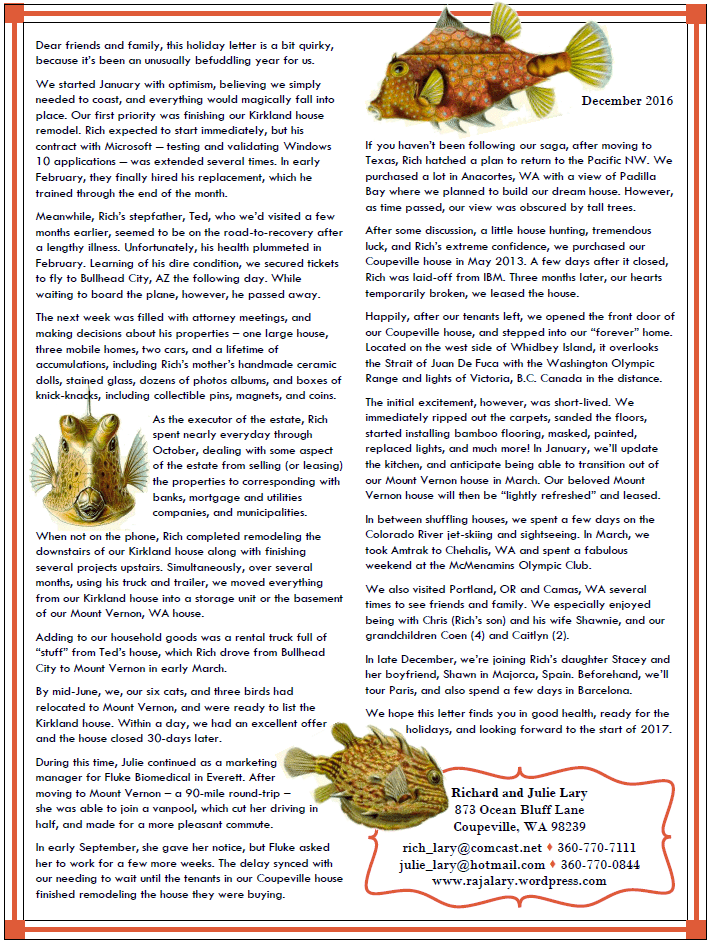
lary_2016-holiday-letter

Posted by rajalary | Filed under Uncategorized

≈ Leave a comment

Comment Leads to Constitutional Research

12 Saturday Nov 2016

Posted by rajalary in Politics, Uncategorized

≈ Leave a comment

Tags

Bill of Rights, Constitution, Electoral College, Founding fathers, Julie Lary, rajalary

An acquaintance recently wrote on Facebook, “The independent states were originally united by the U.S. Constitution, which has been systematically dismantled,”

I inquired “What’s been dismantled?”

He wrote back, “The Constitution, as drafted by the authors, via erroneous interpretation.”

I retorted that the founding fathers couldn’t have visualized today’s modern world, and therefore a document written hundreds of years ago, would have to be open to interpretation to be relevant to today’s technologies, issues, and human needs. The U.S. Constitution is essentially a framework.

He wrote back a missive of gibberish and nonsense citing the Revolutionary War, Lexington and Concord (Civil War), Nazi Germany, and Russia, and how “the Constitution was drafted by geniuses so the county could be run by idiots if they just stick to the script.” It was obvious that he was simply repeating what he’d heard from a conservative pundit or pseudo constitutionalist.

To be honest, prior to our exchange, I barely knew anything about the U.S. Constitution, let alone why there seems to be a perpetual controversy surrounding its meaning.

I went online to do some investigating (and learning).

In 1787, there were approximately 4 million people living in the original 13 American colonies. They were governed under the Articles of Confederation, which lacked the mechanisms to fund the federal government through taxation, and likewise persuade delinquent states to pay their share of expenses, like the Revolutionary War (1775 – 1783). In addition, the Articles didn’t provide a means to adjudicate issues between the states, such as boundaries and tolls on road that crossed multiple states.

Originally conceived to revise the Articles of Confederation, the Constitutional Convention took place from May 25 to September 17, 1787. Because travel in colonial times was challenging, it took several months before representatives from twelve states arrived in Philadelphia, Pennsylvania, establishing a quorum. Seventy-four delegates were invited, but only 55 attended, with 39 eventually signed the Constitution. It took nearly three years for all thirteen states to ratify.us_constitution
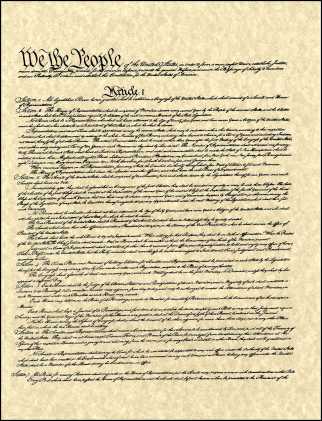
The writing of the U.S. Constitution wasn’t a slam-dunk. It was a compromise between several mindsets with disputes and debates centered on how “proportional representation” would be defined. The final wording in Section 2, third paragraph of the U.S. Constitution is ”Representatives and direct Taxes shall be apportioned among the several States which may be included within this Union, according to their respective Numbers, which shall be determined by adding to the whole Number of free Persons, including those bound to Service for a Term of Years, and excluding Indians not taxed, three fifths of all other Persons.”

While slavery no longer exists in America, making those living in the United States, “free,” if you were to literally apply what’s written in the U.S. Constitution then Native Americas who don’t pay any taxes aren’t counted when determining the number of representatives per state. In 2015, the Tax Policy Center estimated the percentage of households who don’t pay federal income taxed to be 45.3%. If Native America’s mirror this statistic, does that mean that 45% of them don’t count?

And what about the “three fifths of all other Persons” statement? Does that consist of people with green cards? Illegal immigrants? U.S. citizen who live outside the country?

Section 2, paragraph three of the U.S. Constitution further states, “The Number of Representatives shall not exceed one for every thirty Thousand, but each State shall have at Least one Representative; and until such enumeration shall be made, the State of New Hampshire shall be entitled to choose three, Massachusetts eight, Rhode-Island and Providence Plantations one, Connecticut five, New-York six, New Jersey four, Pennsylvania eight, Delaware one, Maryland six, Virginia ten, North Carolina five, South Carolina five, and Georgia three.

If the U.S. Constitution names only thirteen states, is it also relevant to the other 39, plus a couple of territories like Puerto Rico? After all, the “number of representatives shall not exceed one for every thirty Thousand,” which today is the size of small American town, not a huge metropolitan area like Los Angeles with over 4.03 million people.

The point being, the U.S. Constitution must be interpreted in context to today’s world. To bounce up-and-down saying politicians and pundits are straying away from the tenants of the Constitution is preposterous because a document written over two hundred years ago can’t possibly be rigidly followed unless you abandoned progress. It’s like treating cancer by applying leeches.

Sections 3 through 6 of the Constitution spells out the election, responsibilities, behavior, and compensation of members of the Senate, House of Representatives, and President. Section 7 discusses the creation and passage of bills.

Section 8, from a viability point-on-view is one of the most important once because it states, “The Congress shall have Power To lay and collect Taxes, Duties, Imposts and Excises, to pay the Debts and provide for the common Defence and general Welfare of the United States; but all Duties, Imposts and Excises shall be uniform throughout the United States.” It continues, defining how monies can be used including for posts offices, roads, support armies and militia, borrowing on credit, commerce with “foreign Nations, and among the several States, and with the Indian Tribes,” progress of science and useful arts, and much more.

Section 9 deals with migration and “importation” of “Persons,” along with the authority to apply a “Tax or duty may be imposed on such Importation, not exceeding ten dollars for each Person.” Read that again. Once again, if the Constitution were to be followed by the law, and not interpreted, it sounds like people can be imported for just $10 per head.

This section also prohibited states from levying taxes and duties on exported articles, granting titles of nobility, and privileges of the Writ of Habeas Corpus (bring a person before a court to determine if the person’s imprisonment or detention is lawful).

The remainder of the Constitution continues in a similar manner, detailing the design, checks and balances, and responsibility of the government and its officials – as envisions by the representatives of the Constitution Congress in 1787.

Bill of Rights: The other half of the Constitution

One of the more contentious debates surrounding the writing of the Constitution was how slaves or other property was defined. After being drafted, this issue bubbled to the top when the states were asked to ratify the document. States and critics argued the Constitution lacked a bill of rights, which protected citizens’ rights.

Two states – North Carolina and Rhode Island – refused to ratify until the Bill of Rights was proposed in Congress in 1789. Even so, Rhode Island only ratified, by two votes, when threated with the possibly of being treated as a foreign government.

The Bill of Rights consists of ten amendments. As you read them, consider which ones are being “systematically dismantled.”

Amendment I: Congress shall make no law respecting an establishment of religion, or prohibiting the free exercise thereof; or abridging the freedom of speech, or of the press; or the right of the people peaceably to assemble, and to petition the Government for a redress of grievances.

Amendment II: A well regulated Militia, being necessary to the security of a free State, the right of the people to keep and bear Arms, shall not be infringed.

Amendment III: No Soldier shall, in time of peace be quartered in any house, without the consent of the Owner, nor in time of war, but in a manner to be prescribed by law.

Amendment IV: The right of the people to be secure in their persons, houses, papers, and effects, against unreasonable searches and seizures, shall not be violated, and no Warrants shall issue, but upon probable cause, supported by Oath or affirmation, and particularly describing the place to be searched, and the persons or things to be seized.

Amendment V: No person shall be held to answer for a capital, or otherwise infamous crime, unless on a presentment or indictment of a Grand Jury, except in cases arising in the land or naval forces, or in the Militia, when in actual service in time of War or public danger; nor shall any person be subject for the same offence to be twice put in jeopardy of life or limb; nor shall be compelled in any criminal case to be a witness against himself, nor be deprived of life, liberty, or property, without due process of law; nor shall private property be taken for public use, without just compensation.

Amendment VI: In all criminal prosecutions, the accused shall enjoy the right to a speedy and public trial, by an impartial jury of the State and district wherein the crime shall have been committed, which district shall have been previously ascertained by law, and to be informed of the nature and cause of the accusation; to be confronted with the witnesses against him; to have compulsory process for obtaining witnesses in his favor, and to have the Assistance of Counsel for his defence.

Amendment VII: In Suits at common law, where the value in controversy shall exceed twenty dollars, the right of trial by jury shall be preserved, and no fact tried by a jury, shall be otherwise re-examined in any Court of the United States, than according to the rules of the common law.

Amendment VIII: Excessive bail shall not be required, nor excessive fines imposed, nor cruel and unusual punishments inflicted.

Amendment IX: The enumeration in the Constitution, of certain rights, shall not be construed to deny or disparage others retained by the people.

Amendment X: The powers not delegated to the United States by the Constitution, nor prohibited by it to the States, are reserved to the States respectively, or to the people.

Were the Signers of the Constitution Geniuses

James Madison, who became the fourth President of the United States, is considered the “Father of the Constitution” for his pivotal role in drafting and promoting the Constitution and the Bill of Rights. He was born into privilege, the oldest of 12 children, to a Virginia tobacco planter and the daughter of tobacco planter. The Madison family was the largest landowners in the area with hundreds of slaves on a Montpelier, VA plantation.

Madison had private tutors, and attended the College of New Jersey, which later became Princeton University. He studied and mastered a breadth of subject, becoming a Virginia State Legislator 1776, where he initially met Thomas Jefferson. Jefferson later sent Madison crates of books from France on various forms of government. These learnings were central in Madison’s viewpoints when drafting the Constitution, and driving compromise and consensus.

One delegate wrote, he’s “the best informed Man of any point in debate.” Madison wasn’t just wise, but understood human foibles, writing “If men were angels, no government would be necessary.”

The first Secretary of the Treasury, Alexander Hamilton was the consummate statesman, leading the Annapolis Convention, playing a pivot role in composing the Constitution, writing 41 of the 85 installations of The Federalist Papers, and adjudicating in many federal issues. He was also born out of wedlock in Charlestown, British West Indies to a mother whose ancestry was African, British, and French. His father was from Scotland.

In 1804, Aaron Burr was defeated as the governor of New York. He felt that Hamilton’s support of his opponent, Morgan Lewis, and the contents in a letter written by Hamilton, attacked his honor. While attempts were made to reconcile their differences, a duel was arranged between the two men. Hamilton, feeling obliged to his family, and wanting to continue playing a role in politics, resolved to throw his fire, meaning to abort a conflict by allowing one’s opponent to fire first. It’s unknown whether Hamilton fired after being struck by Burr’s bullet or if they fire simultaneously, but the shot to Hamilton was fatal.

It’s easy to assume all of the signers of the Constitution were outstanding individuals, however, like modern-day politicians they had their flaws or at least, a tendency to resolve conflicts through gun fire.

Richard Dobbs Spaight signed the Constitution when he was only 29 years, having previously been a delegate to the Confederation Congress and served in the North Carolina House of Commons. When he was 44, like Alexander Hamilton, he was died from injuries sustained in a duel.

A member of the North Carolina delegation at the Constitutional Convention, William Blount and his brothers gradually acquired 2.5 millions of acres in Tennessee and the trans-Appalachian west, which left him deeply in debt. He then hatched a scheme to increase the value of his lands by working with Great British to seize Spanish-controlled Louisiana and Florida, and then give American merchants free access to New Orleans, and the Mississippi River. When his duplicity was discovered, he was expelled from the Senate, and become the first U.S. public official to face impeachment.

Timothy Pickering, who was also a signer of the U.S. Constitution, and involved in impeaching William Blount, served as Secretary of State under Presidents George Washington and John Adam, and was also a Massachusetts Senator.

In 1810, he challenged Thomas Jefferson’s Embargo Act by holding several conferences with special British envoy George Rose in hope of creating a pro-British party in New England. Passed in 1807, the Embargo Act supporting U.S. neutrality during the Napoleonic Wars, and imposed embargos on Great Britain and France. At the time, the British Royal Navy was forcing thousands of American seaman to serve on their war ships.

Pickering’s insolence in wanting to form a party sympathetic to Britain was in violation of the Logan Act, which forbids unauthorized citizens from negotiating with foreign governments who conflicted with U.S. interests. In addition, Pickering read confidential documents in open Senate sessions before an injunction of secrecy had been removed. By a majority vote of 20-7, Pickering was censured by the Senate on January 2, 1811.

Born in County Carlow, Ireland, and one of the largest slaveholders in the United States, Pierce Butler represented South Carolina when he signed the Constitution. Recognizing human dignity, he introduced the Fugitive Slave Clause to the Constitution. Throughout his life, he lobbied for better treatment of slaves, but continued to support the institution because of its importance to the southern economy.

Considered “eccentric” and an “enigma,” he summarized his view of government as “Our System is little better than [a] matter of Experiment…. much must depend on the morals and manners of the people at large.”

Final Thoughts

The Constitution has withheld the test of time. But it’s important to keep in mind, it was created through compromise with aspects of the final version drawn from five different points-of-view, the Virginia Plan, New Jersey Plan, Hamilton Plan, Pinckney Plan, and Connecticut Compromise. There was heated discussions and modifications that continued for several months with some of the signers reluctantly adding their signatures, and sixteen refusing to sign.

More than half of the delegates were trained as lawyers with others being merchants, manufacturers, shippers, land speculators, bankers or financiers, physicians, a minister, and several small farmers. Twenty-five owned slaves.

Once signed, the next challenge was to get the 13 states to ratify, and adhere to its premises. To nudge reluctant states to sign the Federalist Papers – a collection of 85 articles and essays – were published under the pseudonym Publius. Written by Alexander Hamilton, James Madison, and John Jay the papers are interpretations of what’s contained in the Constitution and were envisioned to speed up the ratification.

If the signers of the Constitution found it necessary to help state legislatures and citizens better understand the idiosyncrasies of the Constitution by writing the Federalist Papers, then it’s not unreasonable to continue interpreting the document as it applies to modern-day issues. Sure enough, the Federalist Papers are often referred to by judges in applying the laws-of-the-land.

One aspect of the Constitution, which is coming under scrutiny, is the Electoral College. In Federalist [Paper] No. 39, James Madison argued the Constitution was designed to be a mixture of state-based and population-based government. Federalist [Paper] No. 68, written by Alexander Hamilton presents the advantages of the Electoral College, focusing on elections taking place among states so they can’t taint “the great body of the people.” He also commented Electoral College delegates – none of whom can be a U.S. officeholder – have information that might be unavailable to the general public.

Unfortunately, recent history has twice elected a president for whom didn’t receive the population vote, which begs the question, is it time to re-interpret this aspect of the Constitution to elect a president who is chosen by the majority of people?
 

Grow Another Me

19 Wednesday Oct 2016

Posted by rajalary in Gardening, Rose's Writings, Uncategorized

≈ Leave a comment

Tags

gardening, Julie Lary, Meaning of life, rajalary, rose ridnor

The following essay was written by my grandmother, Rose Ridnor. I found it humorous because I’m often precariously balanced on a ladder, in the middle of summer, trimming the dead flowers off our two lilacs in Mount Vernon, WA. And while I have the clippers, the nearby apple trees also gets a trimming.

The lilac tree was long overdue for pruning. This particular morning, after spending almost two hours pulling weeds, cutting, and cleaning up the front and side of the house, I was finally ready to begin trimming the lilac. When I as more than half done, I found I was getting terribly tired.

The burning sun had followed me all morning, making my face flush and sticky with sweat. My legs ached from leaning against the runs of the ladder, my hands were stiff from wielding the clippers. I just had to finish. Stop now and who knows when I could get back to it. So I pushed harder with the clipping and snipping to finish faster.

I was concentrating hard on lopping off a heavy branch, my mind as blank as it could get, when out of the blue, a line of words popped into my head. It was odd. I eased off a second to repeat it to myself, “I can always plant another tree, but I can never grow another me.”

Lilac
Lilac
Raspberry lilac
Raspberry lilac
Apple blossom
Apple blossom

Quickly, I fathomed its meaning, and for a moment was tempted to heed its message. But no, I couldn’t stop now. I had to finish.

But it kept bugging me. Why am I pushing myself? What am I out to prove? I have just so much energy, exhaust it, and I’m finished. The tree doesn’t give a darn whether I cut off its dead flowers or crowded limbs. It will just go on doing what it has to do: Grow and produce more flowers that will die, and I’ll have to cut off.

I set the clippers down, stepped off the ladder, went into the den, and plopped into a chair. I could feel the tiredness ease out of my body.

Ten minutes later, quite refreshed, I went out, put away the ladder and tools, left the sweeping to Morris [husband], and that was that! I didn’t hear one word of protest from the lilac tree.

Life is a constant weighing of the importance of one’s own self in relation to everyone, and everything else.

Jujube Camping Extravaganza

09 Sunday Oct 2016

Posted by rajalary in Uncategorized

≈ Leave a comment

There’s been very few times when Rich and I didn’t take a dog, cat (or three) when we went camping in our motorhome. When we lived in Oregon, my sheltie Gigi or rat terrier Cyrano would come along, usually to the Oregon coast or along the Columbia Gorge.

In 2002, we drove the motorhome from Sherwood, OR to Round Rock, TX with six cats – Micheko, Mongojerrie, Goldakevtch, Calamity Jane, Ariel Anne, and Pu’Yi – snuggled in nooks and crannies in-between house plants, luggage, and last minute stuff that didn’t make it into the moving van. Once in Texas, the motorhome sat abandoned in our driveway, used only a handful of times because the air conditioner only worked in the cab. The rest of the motor home would have become uncomfortably warm in the Texas heat.

After buying a house in Mount Vernon, WA, we drove the motorhome back to the Pacific Northwest, parking it in the driveway, where it patiently awaited our return. Sure enough, once we left Texas we started camping again, usually with the three Musketeers: tabby Jujube, calico Zephyra, and Siamese Pu’Yi.

The motorhome also came in handy when we visiting people in Oregon because we could park it on the street, and spend the night in our home-on-wheels.

In 2013, the weekend our Coupeville house closed, we drove the motorhome to Whidbey Island. We figured we could cook in the motorhome or sit at table for meals since there was no furniture in the house. The first night, we set up an inflatable bed in the master bedroom; however, we forgot the air pump. Undeterred, we grabbed the pads from the bed over the motorhome cab, and slept on them instead of the inflatable bed.

A few weeks later, when we leased the house, I decided to clean the area over the cab before putting back the cushions. It was surprisingly dirty and moldy, and when I climb on top, it shattered! The wooden platform over the cab was full of dry rot. After taking part the front of the motorhome, including the outer fiberglass, Rich discovered when the motorhome was built, twenty or so years earlier, they neglected to remove the plastic tape on one side of the weather stripping so there was never a tight seal. For years, water had been dripping into the motorhome, jeopardizing the integrity of the bed over the cab.

With more pressing obligation, Rich put plastic over the front of the motorhome until he had time to deal with the issue. Happily, a few months ago, Rich started rebuilding the front of the motorhome. Over the course of the project, he used a variety of materials, including wood, fiberglass, metal, and sealants; purchased a used high-end band saw (for $200) over Craig’s List to craft rounded wooden pieces for the front of the motorhome, and employed tremendous ingenuity to make the motorhome as good as new.

The crowning moment was last Sunday, pulling out of the driveway for the much anticipated Jujube Camping Extravaganza with Jujube, Zephyra, and Lila.

We left on a Sunday morning, and headed an hour north to Birch Bay State Park. The town of Birch Bay is located, less than 10 miles from the Canadian border on the idyllic Semiahmoo Bay, which is surrounded by quaint cottages, small hotels and condos, camp/RV parks, and a couple of retail shops. It’s a fabulous place to unwind for a few days, wandering along the beach, and watch the sunset. It doesn’t look much different than this vintage postcard.

After arriving, we set up camp, then hopped on our bikes, and road south along the water. A quick lunch later, we went north, riding to one of the most northwest corners of the United States, the Semiahmoo Spit. We expected it to be very rural, but were surprised to find several large up-scale gated communities surrounding plush golf courses, along with many affluent neighborhoods on the water or tucked into forested areas. At the top of the spit is the snazzy Semiahmoo Resort, with the cheapest rooms, starting at around $180 per night.

This slideshow requires JavaScript.

Having ridden for several hours, and shed layers of clothes, we stopped at a mini-mart for ice cream bars before heading back to our motorhome. As the sun started to set, we biked to the beach, and reflected on a wonderful day of biking, sightseeing, and once again, enjoying our motorhome.

The next day, we got up early and biked to Peach Arch Park, which is on the boundary between Blaine, WA and Douglas, British Columbia, Canada. It was built by philanthropist Samuel Hill in 1921 to commemorate a century of peace between the United States and Canada. Hill also built Maryhill on the Columbia River Gorge, which is now a wonderful, eclectic museum, and a favorite place to visit when I lived in Oregon.

After taking some pictures at the park, we zipped through Canadian customs. They have a special area for bicyclists and pedestrians. We then biked a few miles, arriving in White Rock, around 10 a.m. A few years ago, when we took the train to Vancouver, B.C., we passed by White Rock, and vowed to return by car to visit. Little did we know it’s an easy bike ride (11 miles) from Birch Bay.

We wandered around White Rock for quite a few hours, then hearing a train in the distance, waited for its arrival. The train track is on a raised boardwalk in front of the town. You can stand within a few feet of a passing train and experience its power. Rich and I both shot video with our smart phones.

Hungry, we had to choose where to eat. With dozens of street-side restaurants, Rich referred to his smart phone for ratings, and opted for Moby Dick, which has accolades from far and near, and primarily serves fish and chips. We secured a table outside, and eagerly polished off a bowl of clam chowder, three pieces of fish, and a huge plate of seasoned fries.

After walking off our meal, we got on our bikes, and headed back to the United States. To say U.S. Customs and Immigration is a confusing mess would be an understatement. First, it wasn’t well marked where bicyclists are supposed to go. We spent ten minutes or so waiting among the cars to get close enough to the inspection booths to spot a sign, directing us to go around the corner of large building. Once in front of the building, we had no idea what to do, until Rich spotted a customs officer and asked him where we should go.

“Inside the building,” was his response.

We hastily parked our bikes and went inside, and were then perplexed as to which of the three long lines we were supposed to stand in. After ten minutes of waiting, another customs officer, spotting our bike helmet said we were in the wrong line.

Fifteen or twenty minutes more of waiting – since only one of the 18 terminals were manned by an officer – we approached the counter. We were asked a couple of questions, our petite backpacks were searched (containing not much more than our identification, and some snacks), and we were given a yellow slip to “hand to the officer stationed off the parking lot.” Once outside, we discovered Rich left the slip on the counter. Happily, he was able to retrieve it with no further delays.

With slip-in-hand, we biked through the lot, handed it to the officer, and we were finally back in the United States, an hour after approaching the border!

Our ride back was uneventfully, except when we passed a quiet bay, I rode recklessly, watching the dozen or so blue heron perched on their own rocks or swooping overhead in search of a tasty morsel below. I love blue heron!

We slept soundly that evening, and woke refreshed. After a leisurely breakfast, we pulled up camp, drove around Blaine, WA, and were back to Mount Vernon before noon.

We and the cats had a great time. They enjoyed the extra attention, looking out the motorhome windows at black squirrels, and snuggling with us at night. We can’t wait for our next motorhome adventure (or cat camping extravaganza)

Bystanders at Oyster Run

08 Saturday Oct 2016

Posted by rajalary in Entertainment, Travel

≈ Leave a comment

Tags

Anacortes, Calico Cupboards, Julie Lary, Motorcycles, Oyster Run, rajalary, scribbles writing

A few weeks ago, Rich and I attended the 35th Annual Oyster Run, a rally of roughly 20,000 motorcycles, and 30,000 or so riders and spectators in Anacortes, WA (Fidalgo Island). Some came from hundreds of miles away, others a short ride from neighboring towns: North from Tacoma, Seattle, and Everett, south from Bellingham, and parts of Canada.

A few weeks ago, Rich and I attended the 35th Annual Oyster Run, a rally of roughly 20,000 motorcycles, and 30,000 or so riders and spectators in Anacortes, WA (Fidalgo Island). Some came from hundreds of miles away, others a short ride from neighboring towns: North from Tacoma, Seattle, and Everett, south from Bellingham, and parts of Canada.

Knowing there would be large crowds, and streets filled with bikes, we arrived early, parked on a side street, and then scurried to Calico Cupboard for breakfast. While waiting, we engaged in a conversation with a couple from British Columbia who expressed concerns over a Donald Trump presidency. We concurred, explaining the race will probably be tight, but in the end, we’re hopeful Hillary Clinton wins. Nevertheless, should Trump succeed, we deliberated whether Canada will close its border to migrating Americans.

After waiting half an hour, we were seated in full view of Calico Cupboard’s glass cases of scrumptious breads, pies, and pastries. Exercising control, I ordered somewhat healthy breakfast food, a scrumptious Greek scramble (feta cheese, tomatoes, spinach, Kalamata olives, and red onions), and Rich opted for the Santa Fe omelet (green chilies, jalapeno jack cheese, tomatoes, salsa, guacamole, and sour cream). Our meals also came with two slices of their amazing hearty grain bread, and petite cups of homemade jam. I had raspberry and Rich received strawberry.

The food at Calico Cupboard is equivalent to what you’d find at an upscale health resort. Even a simple cup of fruit, which was included with my scramble, is memorable with a stylish slice of pineapple, wedge of kiwi, slice of ruby grapefruit, and section of banana, cut on an angle. Everything is made from scratch with the best ingredients.

Our tummies happy, we ventured outside to wander among the motorcycles. Most of the downtown streets were closed for the Oyster Run. By mid-morning, they were completely filled with cycles, two rows down the middle, and a row on each side of the street, with bikes parked within inches of each other, every brand, color, and type imaginable from vintage motorcycles (some built from scratch) to roadsters, muscle, crotch rockets, and spiffed-out touring bikes and trikes (in my opinion, three-wheeled monstrosities).

This slideshow requires JavaScript.

We were most interested in Harley-Davidson Heritage Softail Classic motorcycls, which we felt would meet our needs for comfort, and yet have a “bad boy” motorcycle feel with room for two, leather saddle bags, and lots of chrome. However, after chatted with several people, including two men who’d each owned several Harley’s, Rich is now leaning towards a Harley Road King, a slightly taller bike (since Rich is 6’ 3”) with locking saddle bags.

Whatever bike Rich choose, it won’t be until 2017 after we’ve moved to Whidbey Island. In the meanwhile, we had a great time, chatting with motorcyclists, taking pictures, and wandering through the streets of bikes, which extended past the designated downtown area.

One man, who we spoke with for 20 or so minutes, was on a red Vespa, my dream bike! He said it’s a “babe magnet” like babies and puppies. He’s often ridden with other motorcyclist who in his words don’t create the best impression. However, when he zips by on his Vespa, people wave, and women come running.

Another man was suited up in leather, a heavy helmet, and bright orange vest. He lives on the southern part of Whidbey Island, and used to work at Boeing. He lectured Rich and me about safety, and the need to have ABS brakes and cruise control on a motorcycle. He also felt we should get a trike and not a motorcycle. Not gonna’ happen!

One of the most memorably motorcycles at the run, we heard before we saw it. After eating breakfast, we were waiting to cross the street when we heard the sound of approaching motorcycles, along with mowing. A man was riding a motorcycle, which sounded like a cow and was tricked-out with a large leather horse saddle, longhorns, cowhide backrest, wooden replica of a rifle, long cow tail, and black testicles, dangling below the license plate.

After parking the bike, the owner put out a basket of hay, and a cow paddy by the back tire. Check out my photos to see it.

We’re looking forward to attending next year, this time as riders, and not spectators.


Shattering of a Quiet Community

28 Wednesday Sep 2016

Posted by rajalary in Mount Vernon, News and politics

≈ Leave a comment

(originally published September 24, 2016 on Quora)

Last night, not enthralled with the movie my husband had chosen to watch, I logged into my smartphone to check my email and scroll through Facebook.

The large picture window in the living room window of our Mount Vernon house faces north. We can see the lights of Burlington, WA, which is a few miles away across the Skagit River. The river, which meanders west before a hairpin turn to the south, divides the communities of Burlington and Mount Vernon. Our house is a short walk from the Skagit, and no more than three miles, as a crow flies, from the Burlington commercial area.

When I turned on my phone, I was greeted with a news alert. There had been a shooting at Burlington Cascade Mall. The pieces quick fell into place. The helicopters I could see from our window, circling over Burlington, were no doubt part of the effort to find the shooter.

It had been less than two hours since the shooting so there was little information, except the location – the cosmetic counter at Macy’s – the injury and death toll, and a blurry picture of the shooter, a young, possibly Hispanic man, carrying a rifle in dark shorts, dark shirt, and presumably sneakers.

My husband and I, each equipped with a smart phone, scanned the news sources and social media, looking for another tidbit as to what happened. Presidential candidate Donald Trump had already arrived at the conclusion the shooter wasn’t Hispanic, but Muslim. Some of the Twitter-sphere had also arrived at the same decision, espousing their hatred of Muslims and 2nd Amendment Right to carry their arsenal of guns.

Their projections and xenophobia was infuriating.

Mount Vernon and Burlington, located in the Skagit Valley, are primarily farming communities, blessed with good weather and extremely fertile soil, which turns tubers and seeds into fields of tulips, daffodils, irises, peas, potatoes, corn, broccoli, tomatoes, apples, strawberries, blueberries, raspberries, and 70 or so other crops. The region is responsible for growing 50% of the world’s beet and spinach seeds. And 95% of the red potatoes grown in the Washington State come from the Skagit Valley.

Every fall, tens of thousands of snow geese and trumpeter swans descend on the area, waddling through the muddy fields in search of seeds, bugs, and other goodies, left from the harvest season. As the sunsets, they fly to protected wetlands and small bodies of water for a cleansing swim. They stay in the area through February, and can be seen in the fields, including along the main corridor, I-5.

As with many farming communities, there’s a large Hispanic population. Although, I suspect most aren’t migrant, having living in the area for decades, starting families, opening businesses, and becoming highly respected, and valued workers.

Mount Vernon and Burlington are like a mullet haircut. Both branch off from the main thoroughfare, Riverside Drive. Mount Vernon has a charming, historical downtown with a river walk to the west, and a gentle mountain to the east, lined with picturesque turn-of-the-century homes. In the past few years, several microbrews, restaurants, a chocolate shop, and several boutiques and antique shops have opened in downtown. At one end of the town is the historical, refurbished Lincoln Theater. Guest musicians play the theater’s original pipe organ before art films and events.

This slideshow requires JavaScript.

On weekends, the farmer’s market, along the waterfront, is packed with buyers, and local merchants and farmers selling produce, flowers, honey, breads, cheeses, meats, and handicrafts. On summer night, the downtown is full of people, eating at restaurants, listening to live performances or enjoying the ambiance.

The overarching issue is dealing with the large influx of visitors during the month-long Tulip Festival. On clear days, traffic is backup on I-5 with people trying to get off, and weave through the miles of country roads to get a glimpse of fields of red, yellow, purple, and other vivid colors.

Burlington, on the other hand, is a hub of box and grocery stores, fast food restaurants, a small outlet mall, and several miles of small, local proprietors, selling everything from appliances and flooring to quinceanera gowns.

One of the busiest places is a large produce store towards the end of the town with crates and displays of gorgeous local produce, including a large wooden crate of pickles with stacks of garlic and stalks of dill in a bucket of water, neatly stacked cardboard boxes of large scarlet-red tomatoes, waiting to be canned, piles of orange pumpkins, squash of every size, and bumpy and striped gourds, melons from eastern Washington, and plums, apples, nectarines, peaches, and apricots from local farms. Most notably, cabbages, the size of human heads, yearning to be turned into sauerkraut.

There is also Cascade Mall, a bit dejected with vacant stores and few visitors. Earlier this year, Sears, an anchor store left, leaving Macy’s and Penny’s as the only large department stores. At one end of the mall, the Children’s Museum of Skagit County has taken over several stores. In the middle is a chapel for worship and wedding, along with a recently opened T.J. Maxx. At the other end is a cinema, which is usually very busy. Extending past the mall, is Target, Red Robin, Popeye’s Chicken, Sleep Country, and other national brands.

Several months ago, my husband and I visited the mall on a Friday night. We scarcely saw more than a dozen people. A small train, which children could ride, wove through the empty mall, the teenage conductor, tooting the train’s horn in hope of a child, breaking free of its parent’s grip and becoming a passenger.

It’s incomprehensible a shooting occurred at Cascade Mall. As with many cities, located along a main highway, and less than an hour from larger cities like Everett, Seattle, and Bellingham, Mount Vernon and Burlington aren’t immune to crime. There are the occasional shootings, a product of bravado, booze, and anger. There are assaults, theft, drunk driving, and other malicious acts.

But a person, carrying a rifle, walking into a lightly trafficked mall, and shooting is incomprehensible. It makes no sense. It’s an act of violence, perhaps of unrequited love. Terrorism seems too big of a word, too out-of-place for Burlington. Too far-fetched for the cosmetic counter of Macy’s with only a handful of people anywhere within fire shot of the perpetrator.

My hope is they catch the shooter in the coming days.

In the meanwhile, I’m not going to bolt my doors, rush to buy a gun, or start pointing fingers at groups of people.

Julie’s Ersatz Chilies Rellanos

10 Wednesday Aug 2016

Posted by rajalary in Food and drink

≈ Leave a comment

I’ve had several requests for this recipe, which has evolved over time, and tastes different every time, depending on the bottom layer, type of cheese uses, and heat of the Anaheim peppers. Many of the steps below can be done simultaneously.

Step 1

  • 6-8 Anaheim peppers
  • 6-8 tomatillos
  • 1 jalapeno pepper
  • Olive oil cooking spray

Line a cooking sheet with foil. Place oven rack in the top position, and turn the oven onto to broil. Lightly coat the peppers with cooking spray. Toss in oven. Watch the pepper, and turn once or twice until charred or the skin starts to blister.

Place the peppers in a plastic bag, twist the bag to seal and place on counter. Allow the tomatillos to cool.

Step 2

  • 2-3 bell peppers (could be a combination of green, orange, red, and yellow)
  • 1 large or 2 medium onions
  • 1 bunch of spinach

Reserve a chunk (half a medium onion), then thinly slice the peppers and onions. Wash then wilt the spinach on the stovetop or microwave. Squeeze the water out of the spinach and chop. Lightly mix onions, peppers and spinach and place in large, flat casserole dish.

Step 3

  • Jalapeno from step 1
  • Tomatillos from step 1
  • Onion from step 2
  • 4-6 cloves of garlic
  • Bunch of cilantro
  • Favorite Mexican seasoning

Remove the jalapeno from the plastic bag, and run under cold water as you peel off the skin, and remove the seeds. Puree in a food processor the jalapeno, tomatillos, onion, garlic, lightly chopped cilantro, and a generous sprinkle of Mexican seasoning. I’ve been using up some Sauza Salsa Seasoning Mix I got as a gift. It contains onion flakes, black pepper powder, salt, garlic, chili, and Sauza Tequila flavor.

Taste the sauce to determine if it needs more flavoring. Pour over the peppers, onions, and spinach in step 2.

This slideshow requires JavaScript.

Step 4

  • Anaheim peppers from step 1
  • 1 pound of white cheese. My favorite is fresh oaxaca.

Under running water, carefully peel off the skins and remove the seeds from the Anaheim peppers. Don’t worry if they split apart or you can’t remove all the skin.

Fill each pepper with a generous strip of cheese. Fold into a neat package, and layer down the casserole. At this point, you can refrigerator the casserole until you’re ready to proceed to the next step.

Grate left-over cheese.

Step 5

  • 4-6 eggs
  • Grated white cheese

Turn your oven to 400°. Separate the eggs. Beat the whites until they’re stiff (i.e. you can turn the bowl upside down, and the eggs don’t move). Beat the yolks until creamy. Gently fold the yolks into the whites. Pour over the casserole and smooth. Sprinkle on the cheese.

Place in 400° oven for 15 minutes until the top is lightly browned. Lower the heat to 350°. Bake for another half hour or so until you can see the vegetables on the bottom bubbling.

Serve with refried beans or brown rice.

Technorati Tags: rajalary,julie lary,chili rellano,healthy cooking

Books and Speeches I Wish I Hadn’t Seen

25 Monday Jul 2016

Posted by rajalary in Politics

≈ Leave a comment

Tags

books, Julie Lary, politics, rajalary, regret, scribbles writing

When I lived in Texas, over ten years ago, I found a book of photos taken by a Los Angeles police photographer of traffic fatalities from the 1930’s through 1950’s. At the time, cars didn’t have seat belts.

I was fascinated by the black-and-white photos, and seeing the circumstances of the accidents. Many of the victims appeared to be barely injured, peacefully slouched in the driver’s or passenger seat, the front or sides of their car crushed, and windshield shattered. Others were covered in blood, their limbs unnaturally bent, and pain and struggle frozen on their faces. Some were dressed in fancy clothes, no doubt starting or returning from a night-on-the-town. While others met their death during the day, perhaps during the course of work or running an errand.

I urgently wanted the book, even though I was filled with disgust at my curiosity, even voyeurism, at my eagerness to flip through the pages, scrutinizing each picture for clues as to what happened to the victims.

Within a few weeks of purchasing the book, I witnesses several traffic fatality. One was within a mile of my house. I blamed the book, illogically reasoning my zeal for seeing the pictures somehow channeled negative energy.

The next day, I brought the book to work, and left it braced against a tree, hoping someone would take it or perhaps, it would be scoped up by a security officer.

Watching Donald Trump’s vile acceptance speech last week, I felt the same disgust and horror, as if I was witnessing something that was none of my business. After five or ten minutes, my mouth agape, I sprung to my feet, and rushed out of the houses, snapping at my husband. I couldn’t possibly listen to another minutes of his hatred-filled, inflammatory rhetoric.

He crossed the line in so many ways.

Like the photos of the horrendous traffic fatalities, I can’t erase seeing his condescending stance or hearing the shameless condemnations that spewed from his mouth.

Jet Skiing on the Toasty Colorado River

05 Tuesday Jul 2016

Posted by rajalary in Family, Hobbies, Travel

≈ Leave a comment

Tags

Bullhead City AZ, Colorado River, jet skiing, Julie Lary, laughlin NV, rajalary, Rich Lary, Tropicana

In February, we visited Bullhead City, AZ to tend to the death of Rich’s step-father, Ted Robertson. At the time, we stayed at the Tropicana in Laughlin, NV. The evening of our last night, a transformer at a local power plant caught fire, creating a city-wide power outage (although, the casinos had back-up generators, keeping the slot machines running and the blackjack tables lit).

After waiting an hour for the power to return, Rich and I headed to the Arizona side of the Colorado River where we ate dinner at a very crowded Carl’s Jr. When we returned, the Tropicana staff were handing out hand-cranked flashlights. We climbed 21 stories to our room by flashlight, attempted to take a shower with a drizzle of water (the water pumps were electric), and then went to bed.

A month later, we received a letter from the Tropicana, offering us three free nights. We took them up on the offer. Two weeks ago, Monday, at 4:30 in the morning, we found ourselves driving from Mount Vernon to the SeaTac airport for a flight to Las Vegas.

A few days before, having read the temperatures were supposed to be in the 100’s, I invested in several pairs of skorts and camisoles from Value Village. Indeed, after stepping outside to take the bus to the Las Vegas car rental facility, I felt like I was standing in front of a kiln or open oven. The heat was oppressive!

We’d arrived at the start of a heat wave with Las Vegas reaching 109 the day we arrived, and Bullhead City, AZ exceeding 120 degrees! Nevertheless, I was upbeat, especially after hearing we were getting a VW Bug to rent. Although, when given the keys, the car had a striking resemblance to a Nissan Versa. At least, it was red!

This slideshow requires JavaScript.

Our first stop was the Hoover Dam. Rich was hoping to take a tour, but moments before we made it to the ticket counter, they ceased tours due to an issue with the elevators. I suspect the heat was a factor. Nevertheless, we were able to buy tickets to see the tourist center, which had many interest displays, and was thankfully in air conditioned buildings. Plus, the main building had a great view of the dam, and the “Winged Figures of the Republic,” which are my favorite part of the dam.

I won’t go into details about the dam, which is considered an engineering masterpiece, especially considering the tools (in comparison to what we have today) were rudimentary, relying primarily on ingenuity and manpower.

After roasting, I mean walking, outside for half an hour, we shuffled to the car, fighting fatigue as we drove to the Tropicana in Laughlin, NV (across the Colorado River from Bullhead City, AZ). Ten minutes after checking in, we were in the hotel swimming pool, cooling off. Even though the sun was setting, it was over 120 degrees.

After a quick shower, and eating at the casino buffet, we quickly drifted off to sleep around 9:30 pm.

The following day, we grabbed iced coffees and Egg McMuffins before visiting the realtor selling Ted’s house and the lawyer handling his estate. We also went to Ted’s house to determine what repairs needed to be made. Several weeks ago, there was an offer on the house, which unfortunately fell through. The only positive outcome was we learned what needed to be fixed after it “flunked” the inspection, and the buyer’s finances imploded.

This slideshow requires JavaScript.

Finally, we visited the three mobile homes Ted owned. One home is being taken by the bank due to being extremely “underwater” with extensive repairs needing to be made before it can sold. Another mobile homes went to Rich after Ted’s death. Rich had paid off this home many years ago, and is now collecting $300 a month in rent. The third mobile home is being sold to the current tenant, who has multiple dogs, cats, and birds. When we knocked on the door, we noticed three tiny kittens under the mobile home, who were very leery of humans. She’s purchasing the house for $5,000, which gives you an idea of its age and condition.

With our chores done for the day, we donned our bathing suits, and headed to Katherine’s Landing, on Lake Mohave, where we rented a jet ski for four hours. Slathered with 30 SPF sunblock, we zoomed to Davis Dam, then circled back to visit the many coves Rich and his family had frequented, starting when he was ten years old. He recalled a cove where a houseboat had tied up. Ted, perturbed at their impedance to anchor near his canopy and water toys, got in his boat, and circled in front of the houseboat, making waves until they left.

For every cove, Rich had a story. He also recalled long weekends of lounging on the shore, jet-skiing, waterskiing, and swimming.

With relatively few people on the river to disturb the wildlife, we saw mallard ducks, American coots, common mergansers, Western grebe, and a fabulous blue heron that swooped in front of us as we motored into a cove. One cove was rather odiferous with several bushes submerged in the water. Dotting the bush was a collection of delicate dragonflies with black, gray, and blue wings. Tired from our jet ski adventure, we headed to Carl’s Jr. for a quick meal before heading back to the Tropicana to shower, turn on the TV, and conk-out.

The following day, we returned to Ted’s house to make some quick repairs, including covering up the rust on his gate with white spray paint. Even though, he’s passed away, his home owners’ association is actively looking for issued with his house. A few weeks after he passed away, they sent a letter saying he had too many “lawn ornaments” in front of his house. For the last seven years or so, he’s had an old horse-drawn wagon, mining pans, and other collectibles he’d gathered in the desert in front of the house. None were added after he passed away!

This slideshow requires JavaScript.

After finishing up what we needed to do, we wandered through the car collection at the Riverside Casino. Don Laughlin, who essentially founded Laughlin by turning a small motel into a blossoming casino and soon destination, was a car collector.

Afterwards, we rented a jet ski on the Colorado River, across from the Laughlin casinos. With the water colder, we did more riding than swimming, and instead of seeing wildlife, we checked out the homes lining the Arizona side of the river. The Nevada side of the river is owned by the Fort Mojave Indian Tribe. There are few buildings along the river, except the Avi Casino. A distance from the river are numerous homes, apartments, and a handful of small businesses. Driving around the area, in search of somewhere to eat, it became clear that Laughlin residents need to travel to the Arizona side of the Colorado River for groceries and most of their shopping needs. Laughlin commerce primarily consists of eight casinos and associated restaurants and shops along a 4 or 5 mile stretch of the river.

The fourth day of our visit, we got up early and headed back to Las Vegas to catch a flight to Seattle. The flight home was a little over two hours, slightly more than the time it took to drive from Seatac Airport through Seattle and Everett up to Mount Vernon. Northwest Washington traffic is horrible!

Death in the Family

[I started writing this in late February]

Last Tuesday, February 21, at 7:45 in the morning, Ted Robertson’s heart stopped. He was my father-in-law, but his death elicited little sadness, only anguish for the amount of work my husband Rich will have to do to settle his estate.

In a sense, his death felt like a wilted bouquet of flowers. What was once appealing and promising was now just frail stems with strewn petals, needing to be cleaned up.

Since September, Ted had been ailing, starting with pneumonia that sent him to a hospital in Las Vegas. The course of antibiotics resulted in his getting c. difficile, a bacterium that causes horrific diarrhea. He spent the next few months isolated in a rehabilitation center in Bullhead City, Arizona (90 miles from Las Vegas). While he was there, two of his toes, which had become necrotic were also being treated.

He was sent home in early January, moving in with Sue, a woman he’d befriended several years earlier, and with whom he gave a “supposed” engagement ring. In December, we’d learned they’re joined checking accounts, except the only funds going in seemed to be from Ted, with Sue making weekly purchases and cash withdrawals, even though Ted was in the hospital or rehabilitation center.

In the three weeks Ted spent at Sue’s house, all of his toes became necrotic, and the local paramedics were called four times. The last time, his blood sugar was over 1,000, and his body had become septic. He was immediately airlifted to Sunrise Hospital in Las Vegas, where he was stabilized, and numerous tests were conducted, revealing he needed a stent, and his lung were filled with fluid.

On President’s Day, Monday, February 20, we received a call from Ted’s son, Chris, who lived in Philadelphia. Ted’s physician wanted the family to make a decision whether to place Ted back in intensive care or hospice. Knowing Ted didn’t want any life-prolonging treatments, Rich and Chris opted for hospice care.

We immediately went home, and made arrangements to fly out the next morning from Bellingham International Airport. The rest of the day, I scrambled to document what needed to be done at work for the rest of the week, then sent emails to my colleagues with instructions. Rich did the same, in-between looking for the legal documents that showed him to be the executor of the estate.

Tuesday morning, while going through security at the airport, Rich received a call from the hospital, indicating Ted was in “bad shape.” Twenty minutes later, he receive another call, saying Ted had passed. We both got on our phones to call and text families before getting on the plane.

Our first stop in Las Vegas was the mortuary, where Sue and her daughter were waiting. We were informed most of the paperwork had been completed by Sue, using Ted’s last name, and pretending to be his wife. Some of the information was wrong, such as his date of birth. Sue ardently argued it was 1936. The mortician used 1935, which was on Ted’s driver’s license. It was an awkward situation, which was tactfully solved by the mortician who insisted he couldn’t complete the paperwork until Ted’s nature son, Chris, arrived from Philadelphia on Wednesday afternoon.

Our next stop was Sunrise Hospital and Medical Center, a 730-bed facility in southwest Las Vegas that looks and feels old. The front doors opened to the crowded main entrance with a guard sitting behind the front desk. He directed us to the security office, located in emergency department to get Ted’s personal effects, which seemed like a bizarre place to keep deceased people’s belongings. We started down a long sterile, non-descript corridor, past an occasional prosaic framed picture, numerous closed doors, and polished linoleum floors with layers of wax, disguising their age.

A few people passed us, darted behind a door or turn down another indistinguishable hallway. We followed the signs, making several turns until we arrived at double-doors indicating we’d arrived at the emergency department. My first thought was apocalyptic.

Nearly every chair was filled. Along the walls were people in wheelchairs or sitting on the floor. Children. Adults. Elderly. Street people with their possessions by their side. People who looked somewhat healthy, and others no doubt regulars to the emergency department, especially the obvious homeless and indigent.

Rich knocked on the door of the security office, and was told they’d get Ted’s possessions shortly. After waiting twenty minutes, I decided to go outside where several ambulance were dropping off or picking up people. A woman approaching me, explaining her husband had been brought to the hospital earlier that morning after having difficulties breathing. She was hoping he’d be admitted. She commented Sunrise regularly turns away ambulance when their emergency room fills up.

Indeed Ted had spent several days in the Sunrise emergency department until they found him a “bed” in the hospital. On Yelp, the hospital barely gets 2.5 stars with most people complaining about the long waits in the emergency room, and subpar care.

After finally getting the handful of items Ted had in his room – including a shaver, phone charger, and stuffed teddy bear – we headed to Bullhead City, AZ.

After checking into the Tropicana Casino, across the Colorado River in Laughlin, NV, we headed to Ted’s house. While we knew it was a disaster from previous visits, we weren’t prepared for the extent of the disarray and filth. And unlike other visits, it was now up to us to clean up the mess, and figure out what to do with his properties, which included a large 4-bedroom house, and three dilapidated mobile homes.

To be continued…

← Older posts
Newer posts →

Subscribe

  • Entries (RSS)
  • Comments (RSS)

Archives

  • December 2025
  • December 2023
  • November 2023
  • November 2022
  • May 2022
  • April 2022
  • February 2022
  • January 2022
  • November 2021
  • June 2021
  • May 2021
  • April 2021
  • March 2021
  • January 2021
  • December 2020
  • October 2020
  • September 2020
  • July 2020
  • June 2020
  • May 2020
  • April 2020
  • March 2020
  • January 2020
  • December 2019
  • November 2019
  • October 2019
  • September 2019
  • August 2019
  • July 2019
  • June 2019
  • May 2019
  • April 2019
  • March 2019
  • February 2019
  • January 2019
  • December 2018
  • November 2018
  • October 2018
  • September 2018
  • July 2018
  • June 2018
  • May 2018
  • April 2018
  • February 2018
  • January 2018
  • December 2017
  • November 2017
  • October 2017
  • September 2017
  • August 2017
  • July 2017
  • June 2017
  • May 2017
  • April 2017
  • March 2017
  • February 2017
  • January 2017
  • December 2016
  • November 2016
  • October 2016
  • September 2016
  • August 2016
  • July 2016
  • June 2016
  • May 2016
  • April 2016
  • December 2015
  • November 2015
  • August 2015
  • July 2015
  • June 2015
  • March 2015
  • February 2015
  • January 2015
  • December 2014
  • November 2014
  • October 2014
  • September 2014
  • August 2014
  • July 2014
  • June 2014
  • May 2014
  • April 2014
  • February 2014
  • January 2014
  • December 2013
  • October 2013
  • September 2013
  • August 2013
  • July 2013
  • May 2013
  • April 2013
  • March 2013
  • February 2013
  • January 2013
  • November 2012
  • October 2012
  • September 2012
  • August 2012
  • July 2012
  • June 2012
  • May 2012
  • April 2012
  • March 2012
  • February 2012
  • January 2012
  • December 2011
  • November 2011
  • October 2011
  • September 2011
  • August 2011
  • July 2011
  • June 2011
  • May 2011
  • April 2011
  • March 2011
  • February 2011
  • January 2011
  • December 2010
  • November 2010
  • October 2010
  • September 2010
  • August 2010
  • July 2010
  • June 2010
  • May 2010
  • April 2010
  • March 2010
  • February 2010
  • January 2010
  • December 2009
  • November 2009
  • October 2009
  • September 2009
  • August 2009
  • July 2009
  • June 2009
  • May 2009
  • April 2009
  • March 2009
  • February 2009
  • January 2009
  • December 2008
  • October 2008
  • September 2008
  • August 2008
  • July 2008
  • June 2008
  • May 2008
  • April 2008
  • March 2008
  • February 2008
  • January 2008
  • December 2007
  • November 2007
  • October 2007
  • September 2007
  • August 2007
  • July 2007
  • June 2007
  • May 2007
  • April 2007
  • March 2007
  • February 2007

Categories

  • Cat Diaries
  • Computers and Internet
  • Coupeville
  • Entertainment
  • Family
  • Food and drink
  • Gardening
  • Health and wellness
  • Hobbies
  • Holiday
  • Home Improvement
  • Invocations
  • Microsoft
  • Motorcycle accident
  • Mount Vernon
  • Movies
  • News and politics
  • Politics
  • Puget Sound Islands
  • Rich Lary Realtor
  • Rose's Writings
  • Sailing
  • Seattle
  • Texas Life
  • Travel
  • Uncategorized

Meta

  • Create account
  • Log in

Blog at WordPress.com.

  • Subscribe Subscribed
    • Rajalary
    • Join 108 other subscribers
    • Already have a WordPress.com account? Log in now.
    • Rajalary
    • Subscribe Subscribed
    • Sign up
    • Log in
    • Report this content
    • View site in Reader
    • Manage subscriptions
    • Collapse this bar
 

Loading Comments...