• About
  • scribbles
  • Tribute to Rose

Rajalary

~ The adventures of Richard and Julie Lary

Rajalary

Category Archives: News and politics

Homeless in Seattle

27 Tuesday Jan 2015

Posted by rajalary in News and politics, Uncategorized

≈ Leave a comment

Tags

homeless in seattle, Julie Lary, rajalary

Driving to work this morning, I heard on the radio that a man had fallen to his death from a Seattle freeway ramp. The police thought he’d lived at a homeless camp. The incident reminded me of an article I’d read last week about a 21 percent increase in the number of homeless people sleeping on the streets or in their vehicles in King County.

The annual One Night Count found 3,772 people camping along freeway overpasses, in campers and cars, in doorways, and under bridges. In addition, a 100 or so people were found, riding night owl buses to keep warm and dry. It’d never occurred to me that riding a bus all night was an alternative to being on the street or in a shelter until I read an article about The Santa Clara Valley Transportation Authority bus 22, which runs 24-hours, going from East San Jose to Palo Alto, California. Every night and into the early morning hours, the bus is full of homeless people, paying $2 for the two-hour, one-way trip.

They ride the bus all night, sleeping between the herky-jerky stops, and then disembarking at the end of the route, getting back on the bus a few minutes later, to go the other direction.

The increase in homelessness, at least in Seattle, is tied to soaring rents, loss of older, more affordable apartment buildings, persistent poverty, unemployment, and inadequate treatment of resources for the addicted and mentally ill.

Several years ago, I helped move residents from a tent city being hosted at a church in Redmond to a synagogue in Bellevue. I remember showing up, and seeing piles of pallets, on which the residents pitched their tents. While handled with great dignity, the tent city was a horrific existence, especially when it rained, when a trip to the porta-potty required putting on shoes, and slogging on muddy paths.

I made a couple of trips in my car, moving residents and their possessions between the church and synagogue. One man, with a British accent and a gentle manner, had a suit, shirt, and tie in a cleaner bag. I asked about the outfit. He said he used to be a programmer for a company in Seattle. He’s gotten laid-off and couldn’t find another job. He wore the suit when he interviewed.

It was a startling admission, and just showed how quickly someone can “fall” when they can’t find employment or as happened several years ago, can’t afford the mortgage on a house or condo. I wonder how many whose houses were foreclosed are still living in apartments or with friends and relatives. On a regular basis, the Seattle Times has articles about people being displaced when their affordable apartment was renovated and turned into more expensive apartments or sold as condos.

Even though people think of homeless people existing primarily in downtown Seattle, it’s in plain site on the Eastside. When I lived in downtown Bellevue, I remember seeing an elderly woman begging by the freeway off-ramp. After getting home, I gathered up all my change and bills, and walked back to the off-ramp. She was dressed in soiled, but tidy clothes, a safety pin held the collar of her shirt together.

She said that she took care of her mother until she recently died. She then found herself on the street. To this day, I wish I’d offered her the extra bedroom in my apartment. She could have taken a shower, and I could have purchased her clean clothes, and investigated social services the following day.

I was reminded of her a few weeks ago when I was getting on the freeway in Kirkland. An elderly woman, wearing men’s loafers (they appeared to be several sizes too large) and shabby, mismatched clothing was holding a sign, indicating she was homeless. The signal turned before I could reach for a dollar or two to give her.

A few hours later, at Pike’s Market, I watched as the women in the restroom step aside to make way for an elderly woman, also wearing men’s shoes, and pushing a cart, filled with her belongings. They seemed embarrassed by her, but I was embarrassed in an upscale town like Seattle there are around 8,000 people without shelter every night.

Not Seeing the Humor

26 Tuesday Aug 2014

Posted by rajalary in News and politics, Uncategorized

≈ Leave a comment

Tags

IBM, inequity, Julie Lary, rajalary, Reno, Republicans, Village Idiot

Last week, I received an email from my mother’s long-time friend. The email consisted of vicious, short-sided cartoons and quotes about President Obama, protesters in Ferguson, Muslims, Hillary Clinton, and Central American children who’ve made their way to America.

In the past, she’s sent skewed Republican crap, but this latest collection filled me with disgust for many reasons.

First, her husband was a vice-president at IBM, who no doubt had a hand in out-sourcing jobs, and scaling back American operations. Maybe he contributed to some of the bad decisions by upper management, which has resulted in nine consecutive quarters of losses, and IBM’s determination to sell off their PC, low-end server, and chip-manufacturing units.

Last July, Rich was laid-off from IBM, after training his “replacements” in Brazil. He was 18 months shy of the earliest date he could have retired. Fortunately, he landed a good contract role at Microsoft, but he missed out on IBM’s retirement benefits, and he’s certainly not earning the same amount of money or benefits as previously.

I’m sure my mother’s friend’s husband retired with full benefits, and a generous pension plan.

Since having to leave Microsoft, I’ve struggled to land a decent job. While my current role pays well, it comes with no healthcare insurance, no sick time, vacation or holidays. I can either go without healthcare benefits (not a good idea) or sign up through the Washington Healthcare Exchange. I’m mortified that I need to use a government-sponsored program, but what choice do I have?

Republican beliefs I’m sure my mother’s privilege friend is in favor of repealing what she’d term “Obamacare.”

One of the quotes she sent said President Obama’s presidency [could be] summarized in a chapter… fitting on one page… as a single paragraph… holding just one simple sentence… which would be abridged.” If Obama’s accomplishment from improving the economy to reducing unemployment, increasing energy production and efficiencies, reforming healthcare, expanded anti-discrimination laws, increasing access to student loans, and remaining calm and reasonable in light of outrageous occurrences in American and around the world, than I can only imagine what would be written about Republicans in Congress.

Words that come to mind are inflexible, unpatriotic (i.e. involved in activities that harm your country), deceitful, and intolerant.

I’m hard pressed to think of anything positive ANY Republicans have done to help anyone who wasn’t in the top 1% or a corporation. They’re adamant about outlawing abortion, but unwilling to support programs for low-income children that provide access to food, housing, healthcare, and equal opportunities. They’re vigilant about gun ownership, failing to recognize the horrendous shooting that flood the news. They rant about taxes yet ignore the fact that millionaires pay less taxes than factory workers. And many corporations avoid paying any taxes while enjoying record earnings, and paying their executives, thousand-fold more than the people doing the work.

A quote I found succinctly pointed out Republicans define democracy as allowing billionaires to spend unlimited sums to buy elections, implement voter suppression tactics against seniors, young people, low income citizens, and people of color, and gerrymander voting districts.

According to Senator Bernie Sanders (I-Vt.), “At a time when 1 out of 4 corporations pays NOTHING in federal income tax, in a given year, and when many working people pay a higher federal tax rate than billionaire hedge fund managers, it is time for REAL tax reform. The wealthy and powerful must begin paying their fair share of taxes.”

Making the rounds on Facebook this week, Senator Sanders continued, “Here’s what income and wealth inequity is about. Last year, the top 25 hedge fund managers made more than 24 billion, enough to pay the salaries of 425,000 public school teachers. This level of inequity is neither moral nor sustainable.”

It’s inconceivable that Republicans can be so critical of President Obama and the democratic policies, yet so forgiving of eight years of the Village Idiot who not only burned through the budget surplus left over from President Clinton, but bankrupted the US Treasury, creating the largest annual national deficit in US history. Two million Americans lost their jobs during his first year in office. Personal bankruptcies soared, there were record home foreclosures, a massive drop in the US stock market, and we entered two groundless wars. While people perceive the Village Idiot was fiscally conservative, he increased the national debt by 115% versus 37% by President Clinton, and 16% by President Obama.

Yet, my mother’s friend found it necessary to share a Photoshopped picture of an African American girl handing money to President Obama who is holding a bag labeled “Deficit,” with a caption that reads, “Are you sure that’s your fair share?”

Other cartoons she sent are about President Obama going on vacation while the Middle East is in turmoil. Unless you’re a Republican, I doubt you’d see anything wrong with the infrequent vacations President Obama has taken to spend time with his young daughters and wife.

After all, Congress has been on vacation since the end of July, and is expected to work a handful of weeks between September and the end of the year.

In the eight years he was in office, the Village Idiot took 149 trips to Camp David, 77 visits to his Crawford ranch, and 11 trips to his father’s Kennebunkport mansion. That’s an average of 30 trips per year, at tax payers’ expense on Air Force One. Each trip to his Texas ranch cost over a quarter million dollars.

My mother’s friend lives in Reno, Nevada, where 20% (3% above the state average) of the people have incomes below the poverty level, which is $11,490 for a single person, and $23,550 for a family of four. The Nevada minimum wage is $8.25 per hour, which works out to a little over $17,160 per year if you work 8 hours a day, 5 days a week, taking off no time for holidays, doctor visits or mishaps like lack of transportation, sick family members, or having to attend to personal business like voting (unless you live in a gerrymandered district where your liberal votes don’t count).

I wonder how much my mother’s friend contributors to her local community? Does she realize the poverty that exists when she shops at her community, buys a hamburger from a middle-aged woman working at a fast food restaurant, complains about the condition of her upscale hotel room cleaned by underpaid cleaning staff, and loses patience with the kid pumping gas who couldn’t possible earn enough to pay his way through college and earn an engineering degree like her husband did in the 1950’s?

This discussion bring me to another theme, which ran through the collection of cartoons she shared, that of children from Honduras and other Central American countries making the dangerous trek to America, in hope of a better life.

The observation she shared, titled “Some food for thought,” provided an analogy about “3 year old to 8 year old” children walking from Houston to Minneapolis by themselves with no food or “belongs” to sustain them. The analogy continues, babbling (in 6th grade English) about avoiding towns and cities, having no maps or “sun protection,” and how the whole truth isn’t being shared. Concludes the missive, “Someone created and assisted this, and the media should be figuring out who it is.”

First, young children aren’t making the journey themselves. They travel in groups, usually at night, often with the assistance of smugglers. They don’t walk the entire way, they ride on top of trains, take buses, and maybe even hitch rides in cars. It can take months to arrive at the border. Many perish, get injured or are victimized.

Putting the journey aside, consider how desperate the parents of these children must be to sell everything they have, and trust them with shady smugglers with the hope, they’ll make it to America, and miraculously be allowed to stay.

No doubt, if my mother’s friend and her family lived in Honduras, with the world’s highest murder rate, coupled with rampant gang violence, and dire poverty, she’d do whatever was necessary to get her twin grandson’s to a safe haven, even if it meant selling everything she had, and making the gut-wrenching decision to send them on a dangerous journey. Maybe then, she’ll understand there’s no humor in poverty, corporations outsourcing jobs, protections for the rich, and the rapid disintegration of the American middle class.

Movie Mud Startling for Unexpected Reason

27 Friday Jun 2014

Posted by rajalary in Health and wellness, Movies, News and politics

≈ Leave a comment

Tags

Briggsville Arkansas, De Witt Arkansas, Julie Lary, Movie Mud, poverty in America, Poverty USA, rajalary

A few days ago, Rich and I watched the movie Mud, featuring Matthew McConaughey and two young actors in a drama set in De Witt, Arkansas. Wanting to learn more about the town, and the actors, I want online.

Mud-Movie-Poster-Matthew-McConnaugheyOne actor, Jacob Lofland, grew up Briggsville, Arkansas, 180 miles northwest of DeWitt. Unincorporated, Briggsville, is located in Yell County, which had a population of 22,185 in 2010, and per capita income of $15,383, making nearly 12% of the family and 16% of the population below the poverty line.

Briggsville, and Yell Country, however, is flush compared to De Witt. The county seat for Arkansas County, De Witt had a population of 3,292 in 2010 with a per capita income of $3,408. That’s not a typo. The median income for a household was $2,545.

A quarter of De Witt residents live in poverty, including a third of kids, and nearly 22% of seniors (age 65 or older). Arkansas County is slightly better off than Yell with the per capital income being $16,401 and only 18% of the population, living below the poverty line.

This is America.

It’s not a fictional, award-winning movie or some imaginary place. It’s the despair, and generation-upon-generation of poverty that exists across America in towns and cities of all sizes.

According to the website Poverty USA, one in six Americans live in poverty. To put this statistic into perspective, the number of people living in poverty is around 46.2 million, equal to the combined population of Texas, New Mexico, Oklahoma, Kansas, Colorado, Arizona, Utah, Wyoming, Nevada, and Nebraska.

The organization’s interactive poverty map, shows Arkansas has an overall poverty rate of 19.8%. Mississippi, on the other hand, has the highest rate with 24.2% people living below the poverty line.

Think about it. One in four residents of Mississippi probably run out of money by the end of the month, even if they’re working full-time. Earning $7 per hour equates to $14,560 per year or just $1,213 per month, which needs to be stretched to cover housing, utilities, transportation, healthcare, childcare, clothing, household supplies, and food. Earning a dollar more per hour, equates to a paltry extra $173 per month.

Now imagine living on $3,408 per year like people do in De Witt.

Poverty in America isn’t something you can switch off when the movie ends. It’s the stark reality of what 50 years of self-interest economic and social policies have wrought.

Dwindling Wages Hard to Ignore

26 Saturday Apr 2014

Posted by rajalary in News and politics

≈ Leave a comment

Tags

income inequities, Julie Lary, rajalary, wages

Thirteen years ago, I was a contractor for a large company in Hillsboro, Oregon. I had a cool job overseeing the architecture, and developing the content for a consumer-facing website. I also wrote a monthly newsletter and customer stories.

When it came time to renew my contract, I was told I was overpaid, and my contract would be renewed at a lower rate. It was a moot point because a week after my contract ended, I moved to Texas.

I always wondered what I’d done the 12 months prior to reduce my worth. Certainly, I knew a heck of a lot more than when I first walked in the door, and struggled to write two coherent sentence about the company’s products, let alone understand the ins-and-outs of their editorial and design standards.

Ten years later, I was hired for another contract role. This time with a Washington company. Along with overseeing their website (ranging from creating the content and architecture to managing the web developers), I was responsible for writing and overseeing their customer-facing blog, social media, creating sales materials, and collaborating with their public relations firm. And when they launched products, I was expected to be awake at 5 a.m. to ensure the updated web content, blog and social media posts went live within minutes of each other.

For this honor, I was paid $1.75 less per hour then I’d earned a decade earlier.

Flat wages? Higher expectations? Longer hours? Affirmative.

Nevertheless, I’m not complaining. Today, I earn $3 more per hour than thirteen years ago, and I have great benefits, work for a top agency, and do highly creative, fulfilling work. I feel lucky given the challenge of finding gainful employment in a marketplace where subjective factors carry a higher value than experience and accomplishments.

What’s got me “hot under the collar” is an email I received this morning. A local temporary agency was seeking people to ask survey questions over the phone in both Spanish and English. They pay $10.10 per hour, and expect candidates to work Monday through Friday 2 pm to 9 pm, and either Saturday or Sunday from 10 am to 6 pm for a total of 43 hours per week. The extra 3 hours per week equates to working nearly an extra month of work per year.

The pay for working 6 days a week is $434.30, less than $1,740 per month. The company graciously offers major medical, based on your gender and age. As an example, if you’re a 30 year old female, you pay $105.53 per month ($6.10 more than a 30 year old male) with a $2,500 deductible. Over the course of a year, you would be paying nearly 6% of your salary in medical premiums, along with the cost of your doctor visits, tests, prescriptions, and medical procedures up to $2,500.

After paying your monthly medical premium, you’d be left with $1,635.67 for housing, utilities, transportation, food, clothing, additional insurance (such as life and dental), and other expenses. You’d probably be stretched thin if you also had to support a family and pay child care.

Also in my email was a news feed with a link to an article in the Washington Post about the amount of money one would need to earn per hour, working a 40-hour week, 52-weeks per year, to afford a decent one-bedroom apartment.

The interactive map by US counties shows you need to earn $17.56 per hour or around $36,525 per year to afford a decent one-bedroom apartment in King County. That’s $13,942 more than the $10.10 job listed above

If you go south to Pierce County, you need $14.75 per hour. Better, but you’d still be short $8,096 a year for a “decent one-bedroom apartment.”

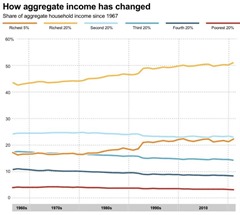
Income inequity People in Washington are better off than other parts of the nation, where the minimum wage is $7.25 per hour or around $15,080 if you worked 40 hours a week, 52-weeks a year. The minimum wage in Washington is $9.32 or $19,385 per year. The job advertised above, with earning 78₵ more per hour, and working 3 hours more week, nets an additional $1,623.

The inequities in pay across the United States are now getting front page coverage. The chart above from the U.S. Census Bureau clearly shows the unmistakable decline in income for the bottom 60% earnings flat for the next income bracket (pale blue).

It’s discouraging when job security is unpredictable, and the prospect of finding a good job diminishes with age.

East Cleveland’s Crumbling Heritage

25 Thursday Jul 2013

Posted by rajalary in News and politics

≈ 1 Comment

Tags

East Cleveland, houses in Cleveland, Julie Lary, rajalary

Yesterday I was aimlessly browsing the Internet and came across a story about murders in East Cleveland, Ohio. Three bodies had been found, two in an abandon house. The video showed large, turn-of-the-century houses, which had fallen into disrepair.

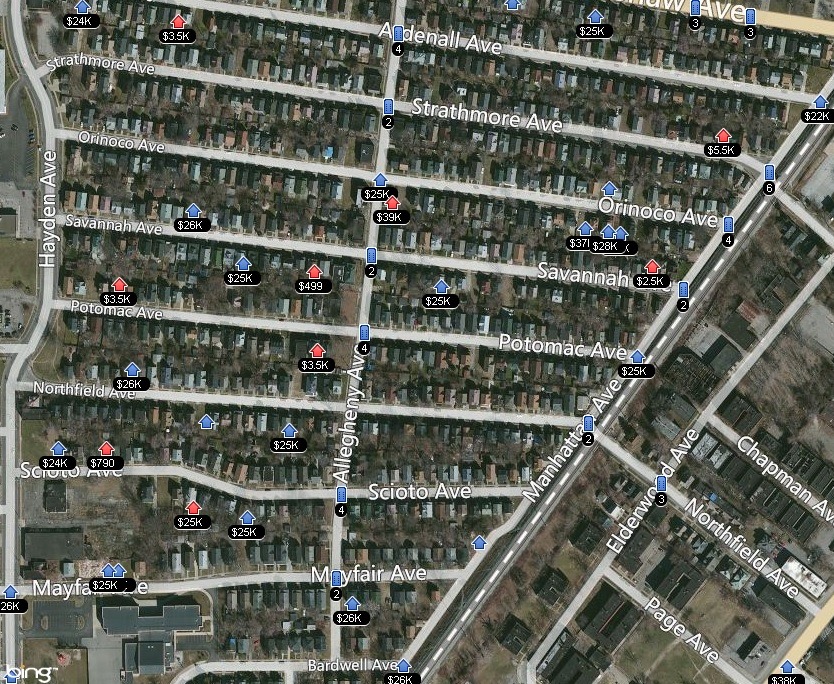
According to East Cleveland Mayor Gary Norton, there are 2,500 vacant and abandoned homes in the city’s three square miles. In the entire Cleveland metro area, there are nearly 76,000 vacant residences. Snapshot of streets in East Cleveland

Last year, the population of Cuyahoga County, which comprises the Cleveland metro area, was 1,265,111. Homeownership was around 62% from 2007 through 2011, with an average of 2.34 people per household. And in 2011, there were 620,830 housing units, which included apartments.

Doing rough calculations, around 12% of housing units are vacant in the Cleveland metro area. However, the percentage of abandoned houses is probably considerably higher because 62% of the population lives in houses!

Cleveland, like many Midwest cities, was once bustling with industry. Located on the shores of Lake Erie, Cleveland was a shipping hub – water and railroad — for iron, steel, machinery, and automobiles. It was also the location of the lamp division of General Electric, National Bindery, and other light industries. At one time, nearly a million people lived in East Cleveland. Today, that number has dwindled to less than a third. The per-capita income is just $16,000 per year.

Blocks of stately Colonial Revival, Greek Revival, Federal, and Neoclassic homes on narrow, deep lots were built to house workers and their families between 1910 and 1920. Many of these houses were probably owned by the same family for generations, with children growing up and moving out, and returning when they’re parents could no longer care for the houses or passed away.

View House in East Cleveland (Zillow)

View Full Album

Built at the turn-of-the-century, they featured hardwood floors, carved banisters, inset cabinets with leaded glasses, and woodwork around the window. Many had basements for furnaces, and large double sinks for doing laundry. Attics were common, and were probably primarily used for storage. In the backyards were garages and outbuildings, along with a small patch of grass for the kids. The fronts had porches for cooling off during the summer months. Some had beautiful rock work and carved banisters.

These houses were built to last with quality materials, which is why most are still stand, even in disrepair.

Curious about the inside of the houses, and type of houses that have been abandoned, I went onto Zillow, and browsed the houses in East Cleveland near the Cleveland Metropark Zoo. What I found was startling. Houses are being auctioning, starting at $500!

While most of these houses are in horrific shape, undoubtedly filled with varmints, rotting wood that makes them dangerous to renovate, and antiquated electrical and plumbing, some look to be in “okay” shape, their owners simply not having the money to make the mortgage payments.

Pages of houses are foreclosed. And some are selling for a fraction of their worth. One house was purchased in 2005 for $67,500, and is currently selling for $3,500. Crazy!

Here’s a snapshot of what I found (check out the album above to see pictures of the houses):

Table of East Cleveland houses

It’s anyone’s guess as to what’s going to happen to the abandoned and reduced priced houses of East Cleveland (and those in other struggling Midwest cities like Detroit). These houses are our heritage. Most are a century or more in age. However with people in East Cleveland earning an average of less than $1,500 per month, and high unemployment it’s doubtful people will be hustling to purchase these houses and fix them up for future generations.

The irony is some of these houses are worth less than an outfit featured in Vogue magazine. Think about it. A pair of Jimmy Choo shoes, Valentino dress, and Gucci bag cost more than a 3-bedroom house in East Cleveland!

Crime isn’t Anonymous

23 Monday Jul 2012

Posted by rajalary in News and politics, Uncategorized

≈ Leave a comment

Tags

aurora colorado, crime, Julie Lary, rajalary

Monday morning, we start the work week by going around the table and sharing a highlight from our weekend. I’m always quick to share what I harvested from our garden. Others relate enjoyable get-togethers with family and friends.

This morning, however, our zeal for sharing quickly fizzled. A designer in New York lamented she’d had a difficult weekend. She blurted out she knew the man who was celebrating his birthday when he was shot at the premier of the new Batman movie in an Aurora, Colorado theater.

Having read numerous articles about the horrific tragedy, I knew she was referring to 27-year old Alex Sullivan.

Crime isn’t anonymous.

When I heard about the shooting on Friday evening, I drew a mental picture of Colorado, many states away. Just a few days later, the distance drew closer, hearing the angst from a woman, across the nation in New York.

And this evening, I learned my stepson’s sister who lives in Colorado had a friend who was planning to go to the premier. She changed her mind at the last-minute.

No crime is anonymous.

Donald Trump. Really?

26 Tuesday Apr 2011

Posted by rajalary in News and politics

≈ Leave a comment

Anderson Cooper’s interview with Donald Trump is blasting in the other room. I can’t decide if Donald is a trouble-maker or simply so full of himself that like many Republicans he can’t comprehend what’s true and what’s a figment of his imagination and mendacity.

Denial Only Goes so Far

01 Monday Feb 2010

Posted by rajalary in News and politics

≈ Leave a comment

Rich and I are fervent recyclers. We’re constantly looking for ways to reduce our footprint, such as buying less packaging, chipping leaves and branches to make mulch, and perusing local Goodwill stores for slightly used books, clothing, cooking utensils, and collectibles.

One of my favorite “green” locales is the “magazine exchange” in Mount Vernon. Okay, it’s not really an exchange. It’s the local recycling center, but they usually have a large dumpster brimming with slightly read magazines. I routinely remove three to four magazines for each one I deposit. And most times, someone has tossed out a stack of older National Geographic.

I fish these gems out like a child reaching in a candy barrel. Most times, they end up on a bookshelf until I run out of reading materials. A month ago, I started reading a National Geographic from April 1987.

Reading a magazine that’s nearly twenty three old has its pros and cons. The pro is that you can learn how far technology, medicine and other sciences have progresses. An article that espouses the computational power of a PC in 1987 is laughable today.

The con is that you can learn how environments, animal life, and manmade infrastructure have deteriorated or cease to exist. The initial article in the magazine was about the high Andes in Chili and Bolivia. Many of the same issues exist today when it comes to healthcare, exploitation of natural resources, and quality of life.

The article “Seals and Their Kin” discuss the horrors of debris such as fishing nets and plastics in the ocean that contribute to the death of seals and sea lions. The story hasn’t changed.

I had to ease into the article “AIR an atmosphere of uncertainty” because many of the issues twenty three years ago are no different today. Even more sobering, decisions that were made in 1987 weren’t always in the best interest of communities and the environment.

For instance, the article discussed the town of Casmalia near Santa Barbara, California. At the time, chemicals – cyanide, oil field acids, pesticides, and industrial solvents – were being dumped in an open lagoon at a toxic waste dump. The 200 citizens in the town complained of noxious smells and respiratory problems. The director of the state health services, however, decided the dump posed no imminent danger to people and should remain open.

No doubt, the three million dollars of fees that the county collected every year from the facility influenced their decision to overlook current and potential issues.

Two years after the article was written the toxic waste dump was closed because of numerous permit violations. A few years later, the dump became a Superfund site that was overseen by the federal Environmental Protection Agency. Around 4.5 billion pounds of hazardous waste from around 10,000 individuals, businesses and government agencies were buried at the site.

In August 1987, the World Commission on Environment and Development, also known as the Brundtland Commission, published, “Our Common Future,” a report that laid the groundwork for the 1992 Earth Summit and establishment of the Commission on Sustainable Development. What the commission probably overlooked at the time was the rapid growth of what was considered second and third world nations such as China and Brazil.

In 1987, China produced few pollutants as compared to developed nations. A decade earlier the Cultural Revolution had come to an end with the death of Mao Se Tung and the arrest of the Gang of Four. China has since become the world’s second largest energy consumer behind the United States. About 70 percent of its energy needs include the use of “dirty” coal. Twenty of the world’s thirty most polluted cities are in now China. In addition, 90 percent of China’s cities suffer from some degree of water pollution and nearly 500 million people lack access to safe drinking water.

While advances and availability of healthcare and improved nutrition has boost life expectancies and reduced infant mortality in China, these advances have been counterbalanced by a marked increased in respiratory problems as a result of widespread air pollutions and millions of cigarette smokers. Today, industrial pollution, particularly of the air, is a significant health hazard in China.

In 1987, 65,000 commercial components, each a proven carcinogen, entered the environment. At the time, Cubatão, Brazil was considered the most polluted place on the earth and had earned the distinction of being called the “Valley of Death.” Scores of manufacturing and processing plants spewed at least 75 pollutants into the acrid air. According to an article written in 2000 by Reuters Limited, “At the base of tropic mountains as green and dense as broccoli lies Cubatão, lies a city many Brazilians still know as the place where babies were born without brains 20 years ago. Cubatão’s chimneys still belch smoke and flames into the air 24 hours a day and a stale industrial odor lingers.”

The article continues, elaborating on bladder cancer being six times more prevalent in Cubatão and neighboring cities. Cancers of the nervous system, including the brain, were four time more widespread, and lung, throat, mouth, and pancreatic were twice as high.

Even though pollution controls have been implemented, and by 2000 the micrograms of particles per cubic meter of air had been reduced from 100 micrograms in 1984 to 48, the air and toxin-saturated soil and groundwater continue to be a health hazard for the 120,000 residents of Cubatão.

It easy to dismiss what happening in another country as “their problem,” but the reality is that the United States is equally polluted. The New Jersey Public Interest Research Group (NJPIRG) reported in 2002 that New Jersey had the worst air pollution in the country. According to the report, “Every resident in New Jersey’s 21 counties lives with unhealthy levels of ozone, [which] causes chest pain and coughing, aggravate asthma, reduce lung function and lead to irreversible lung damage.”

During an ozone alert day – one out of every three days during the summer of 2002 – there was a 20 percent increase in emergency room visits by asthmatics, 30 percent of which were children. In addition, during bad-air days in New Jersey, the mortality rate of senior citizens increases as labored breathing triggers strokes and heart attacks.

In 1987, according to the article in National Geographic, twenty automobiles, including those built before 1975 without catalytic converters, emit the equivalence of 525 pounds of lead in exhaust fumes during their average life span of ten years. Fast forward fifteen years to New Jersey and forty percent of smog pollution is attributed to passenger cars and trucks – the largest source of air pollution in the state. At the time, President George W. Bush and the Environmental Protection Agency (EPA) authorized a serious roll-back of the Clean Air Act that paved the way for more pollution from power plants in New Jersey and across the nation.

The State of New Jersey, however, wasn’t ready to concede that pollution was a given. Instead, they worked to pass the New Jersey Clean Cars bill in early 2004, which legislated reducing air toxics by 23 percent more than the federal emission standards through stricter car emissions standards and the promotion of cleaner, advanced technology vehicles.

Five years later, the “Cash for Clunkers” program took 700,000 gas-guzzling cars off the road by providing cash incentives for consumers to purchase more full efficient cars. It’s estimated that the program will cut total carbon-dioxide emissions by 9 million metric tons over the next 25 years.

When National Geographic published the article “AIR an atmosphere of uncertainty” in 1987, the EPA’s National Air Quality and Emissions Trend Report noted that nearly 80 million people live in countries where ozone levels exceed air-quality standards, 61 million breathe too much carbon monoxide, and 32.6 million share air space with too many particles. These findings created a call-to-action by many countries who can proudly proclaim that they’ve put in places regulations, standards, and technologies to reduce pollutants. For other countries, industrialization, at any costs, superseded potential health hazards.

David Pimental, a professor of ecology and agricultural sciences at Cornell University, examined data from more than 120 published papers on the effects of population growth, malnutrition, and various kinds of environmental degradation on human diseases. In 2007, his published findings in Science Daily, showed that 40 percent of deaths worldwide are caused by water, air, and soil pollution. According to Pimental, this environmental degradation, coupled with the growth in world populations, contribute to the malnourishment and disease susceptibility of 3.7 million people.

From a pollution point-of-view, according to Pimental’s research, 1.2 billion people lack clean water, leading to the death of 1.2 million to 2.7 million people a year from waterborne infections and toxins. Add another 3 million deaths per year from air pollution (carbon dioxide and other gases) and 5 million annual deaths from unsanitary living conditions (half of which are children) and you begin to wonder why people are more concerned with swine flu and HIV/AIDS than the effects of pollution.

Yet, in 2010, segments of the population are denying the obvious connection between pollution and health issues, climate changes, and the end product, global warming. Reducing carbon dioxide and other greenhouse emissions – from industry, transportation and energy use – can both slow climate change and improve the health of people worldwide.

Many of these changes can be implemented on a small scale. Kirk R. Smith, a professor of global environmental health at the University of California, Berkeley, proposed replacing the solid fuel stoves in 150 million households in India with low-emission stove technologies. Over a ten year period, this change could prevent 2 million premature deaths and reduce greenhouse pollution by hundreds of millions tons.

Go to Fox News, however, and the debate isn’t about environmental degradation and the corollary to climate change, but the validity of scientific research. An article published on December 8, 2009, Surprise, Surprise, Many Scientists Disagree on Global Warning, reports “There is hardly unanimity among scientists about global warming or mankind’s role in producing it. But you wouldn’t know it if you just listened to the Obama administration.”

The article cites a petition signed by 30,000 American scientists that urge the United States government to reject the Kyoto treaty that aims to reduce greenhouse gas concentrates that contribute to global warming. Anyone, however, can sign the petition whether you have a PhD, MD or no initials after your name. Check out the number of “Bush’s” on the list of “B” signers.

Whether you believe in global warming or are so naïve to believe that higher temperatures are actual good for increasing agriculture and people’s health, denial only goes so far. Pollution is unhealthy. It doesn’t matter whether polar bears are dying because the ice caps are melting, reducing their ability to get food, or if high levels of pollutants in their fat is hampering their immune and reproductive systems. The polar bears are dying. People around the world are dying. What’s left to question?


Sensing an Undertone of Prejudice

18 Monday Jan 2010

Posted by rajalary in News and politics

≈ 1 Comment

Last week, I received a belated Christmas card from a woman I met in Texas. She was my roommate at HealthSouth, a rehabilitation center in Austin. She’d been hit by a car that backed into her and broke her hip. I was recovering from a car accident that fractured my pelvis. Initially, I was leery of having a roommate, but was deeply grateful for her friendship and encouragement.

We kept in touch after I left HealthSouth. Her recent letter, however, reaffirmed what I believe is an insurgence of prejudice in America. She wrote of her travels, noting “Portland – the delicious blueberry pancakes made by a black chef in the downtown area.”

The use of the word “black” not only seems out of place, but also possibly reveals racism. Is she implying that they’re willing to eat at an establishment where the chef is black? Perhaps she’s surprised that a black man can cook.

I’m jumping to these conclusions because of the volumes of emails that she sent prior to Obama being elected. She deduced that Obama was an evil man with Islamic upbringings and undoubtedly was of foreign birth. She relied on her strong Christian beliefs to fan her fear of liberal policies and the perceived inevitable downfall of America. In addition, she was deeply concerned with my husband’s and my salvation. She even sent us tape to help us “see the way.”

Admitted, during the presidential primaries, my first choice wasn’t Barack Obama. “Who is this man,” I wondered. Once he spoke and I learned of his past, I was not only a supporter, but also enthusiastic devotee. I never figured out whether he was a white man with a black father or a black man with a white mother. It never really matter. I was in awe of his intelligence, accomplishments, and extraordinary determination to obtain his goals.

I was proud to elect a man whose convictions propelled him to become a humanitarian (community organizer) as opposed to someone whose newly found religious fervor — after decades of drinking, partying and failed business schemes – was a testament of his compassion.

The facts are irrefutable. When Bush was elected Governor of Texas, he inherited a large surplus from the former Governor, Ann Richards. After burning through the money, borrowing billions, relaxing regulations ― resulting in Texas becoming the most polluted state in the nation ― and signing the execution order of 155 people (the most execution by any governor in American history), he waltzed into the presidency, a result of political machinations.

Once again, he was given the luxury of a budget surplus. Eight years, two wars, creation of the biggest annual deficit in history, and other unprecedented economic woes, he left office with a smile on his face and not an ounce of remorse.

During his tenure, he set the all-time record of the most days on vacation by any president (including the entire month before 9/11), and turned a blind eye to Americans in need — over 2 million Americans lost their jobs in 2001 and 2002, unemployment benefits were cut along with healthcare benefits to war veterans, and freedoms and civil liberties were axed. In addition, he ran a corrupt, highly secretive government that included changing US policies to allow convicted criminals to be awarded government contracts, appointed more convicted criminals to administrative positions than any other president and signed more laws and executive orders that circumvented the Constitution than any other president! View his resume.

In spite of his undeniable incompetence, mendacity, and determination to destroy the American way-of-life by creating massive budget deficits, invading countries, removing civil liberties, pampering the rich, rewarding the unscrupulous, and remaining oblivious to those in need, swarms of Americans continue to praise Bush while denigrating everything that President Obama says and does.

Visit Fox News and comment after comment refers to Obama as a destructive narcissist, shameful individual, self-serving, dictator, clueless, stupid, liar, Marxist, coward… un-American, communist, Chicago thug, and even the antichrist.

It’s a mystery to me how these words could be applied to a man who has worked tirelessly to rectify the wrongs that occurred in the prior eight years, and, as far as I can tell, hasn’t made anything worse. The only conclusion that I can draw are that many America are opposed to President Obama because his skin color.

My belief is strengthened both by the pompous proclamations of Rush Limbaugh – whose vicious and racist tone does little to crimp his popularity – and the comments on Fox News (the ghastly grammar and spelling illustrates the intelligence of these individuals)…

  • “Barry is an abomination. Barry should go back to Kenya.”
  • “I feel that he has totaly and fully embarassed you people by being the first black American president that even white people was proud of, muchless the pride that you felt when he was elected, and then turn out to be a corrupt, self-centered criminal.”
  • “THE VERY DUMB FASCIST KENYAN IS IN NO POSITION TO GIVE ADVICE , THE 4TH REICH, BARELY LASTED 1 YEAR, AND THE BROWN SHIRT RATS ARE FLEEING THE SINKING TUB, NO NOT U MICHELLE”
  • “Pray for Obama, Psalms 109:8: May his days be few; may another take his office." (written 1/17/10)
  • “You will never own us obomo sambo!”
  • “i l ike your style here . keep up slayin the tards. I see them as naggers. – aka p[eople who annoy us.”
  • “Nappy is going down.”
  • “Once again Nappy lies to Americans. His lies are well documented. Why should anyone believe anything this whack-job says?”

Similarities Between “The Changling” and American Politics

20 Sunday Dec 2009

Posted by rajalary in News and politics

≈ Leave a comment

Friday night, we saw the flick “The Changling” about a woman’s son who goes missing in 1928 in Los Angeles. Months later, the authorities locate a boy that they claim to be her son even though the evidence that he’s an imposter is undeniable. The woman, Christine Collins, stands up against the Los Angeles Police Department and is placed in a psychiatric ward because of her “delusions” that the boy wasn’t her son. The police and doctor reason that she trying to avoid the responsibility of being a mother. Adding to her lack of credibility is that she’s a single mother who has a job, usually held by a man – a supervisor with the phone company.

I found the movie disturbing not only because of the injustices, but also because of its similarities with today’s political environment. No doubt, we’re in challenging times with wars in Iraq and Afghanistan, economic melt-down, high unemployment, undeniable climate change, and threats of pandemics. What’s most troubling, however, is that fractions of American hold beliefs that aren’t based on truths or logic.

Believing America’s deficits suddenly cropped up and worsened as a result of the last twelve months of policy is about as rational as claiming a woman can’t tell the difference between an imposter and her own son. Thinking that a war that’s been going on for longer than World War I and II combined can be wrapped up within twelve months is not just naïve, but preposterous.

Nevertheless, a large percentage of the country sides with Republican leadership and pundits who espouse President Obama is destroying the country with his defense policies, uncontrollable debt, “socialized” medicine, high unemployment, and stifling environmental regulations. They are in denial that when Bush was elevated to dictator-in-chief, there was a budget surplus, low unemployment, funding for social programs, and America wasn’t at war or had poor diplomatic relations with any country.

What’s changed? President Obama, like Christine Collins, doesn’t fit the mold. Collins was a single, successful working woman in an America that had given women the right to vote just eight years earlier. Obama is an accomplished black man in an America that had fifty years earlier permitted racial segregation. Compared to Bush, Obama is articulate, astute, and empathetic. He surrounds himself with intelligent people from all walks-of-life.

Until evidence arose that Collins’ son may have been kidnapped and most likely murdered, her veracity was questioned. In the same vein, Obama’s policies to reform healthcare, put people back to work, exist Iraq and Afghanistan, improve America’s integrity in the world, and tackle environmental issues probably won’t be acknowledged by a large percentage of Americans for decades as the work of a great politician. Instead, they will see it as the folly of a black man.

← Older posts
Newer posts →

Subscribe

  • Entries (RSS)
  • Comments (RSS)

Archives

  • December 2025
  • December 2023
  • November 2023
  • November 2022
  • May 2022
  • April 2022
  • February 2022
  • January 2022
  • November 2021
  • June 2021
  • May 2021
  • April 2021
  • March 2021
  • January 2021
  • December 2020
  • October 2020
  • September 2020
  • July 2020
  • June 2020
  • May 2020
  • April 2020
  • March 2020
  • January 2020
  • December 2019
  • November 2019
  • October 2019
  • September 2019
  • August 2019
  • July 2019
  • June 2019
  • May 2019
  • April 2019
  • March 2019
  • February 2019
  • January 2019
  • December 2018
  • November 2018
  • October 2018
  • September 2018
  • July 2018
  • June 2018
  • May 2018
  • April 2018
  • February 2018
  • January 2018
  • December 2017
  • November 2017
  • October 2017
  • September 2017
  • August 2017
  • July 2017
  • June 2017
  • May 2017
  • April 2017
  • March 2017
  • February 2017
  • January 2017
  • December 2016
  • November 2016
  • October 2016
  • September 2016
  • August 2016
  • July 2016
  • June 2016
  • May 2016
  • April 2016
  • December 2015
  • November 2015
  • August 2015
  • July 2015
  • June 2015
  • March 2015
  • February 2015
  • January 2015
  • December 2014
  • November 2014
  • October 2014
  • September 2014
  • August 2014
  • July 2014
  • June 2014
  • May 2014
  • April 2014
  • February 2014
  • January 2014
  • December 2013
  • October 2013
  • September 2013
  • August 2013
  • July 2013
  • May 2013
  • April 2013
  • March 2013
  • February 2013
  • January 2013
  • November 2012
  • October 2012
  • September 2012
  • August 2012
  • July 2012
  • June 2012
  • May 2012
  • April 2012
  • March 2012
  • February 2012
  • January 2012
  • December 2011
  • November 2011
  • October 2011
  • September 2011
  • August 2011
  • July 2011
  • June 2011
  • May 2011
  • April 2011
  • March 2011
  • February 2011
  • January 2011
  • December 2010
  • November 2010
  • October 2010
  • September 2010
  • August 2010
  • July 2010
  • June 2010
  • May 2010
  • April 2010
  • March 2010
  • February 2010
  • January 2010
  • December 2009
  • November 2009
  • October 2009
  • September 2009
  • August 2009
  • July 2009
  • June 2009
  • May 2009
  • April 2009
  • March 2009
  • February 2009
  • January 2009
  • December 2008
  • October 2008
  • September 2008
  • August 2008
  • July 2008
  • June 2008
  • May 2008
  • April 2008
  • March 2008
  • February 2008
  • January 2008
  • December 2007
  • November 2007
  • October 2007
  • September 2007
  • August 2007
  • July 2007
  • June 2007
  • May 2007
  • April 2007
  • March 2007
  • February 2007

Categories

  • Cat Diaries
  • Computers and Internet
  • Coupeville
  • Entertainment
  • Family
  • Food and drink
  • Gardening
  • Health and wellness
  • Hobbies
  • Holiday
  • Home Improvement
  • Invocations
  • Microsoft
  • Motorcycle accident
  • Mount Vernon
  • Movies
  • News and politics
  • Politics
  • Puget Sound Islands
  • Rich Lary Realtor
  • Rose's Writings
  • Sailing
  • Seattle
  • Texas Life
  • Travel
  • Uncategorized

Meta

  • Create account
  • Log in

Blog at WordPress.com.

  • Subscribe Subscribed
    • Rajalary
    • Join 108 other subscribers
    • Already have a WordPress.com account? Log in now.
    • Rajalary
    • Subscribe Subscribed
    • Sign up
    • Log in
    • Report this content
    • View site in Reader
    • Manage subscriptions
    • Collapse this bar
 

Loading Comments...