• About
  • scribbles
  • Tribute to Rose

Rajalary

~ The adventures of Richard and Julie Lary

Rajalary

Category Archives: Sailing

Bumblebees in the Water

30 Wednesday Jun 2010

Posted by rajalary in Sailing

≈ Leave a comment

This is a continuation of our BVI sailing adventure… Following the traditional of getting up before the roosters crow, Rich had the motor started and mooring lines in by 6 a.m. the following morning. We zipped over to Monkey Point for two rounds of fabulous snorkeling then sailed to Diamond Cay (Manchioneel Bay) on Jost Van Dyke. We grabbed a mooring ball, close to the shore and the coral reefs. Foxy Taboo_3
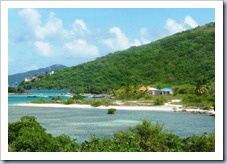
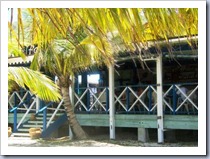
At the foot of the bay is Foxy Taboo, a charming bar and restaurant opened in 2003 by British Virgin Islander Foxy Callwood. Unlike other parts of BVI, Diamond Cay is spic-and-span with swaying palm trees, groomed paths, a well-built and maintained dock, and other amenities that make visiting a joy.

After getting directions at Foxy’s, we walked to Bubbly Pool, which is a shallow pool protected by piles of boulders. As the seawater surges through the boulders, it creates bubbles, hence turning the calm pool into something akin to a Jacuzzi. Typical day

What it didn’t say in the sailing guide is that the pool is calm at low tide with barely a bubble on the surface. Nevertheless, it was worthwhile to visit because the pool contained baby “bumble bees.” Not really bees. Sergeant Majors, which are perky black and white striped fish that can grow up to six inches in length. The ones in the pool were itty-bitty, maybe half an inch in length.

We’d seen the grown up versions while snorkeling and earlier in the day at Monkey Point. Several dozen of these charming fish were swimming around our swim ladder. We “accidentally” feed them bits of dried out bagels, which they happily chomped down until a solid black fish showed up and started to chase them away. It just shows that even the reef has tension among the species. Foxy Taboo
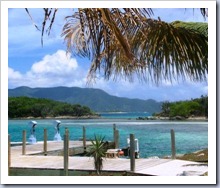
Several days later, at Sopher’s Hole, when we were getting into our dinghy after buying ice and other groceries onshore, I noticed a school of bumble bees near the dock and exclaimed to Rich, “Look at the bumble bees!” 

A woman getting out of a dinghy nearby heard me and almost fell overboard, thinking that the stinging airborne variety of bumblebees were swarming. Ha! She was kinda’ a fancy lady who along with her husband and another couple were being brought to shore by the captain of mostly likely a catamaran they were chartering. Many people who charter in BVI have a captain, especially if they’re on a moose-sized catamaran with several other people.

After delighting in the baby bumblebees in Bubbly Pool, we headed back down the rocky trail, past several Manchioneel trees. Signs posted around the trees, reminding visitors not to stay away from the trees because they’re highly poisonous and can produce a severe skin reaction, especially after a rain. In addition, their fruit, resembling a small green apple, is highly toxic. Foxy Taboo_2
Part of the trail back to Foxy Taboo goes over sections of rocks. We must have zigged when we should have zagged and ended up on another trail. Trying to get my bearings, I looked down and saw several shells moving by my feet; I yelled for Rich to bring the camera. Inside each shell was a teeny crab. To the right is a picture of one of the crabs. 

I’d spied several of these crabs during our beachcombing adventures. They’re the ultimate recyclers in that they move into abandoned shells. When they grow too Tiny crabslarge for their existing shell, they’ll find another. Theoretically, a small starter shell could have half a dozen occupants before it breaks or disintegrates.

Even though these crabs are very small – like a peanut with legs – their pinchers are very strong. I allowed a little fellow to grab my thumbnail and he held it so tight that I couldn’t pry him loose! When I put my hand in the water, he let go.

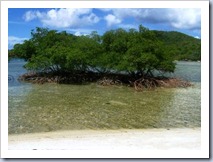
Also walking back, we stopped to take pictures of the mangrove trees (below), which grow in the brackish or seawater. They have huge roots that are on top of the water and most likely extend down tens of feet.

After our Bubbly Pool visit, it was time to snorkel again. We headed to Sandy Spit, which proved to be terrible snorkeling. We had a bad omen within seconds of putting our heads in the water and spying a large, tuna-like fish swimming within a few feet of the shore. Not only was the current strong in the area, but the reef was only a few feet beneath the water. In this situation, you must keep your body perfectly horizontal and your face in the water to avoid hitting any coral and possibly damaging it or yourself. I find it very claustrophobic to swim that close to sharp coral, especially, if you encounter a barracuda or other large, scary fish. Mangrove trees
Disappointed in the snorkeling, we dingy along the shore on the way back to the boat and stopped on a sandy beach that at one time had a small bar. To accommodate or more aptly take advantage of the thirty sailors, there are numerous bars throughout the islands, which range from anchored boats where you can tie up and a get a beer or shot of rum to fancy establishments with upholstered chairs, froufrou appetizers, live music, and drinks with umbrellas and multiple liquors like a Royal Navy Fog Cutter (Pusser’s Rum, gin, lemon juice, orange juice, orgeat syrup, dash of Cointreau, and club soda) or Deep Six (Pusser’s Rum, lime juice, sugar syrup, and champagne). 

Pusser’s is a BVI institution. Throughout BVI, there are Pusser’s stores, restaurants, and most of all, bottles of rum. Founded in 1655, Pusser’s is the “father of navy rum” and the original grog that was issued to sailors of Great Britain‘s Royal Navy from 1655 through 1970. It’s hard to imagine that rum was the daily libation on pitching ships, where attentiveness is key to safe sailing.Sunset

The breath of a beach, where we stopped near Sandy Spit, had a small, beat-up boat on it, which had been modified to enable people to sit around the pilothouse and order a drink. The boat was now nothing more than debris rising above wealth of riffraff and trash the waves deposited – cans, bottles, shoes, swim fins, buckets, fishing nets, dishes, utensils, and other stuff that had fallen off boats, or more likely, washed into the ocean.

As far as we can tell, there is no recycling in BVI and no desire on the part of the residents to consistently use trashcans rather than gullies, parkways, bushes, and the beaches. 

On many of the island, roosters, chickens and goats roam free. I don’t know whether these animals are eventually eaten or domesticated livestock returning to nature. On the deserted beach, near the dilapidated boat-bar, Rich found jaw bones from a small goat. Its teeth were blackened. I suspect that it had been barbequed in a fire pit we spotted on the beach. Self portrait_getting darker
Yes, I took one of the bones, which I cleaned with bleach and a toothbrush when I got home. It’s next to the deer jaw bones I found in Texas.

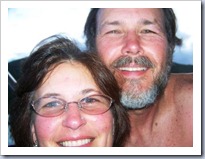
Above, you can see how dark we were by the fourth day… and slightly red. This stunning self-portrait was taken after we ate dinner and before we started to watch the sunset. Every evening, I smashed up some mint leaves with sugar and a squeeze of lime juice. I’d then divide the mixture into two glasses, add ice up to the top and fill almost to the top with club soda. Rich would then pour of splash of rum in my glasses and a finger or two into his. Now you know why he looks a bit wasted in the picture above!
Maximum Snorkeling and Sailing

27 Sunday Jun 2010

Posted by rajalary in Sailing

≈ Leave a comment

This is a continuation of our British Virgin Island sailing adventure… Day three of our British Virgin Island sailing adventure started off poorly. Having burned my back to a crisp, I slept poorly. In addition, Rich and I were having sheet wars. I’d brought our own sheets since you never know what type of linens they’ll have on the boat. v-berth

While I tend to be very thorough in assessing what I need to pack, I missed an important detail. The pretty patterned percale sheets that I brought were for a twin bed (no wonder why I didn’t recall ever using them). The fitted sheet was long enough to fit over the cushions in the v-berth, but half as wide as necessary. I therefore put the top sheet on the bottom and rationalized that I could use the fitted sheet as a top sheet.

Obviously, this wasn’t the swiftest plan. The fitted sheet barely covered one of us and the elastic at the bottom made it even smaller. By our third night, Rich wised up and used one of the sheets that came with the boat to cover himself while I abused the fitted sheet, depending on my discomfort level. Check out the scramble of sheets and pillows in the v-berth above. Below shows the v-berth at the very front or forward of the boat.Forward cabin 

Keep in mind we both ended up getting nasty sunburns, which made it hellish to sleep. And above the v-berth was a hatch that we opened and closed throughout the night, depending on whether we were hot or cold. Rich tended to close it; I’d inevitably open. Add that it rained on-and-off many nights, making it imperative to quickly get up from a sound sleep and race around the boat closing windows and hatches. Multiple these activities by territorial wars over the four pillows and four sheets and the reality that Rich’s 6-foot, 3-inch body only fit diagonally in the v-berth!

Yes, it would make anyone crabby in the morning.

The morning of our third day, I was especially crabby because of the heavy winds and pelting rain during the night. Because we were both miserable, we got up with the sun, started the engine and were to George Dog by 6 a.m. The good news was that we hadn’t pay for the mooring ball because no one came around the night before to collect the money! 

George Dog is one of four canine-named islands, which includes West Dog, Great Dog, George Dog, and two bitty islands called Seal Dogs. The islands were named by sailors who mistook the barking noises made by Caribbean Monk Seals for that of dogs. They then discovered the seals were quite tasty and in a few decades ate them to extinction.Stern berth

After arriving at George Dog, we dried out the boat (many of the hatches and windows were open during the stormy night), had some cereal and milk, then pulled on our snorkel gear (which we stored in the back cabin along with all of our clothes, bottled water, shells, books, and electronic gear). I quickly forget that I was tired and cranky. The variety of fish, coral, filtered sunlight, and calmness of the water was unsurpassed.

After snorkeling around both sides of the reef, we tossed our gear into the boat, climbed into the dinghy and motored to a deserted beach on the opposite end of the island (below). I was enthralled with the sand near the water; it was composed entirely of seed-sized pieces of shells and rocks. I sat on the beach, completely absorbed in sifting through the sand, picking out tiny unbroken shells and interesting bits of coral. I then filled a baggy full of the sand, which I now have in a pretty glass vase. Gathering shells

Twenty feet or so from the shore, the finely crushed shells and rocks became a strip of small BB-sized pebbles. Past the pebbles was fine sand with larger rounded stones, chunks of coral, and jagged rocks from the cliffs and underwater reefs.

While I was focused on the composition the beach, Rich climbed on the rocky cliffs and returned with a couple of pieces of interesting coral.

As we headed for the dinghy, a small motor boat pulled up and deposited several people on the beach. By the reef, where we’d snorkeled less than an hour earlier, all of the mooring balls were taken. It was definitely to our advantage to get up early and race to the prime snorkeling spots. Dog Island

As we trimmed the sails, the sky darkened and the fluffy white clouds turned gray and heavy. By the time we reached Marina Cay we saw cracks of lightening and a few drops of rain started to fall. Nevertheless, because we planned on getting gas and water at the marina and also pick up a mooring ball, we had no choice, but to wait in the drizzle until the fuel dock was clear. As we approached the docks, the sky opened up and the rain pelted down.

Happily, the attendant ran out from the office, and helped us tie up to the dock (below). He was from Jamaica and wasn’t thrilled with B.V.I, which he found very hot and dry. From a distance, the islands look green, but as you closer, you can see much of the landscape is rocky with drought-tolerant trees and scraggily bushes, sedum, and cactus. Depending on the location, however some parts of B.V.I. are more green than others, owing to them receiving more rain and less afternoon sun. Eftihia at Marina Cay_stormy day

Jamaica, as the attendant at the fuel dock explained, has many springs and the flora is thick and lush. He told of a village where everyone drowned because during the night a spring rose up and submerged the village under many feet of water. The area is now a large lake!

At the far end of the fuel dock was an old fashioned red telephone booth from England. A camera, mounted across from the telephone booth, snaps a picture every fifteen seconds. If you stand in front of the booth, your picture will be captured. Later, you can go onto the Pusser’s Rum site and download your picture. You can also call friends and family on cell phone and have them log onto the site and watch you live.

I stood in front of the booth numerous times while we were on the fuel dock and later that day when we took our dinghy to Marina Cay. The first few images turned out horrible because of the rain and water drops on the camera lens. Here’s the best image of Rich and I. Pusser's Picture

Even though it was early in the day, after getting drenched at the fuel dock, we happily grabbed a mooring ball. Because of the bad weather, the marina was very crowded. After a quick lunch and dry clothes, we took the dinghy to the fuel dock to catch a commuter boat over to the Trellis Bay, on the east side of Tortola.

I’d been delighted with this tourist destination when we visited BVI seven years ago. The day we went, however, the pocked dirt roads and walkways were muddy. And the accumulation of trash, a mangy black kitten, and abandoned and tossed-together buildings overshadowed its charm and artist colony allure.

My attitude of Trellis Bay had been tainted even before we arrived. The commuter boat was actually a small ferry for the workers at the Pusser’s Marina Cay resort – islanders — who like the many natives we’d encountered in the past few days, have a love-hate relationship with tourists. We bring money into their communities and generated jobs, but our standards-of-living and our apparent unlimited dollars (or Euros) for food, drink, and entertainment, probably stings when they’re barely getting by on low-wage medial jobs. Trellis Bay

We tried to strike up a conversation with two of the women who had knife bags. They acknowledged that they were chefs and commented that they’d never leave their knives at work. It was obviously, however, that they weren’t interested in talking with us.

When we got to Trellis Bay, they disembarked and hopped into waiting cars. One man, who appeared to be associated with a diving school, had his own car and we could hear him offering to take another worker to a location on the island. Hitching a ride is a common means of transportation on an island with few cars and expensive gasoline. Man in the water

In spite of the disarray of Trellis Bay, the main attraction, Aragorn’s Studio, had thrived and was now triple in size. It offers everything from fabulous ceramics to woven baskets, wooden carvings, traditional reversible dolls, jewelry, clothing, and purses made from gourds. Many of the pieces would have been welcome in our collections, but Rich reminded me that we already have “so much stuff.”

The artist, Aragorn Dick-Read, makes huge metal structures, which during the full moon he fills with firewood and sets afire. The pieces are quite ornate and scattered around the studio. A large sculpture of a person stands watch over the studio, several feet out in the water (above). Trellis Bay trash

After a short time at Trellis Bay, we head to the dock to wait for the boat back to Marina Cay. It gave me plenty of time to shoot pictures of the accumulation of trash in the area. It’s astonishing that everywhere you turn in BVI there is junk. People dump their stuff everywhere… into fresh water creeks that run along the side of the roads to the beaches, streets, areas under construction (like openings in docks for utilities), under picturesque trees… in the water.

Towards the end of our trip, Rich and I took our dingy to a rugged beach across the water from Tortolla, the main island. Washed on shore was shoes, packaging, clothing, household good… and a medium-sized, white plastic bowl, which happened to complement the set of bowls on our boat.

Trash bin on dock

The water taxi back to Marina Cay was crowded with workers going over to the resort, including a startlingly handsome man of India descent with pierced ears and several metal bangles on his wrist. The mixture of people in BVI now includes people from other nationalities, whose influence is furthering adding to the diversity of the island. Our last night in BVI, we ate at the Drake Point restaurant at the Fort Burt Hotel. I had a tasty curry with mango chutney, and other Indian condiments.

The picture below are some of the seagulls that we would feed every night from the back of our boat. They’re smaller than the seagulls you see in the Pacific Northwest and bright, bright white with jet black heads, and soft blue gray feathers on their wings. They are very beautiful and entertaining. They had no hesitations about riding on our dingy when we were under sail or hovering around us as we ate dinner topside.

Seagulls

Getting into the Swing of the Caribbean

31 Monday May 2010

Posted by rajalary in Sailing

≈ Leave a comment

Thursday was our first full day of sailing and an opportunity for Rooster Rich to rise with the sun, start up the motor and pull up lines before anyone else. He headed straight for The Baths on Virgin Gorda (below). This was one of our favorite places the last time we visited and a favorite with tourist, coming by sea or land. By the time we arrived, many of the mooring balls were already taken, so we opted for one that was opposite Devil’s Bay, a pleasant sandy beach with a roped off area for swimming. Baths from the water

Because of the rough water and reefs around the area, you can’t take your dingy ashore. There’s a mooring line that you can tie your dingy to and then swim the rest of the way. I don’t like this approach because even if you’re a great swimmer, the turbulent waves near the opening of The Baths can “wash” you ashore. Seven year ago, I landed on the beach, face first, rocks and sand down my bathing suit, and my dignity battered. In addition, it’s awkward and physically challenging to pull yourself up and back into the dingy after swimming back from The Baths.Find us at The Baths

The alternative was to swim from Efithia to Devil’s Bay, a lengthy and somewhat strenuous swim until you get close to shore where the tepid water gently kisses the sand (Can you see us in the picture to the left?). Rich had a dry bag in which we placed our camera, glasses, and other things we wanted to keep dry. As I had done the day before, I slathered sun block on my legs, arms, face, and chest. In the excitement, however, of seeing The Baths, I neglected to have Rich put sun block on my back. Within a few hours, my back was so badly sizzled that for the rest of the trip, I worse a sleeveless shirt, even when I snorkeled. Rock towers at The Baths

Rich, claiming that he’d never burned before, and therefore opted not to put on sun block. By day three, however, he wised up. By then, his back, legs, arms, and shoulders were well done and rather than slightly pink in the middle, they were red!

A short trail, south of Devil’s Bay, lead to another beach. As we approached, we could see a handful of small cairns or towers of rocks and coral that people had erected to mark the pathways or add to the landscape (above). As we turned the corner, I gasped. The beach was littered with dozens of cairns. It was very spiritual and picturesque. Before we left, I recommended Rich build a tower out of coral. The result is a bit phallic (below).

Several days later, I built a more respectful cairn at Bubbly Pool by Manchioneel Bay. Close up of Rich's tower

With the sun beating down on us, we headed to The Baths, which consists of gigantic boulders, the size of small houses, several stories in height and width, thoughtlessly tossed onto the beach, forming narrow passages and small pools of seawater. You amble through the boulder on narrow sandy paths and wooden steps. Using a rope, secured with heavy metal rings to a rock wall, we gingerly walked down a steep, slippery boulder into the grotto. At the bottom was a green pool of water that gently lapped at your ankles.

You can see me below, hanging onto the rope and leaning across one of the wooden stairs. In the lower picture, I’m standing on a house-sized rock.  Hang onto a rope at The Baths

After The Baths, we swam back to the boat, pulled up lines and headed to Great Dog, one in a series of small canine-named islands that have numerous National Park Trust Buoys for tying up and spending a few hours snorkeling or diving. Sailor, who heard barking when they anchored near these islands, named them Dog Islands. However, the barking they heard were from Caribbean Monk Seals. The seals also proved to be quite tasty and are now extinct. 

Surrounding the rugged coastlines of the Dog Islands are reefs that are teeming with tropical fish and many varieties of corals. Even though the currents were hefty, we snorkeled twice, going a different direction each time.Ladder at The Baths

Snorkeled-out and shriveled up from being in the water several hours, we headed for Gorda Sound and the bay by the Brias Creek Resort. The cheapest room at this very upscale resort is $585 in the summer (hot months) and from $810 to $1,710 during the winter. You need to make reservations for dinner, a four-course prix fixe for $75 per person plus 17% gratuity. If requested, the resort’s powerboat will pick you up at your sailboat or yacht then whisk you to the resort’s restaurant for lunch or dinner. After 5:30 p.m., they request “gentlemen wear trousers and a collared shirt” and “ladies wear suitable resort attire.” 

You can also reach the resort by dinghy; but if you’re dressed for dinner, you might look a bit disheveled when you arrive. The Baths_4

Having left our snazzy clothes at home, Rich and I settled for a humble, but tasty dinner of chicken kabobs (chicken, canned pineapple, bell peppers, and red onions) and potato bundles (sliced potatoes, onions, garlic, fresh basil, zucchini, olive oil, and Caribbean Spice wrapped in foil and placed on the barbeque). Afterwards, we piled into the dingy and headed to the resort.

In the water, on either side of the walkway from the Brias Creek Marina to the resort, are blue lights that give the water an eerie glow and attract swarms of two to three foot long barracudas. We saw a handful of these fish when snorkeling; they can attack and bite humans and are attracted to shiny objects like Rich’s and my wedding rings! Land crabs

The only part of the Brias Creek Resort that is open to non-guests is the bar and restaurant; nevertheless, Rich and I wanted to explore. While walking through a grove of trees, with flashlights in hand, we spotted numerous large holes on the ground with light orange crabs scampering in-and-out. This sighting was unusually because we were hundreds of yards from the water. I always thought that crabs live right next to the water.

We saw the same type of crabs near the airport on Tortola (above). Once again, they were far from the ocean. Although, a small fresh water creek flowed nearby.

When I edited this article, I typed “land crab” into Bing and amazingly, “land crab” is the common name for Cardisoma guanhumi, the crabs that we saw. There are several varies of these crabs in the Caribbean. When not turned into crab and rice dishes, they live in low-lying areas near mangrove swamps, salt ponds, wetlands, and marshes inside holes or burrows that go down on an angle to a larger living area where the crabs store food for winter dry spells. Julie and Rich at The Baths

Part of their burrows usually extends below the water line, creating alternative openings to the surface. Typically, they only venture out at night or when it’s raining to search of tasty morsels, which includes plants, dead things, and garbage.

Here’s a picture of Rich and I at The Baths. Our skin is still pale…

The Only Thing Not Laid Back is Their Driving

29 Saturday May 2010

Posted by rajalary in Sailing

≈ Leave a comment

Sailing_day 1The flight from Seattle to Dallas was about 3.5 hours. I’ve always enjoyed this airport because it has many shops to see, in while waiting for your flight. It also has a circular maze of glass walls that you can meander through. Every few feet is a glass disc set in the floor. As you walk over a disc, a musical tone sounds. If you walk quickly, taking varying routes through the maze, you can create a tune. It’s very spiritual and serene inside the maze.
Before I could play in the maze, we grabbed a quick bite – bagel and cream cheese for me and pulled pork sandwich for Rich. We then boarded a four-hour flight to San Juan, Puerto Rico. Squished like sardines and limited to talking to each other and reading, Rich and I dozed for some of the flight and were happy to see twinkling lights after several hours of flying over the ocean.

From high above, Puerto Rico appears to be a hodge-podge of houses, buildings, and industrial sites. There are no tidy tracts of houses and tree-lined neighborhoods. Puerto Rico may be a U.S. territory, but it doesn’t appear to have evolved from being a second world country with a per capita income of less than $20,000 per year.

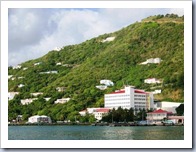
Road Town The small island is home to around four million people. In recent years, it’s become the permanent home of over 100,000 legal residents who immigrated from Spain, Argentina, Cuba, Dominican Republic, Colombia and Venezuela. In spite of the island being shoulder-to-shoulder people, both Rich and I would love to spend a day or two exploring the island by car or sailboat.

After a short lay-over with just enough time to buy an overpriced, dry submarine roll with two slices of rubbery American cheese, and greenish non-descript meat (it was disguised as a sandwich) we boarded a small plane for the final hop to Tortola, the largest of the British Virgin Islands.

We landed around 8:30 and spent an hour or so going through customs and waiting for our luggage to arrive. The plane was full, including a couple and their parents who were going to get married the next day. The rest of the people were either residents or heading for resorts or charter companies.

We were directed to a taxi van with another couple who were going to a resort at the far end of Tortola. They chattered about needing a drink, which is good advice for the faint of heart for the taxi driver immediately accelerated to forty or so miles per hour, even though the speed limit was considerably lower on the narrow, unlit, two-lane road. Although BVI drivers are supposed to drive on the left-hand side of the road, they continually cross the line, playing a constant game of chicken to see who will flitch first as they scramble around corners and cut each other off at intersections and wide sections in the roads. Bobby's

As I wrote seven years ago, it’s Disneyland’s Mr. Toad’s Wild Ride with taxis, cars, vans, small trucks, and motorcycles racing each other on narrow roads, lined with parked cars and pedestrians who don’t have the protection of formal sidewalks. It is a recipe for disaster. Sure enough, we read in one of the papers that a 22-year old girl was struck and killed by a speeding car several weeks earlier.

We arrived at the Conch Charter Marina in Road Town lickety-split and unloaded our two huge army duffle bags, Rich’s backpack, a sports bag of sailing equipment, my Eddie Bauer tote full of magazines, foods, and necessities, and finally my beloved netbook, Sputnik, on which I documented much of this trip, and Rich nightly downloaded information from his GPS and programmed way points for the following day’s sailing route.

We were pleasantly surprised by Eftihia, the 33.2 foot Beneteau sailboat we chartered. It has a large v-berth, white vinyl seats (better than upholstery when you’re wearing bathing suits most of the time), and a spacious kitchen with a large refrigerator.

Because we’d provisioned (i.e. ordered food, water, drinks, and ice) two weeks earlier, there was no need to rush to the big supermarket in town, Bobby’s (right), to buy what we needed for nine days of sailing. While there are small markets at various marinas, you never know what you’ll find and what’ll cost. Therefore, the best approach is to get what you need before you leave Road Town. 

In spite of having gotten up at 3:30 a.m. and hardly slept during the eighteen or so hours we’d been traveling, we were fully awake – especially since BVI iWalking back from Bobby'ss on east coast time and our west coast bodies were telling us it was only 7:30 p.m. After making up the v-berth with the linens we’d brought and stashing our clothing and gear in the boat, we grabbed three canvas grocery bags and walked a mile or so to Bobby’s.

Because the town has grown up considerably since we visited seven years ago, it took us a while to find the store, mainly because it doesn’t have a prominent sign and looks like a warehouse. Fortunately, it closed at midnight.

We primarily needed to buy fresh produce and fruit along with mint leaves, limes, and club soda to make mojitos using the bottle of rum the charter company had left on the boat.

Anything fresh in the BVI is very expensive and in limited quantities. We opted for three potatoes, two yellow onions, one red onion, a clove of garlic, a bag of lettuce, one mango, one bell pepper, three carrots, four locally grown cucumber pickles, two limes, one lemon, four cobs of frozen corn, two litters of club soda, dish soap, two cans of soda (to drink on the way back), and a bag of ice. The bill was $43. Rich's All-Stars

Happily, our three bags of groceries were much lighter than the half dozen bags of food and twenty pounds of ice we’d purchased seven years earlier when we opted not to provision. At the time, we barely staggered out of Bobby’s and across the street to the taxi stand.

This trip, we leisurely walk back to the marina. Still wired after putting away the food and thoroughly unpacking and putting away our clothes, sailing gear and the little bit of food we brought, we took a shower at the marina’s facility, We then stayed up until around 2 a.m. (11 p.m. Seattle time) talking and admiring the nearly full moon from the cockpit.

The next morning, as expected, Rich was up at the crack of dawn and dragged me out of bed for another trip to Bobby’s for ground pepper (Rich puts it on everything), a roll of paper towels, and a roll of toilet paper… it’s better to be safe than sorry. Above is Rich in his spank’n new, brown All-Stars, holding a bag from Bobby’s.

We ate the bagels that we’d brought and chatted with the man in the boat next to ours as we waited for the rest of our food, cans of Dr Pepper (Rich’s) and club soda (mine), bottled water, and ice to be delivered. It was then time to start the laborious process of going over the ins-and-outs of the boat with the charter company, and pay for insurance, park and cruising permits, and a hat with the charter company’s logo.

Finally, at around, 11:30 a.m. we hit the sea. We sailed for nearly three hours before reaching Cooper Island. By then, we were both exhausted fromJulie swimming at Cooper Island jetlag, the heat, stress of learning the particulars of the boat, and physical exertion of running back-and-forth from the boat to the charter company office, and up-and-down from the cockpit to the galley of the boat to get everything ready and checked out!

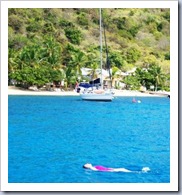
We easily grabbed a mooring ball at Cooper Island. Two minutes later, I flung off my clothes, pulled on a bathing suit and jumped into the astonishingly clear, warm, and aquamarine water (below is me on my back). It was heavenly. Rich joined me a little while later and I coerced him into swimming ashore. Most people, with their wits about them, take a dingy. Even though the shore looked close, it was a hefty swim.

Once ashore, we walked a bit, checking out the beach bar and restaurant that is associated with the Cooper Island Beach Club, and then swam gasped back to the boat. As if we weren’t already fully spent, we hopped in the dingy and motored over to a supposedly good snorkeling area.

It was the first time either one of us had donned fins, snorkels and masks in seven years. Rich was an old pro. I hyperventilated, gagged on sea water, fidgeted with my mask, and got very frustrated. Exacerbated, we returned to dingy then motored to the beach to pay for the use of the mooring ball ($25 per night).

Even though the lounge chairs on the beach are for resort guests, we decided to use two of them since there was hardly anyone left on the beach. We both instantly conked out under the shade of several palm trees.

Rested, we returned to the boat to cook dinner and prepare foods for the rest of the week – tuna salad (two cans of white tuna, lemon juice, slivers of lemon peel, and thinly chopped bell pepper), egg salad (eggs, chopped pickles and bell peppers, mayonnaise), and hummus (mashed canned garbanzo beans, olive oil, and Caribbean spice mix) for sandwiches. Our dinner was less dramatic, tortellini (brought from home) with olive oil and Caribbean spice mix, canned green beans (awful), and Jelly Bellys.

The end of our first day also marked sunburn phase I. I had liberally coated my legs, arms, face, and neck with Bullfrog sunscreen, which worked as expected to protect me from sunburn. I had neglected, however, to have Rich put sunscreen on my back. The hour of so swimming and snorkeling had singed my back.   Conch Marina

Deer Harbor

08 Thursday Oct 2009

Posted by rajalary in Sailing

≈ Leave a comment

After visiting upscale Roche Harbor, we headed to Deer Harbor on Orcas Island. This sleepy town is a Stephen King novel waiting to happen. It’s tranquil. Very tranquil. The five or six docks meet at the Dock Store and Deli (pictured below with a green roof), which offers everything from lattes to shower tokens, fresh fruits and motor oil.

The people are uncommonly friendly and helpful; they match the stereotype of the inhabitants you’d expect to find in a small coastal town. We called ahead to get a slip and as we approached the marina, we spotted a teenager in khaki pants and polio shirt standing by the slip, waiting for me to throw him the lines to tie of our boat. This courtesy is uncommon in larger marina.

The teenager, tanned and freckled from a summer spent in the summer tirelessly answered our questions about the area and helped Rich fill a gas can for the outboard motor on our dinghy. Strange deer at Deer Harbor

Once settled, we walked to the store. Hung from poles on the dock were pots overflowing with flowers. Outside the store was a deer head, reaffirming we were indeed at "Deer" Harbor. Although, I think the official mascot was this husky who was happy to pose, provided you gave him a pet or two and a kind word.

We bought our shower tokens along with two Hagen Daz bars (essential for sailing) then wandered up to the resort. Our moorage fee entitled us to swim in the resort’s pool.

The Resort at Deer Harbor offers a variety of accommodations from charming cottages for two to rustic cottages that can accommodate several families. We peeked in a window of one of the deluxe cottages. They resemble small houses with a staircase that leads to the front doors. Each cottage has an outdoor hot tub (on a covered deck) along with a fireplace, kitchenette, and a spectacular view of the marina. Deer Harbor

Grungy and achy from several days of sailing and hiking, we zipped back to our boat to grab our swimsuits and towels. After a chilly swim, we scrambled to the showers… it’s amazing how a shower change ones perspective and temperament!

It was also nice to be tied up to a dock where we could wander ashore in the evening, instead of having to gingerly get in the dinghy and row ashore.

Even though there are places to eat ashore, we cooked and ate all of our meals on Wave Dancer, the sailboat we chartered. The boat has a full kitchen with a refrigerator/freezer, stove/oven, sink, and plenty of counter and storage space.

Breakfast was freshly brewed coffee — using a French press– along with cereal and fruit. Rich had wisely purchased a Black Forest ham for the trip, which we cut up and combined with colored bell peppers, tomatoes, lettuce, red onions, and a spicy sauce for wraps and sandwiches. For lunch, we also ate carrots, Sun Chips, and red and green grapes.  Deer Harbor_2

Dinner ranged from fajitas with pulled pork to barbequed salmon,stuffed bell peppers — that I’d prepared and frozen a week earlier — and macaroni and cheese (final night). We also had two bottles of wine, a large container of assorted cheese, boxes of crackers and Japanese snacks… Jelly Belly’s, granola bars, and dark chocolate M&M’s… bottles of flavored waters, hot chocolate mix with ground up candy canes, packages of tea and miso! We didn’t starve!

The final night, we grabbed a mooring ball at Cypress Island. Camping on shore was a group of kayakers who’d been paddling through the island for the past week. We enjoyed a magnificent sunset that evening and happily crawled into our bed.

Rich and I are both bed snobs. We brought a huge flannel sleeping bag, which we unzipped and laid on top of the foam mattress in the aft berth. I then put a flannel fitted sheet on top of the sleeping bag, followed by another flannel sheet and a feather comforter in a flannel duvet. We also brought feather pillows with flannel pillow cases. Sleeping on the boat was heavenly!Bed on boat

For the most part, we slept soundly with little wind and wave action. On our final night, however, a huge boat must have passed creating a horrific wake.When it hit the boat, I was convinced that another boat had rammed into us. It was around 11 o’clock at night so we’d been sleeping soundly. It must have taken 15 minutes or so until the boat stopped rocking violently back-and-forth. My heart pounded the entire time!

The next morning, we rowed a shore for the final time to take a liesurely walk around the island. The kayakers were just waking up. One man asked if we’d heard the orca whales during the night. Evidentially, at around 2 a.m. he awoke to hear the whales coming to the surface and exhaling through their blowholes. There are four pods of orca whales in the area, but we weren’t lucky enough to see them… maybe next year. 

Stuart vs. Roche

04 Sunday Oct 2009

Posted by rajalary in Sailing

≈ Leave a comment

On the last day of our sailing trip, a kayaker we met on Cypress Island asked which island we liked best. I paused and thought for a moment then commented, “It depends on whether you prefer a rustic or civilized environment.”

One of the most unusual islands that Rich and I have visited — by ferry or sailboat — is Stuart. Less than three square miles in size, the island is home to around 800 full- and part-time residents who relish the simpler life because… there’s no electricity, running water, or other amenities on the island! The only commercial enterprise is a family-run business called Boundary Pass Traders, which offers shirts and cards from “treasure chests” located throughout the island.

Part of the island is a state park and the two anchorages have state park mooring balls and public docks, making it easy to tie up for a few hours, dinghy ashore, and hike around the island… which has no paved roads. The main thoroughfare, called County Road, is compacted gravel.

Oh, you’re wondering ho w the residents subsist without “modern” amenities.” They have propane tanks or use solar energy. Wells and septic tanks are used for water and sewerage. Along with boat docks, they have two private airstrips for small planes.

I know you’re thinking, “Heck, it must be cheap to live on the island. Land probably goes for a buck an acre.” Not really. Land is fairly inexpensive at $70,000 or so an acre. Because everything necessary to build a house must be brought by boat or barge, the houses are fairly expensive. For instance, a four bedroom, one bathroom, 1,600 square foot house built in 1979 with propane, free-standing stove, deep-water well, septic system, and appliances is $595,000. Take a peek. Thirteen acres on the water sells for nearly a million dollars!

We reached Stuart Island early in the day so we grabbed a mooring ball and rowed our dinghy ashore. An elderly man — in faded overalls stretched tightly over his beach ball-sized stomach – helped tie up our dinghy. Also tied to the dock where two small tug boats, similar in size and charm as this one. I inquired about them and the man proudly announced that he’d spent the past two years building one of them – a delightful boat painted in forest green with burnt orange trim. He explained to Rich that the hardest part was forming the compound curved roof from layers of plywood. Rich swinging on Stuart Island

After chatting (or as Congressman Alan Grayson’s terminology “nattering”) for a few minutes, we bid the man good-bye and climbed the steep ramp onto the island. After a short walk, we came upon dozens of wooden stairs that lead down a lush forest. I felt like I was in a storybook. The moss- and leaf-covered paths meandered by bushy ferns and native grasses, around babbling brooks, and towering trees that allowed trickles of light to dance on the forest floor. I’ve never been the Olympic rain forest, but Stuart Island State Pak must be a close approximation.

Above is Rich swinging from one of the many huge trees on the island.

A few steps from the park is County Road, which according to our Xeroxed map lead to the historical schoolhouse and museum. The map didn’t lie; it just didn’t reveal the hefty hill that was probably equivalent in elevation to the staired area we left half an hour earlier. Rich going through chest on Stuart Island

As we neared the top, I spied a clothes line with tee-shirts pinned to it. These were the shirts available through Boundary Pass Trader. In front of the clothes line was a small shelter made from branches with a treasure chests underneath (right). Inside were silkscreened shirts, hats, and cards with local scenes. Each item is individually packaged with an I.O.U. for where to send your payment, by check or PayPal. Since we have more clothes than we could possibly wear, we opted to purchase a set of four cards.

A sign on the shelter congratulated us on reaching the top of the hill and invited us to enjoy a glass of water from a local well. It was a welcome respite before we visited the one-room school house (below), which had been turned into a museum.

The account of life on the island was fascinating. Early families primarily raised dairy cattle, the milk and cream was then shipped to Seattle to be turned into ice cream, cheese, and other dairy products. While the women stayed home and tended to the children and cattle, the men found work fishing. Families were large and until the 1960’s the primary means of transportation were by foot, using wheel barrels to haul goods from one end of the island to the other, and from dairies and farms onto boats. Today, fuel-efficient all-terrain vehicles are the preferred means of getting around the island.One room school on Stuart Island

After wandering through the school grounds and peeking in the windows of the new, considerably larger school (last year, only two students were enrolled), we continued trudging up hills until we reached the Turn Point lighthouse.

I had a preconceived notion that the lighthouse would be a small structure with a narrow turret that led to the light at the top. Built for $15,000 in 1892, the lighthouse is very impressive and is now remotely monitored by the coast guard and Bureau of Land Management. Tip of Stuart Island

More impressive is the spectacular 200-220-degree (to the right and below) view across the Haro Straits. If you stand by the lighthouse, stretch out your arms, pushing them back as far as possible, then turn your head back-and-forth to look at your fingers, you see the ocean, islands, across to Canada, and more ocean. The panoramic view is nothing less than breathtaking. You are literally standing on the tip of a thin sliver of an island, surrounded by hundreds of miles of water. Light house on Stuart Island

Built a few years after the lighthouse was an elegant “duplex,” barn, water tank and other ancillary buildings for the lighthouse keeper and his assistant. One keeper, who arrived in 1900, had 13 kids!

The most civilized, or more appropriately, the most upscale island we visited was San Juan Island, in particular Roche Harbor. A harried sail across the Haro Strait from Sidney, British Columbia, Roche Harbor is a port of entry for pleasure ships. It also seems to be where the elite keep their multi-million dollar yachts during the summer season.

We got to the harbor around 10 o’clock and were able to tie up to the guest dock, in front of several sailboats. We then ambled up the dock towards the shoring, passing dozens of huge ships. The marina can hold 377 vessels, ranging from 30 to 150 feet in length. It’s like walking between rows of semi-trucks, except, most trucks are around 53-feet in length and just 14 feet high. These ships easily towered 20-30 feet above the dock and were longer than an average mobile home! 

 To give you an idea of the types of ships we saw, I found a listing for a 55-foot Fleming yacht for sailing in Roche Harbor for $1.6 million. Here’s the site for Fleming Yachts, which are popular in the Pacific Northwest because they’re made in California and can be cruised up to Washington. If you’re in the marketing for a yacht on the west coast, you might want to check out Crow’s Nest Yachts.

Because of its proximity, Roche Harbor piqued the interest of several countries. In 1787, Captain de Haro and his crew were the first Europeans to sail among the San Juan Islands. The Canadian Hudson’s Bay Company built a log trading post at the head of the harbor in 1845. Meanwhile, American settlers migrated to Roche Harbor from the surrounding Islands, along with key cities like Bellingham and Anacortes.

In 1871, the United States and Great Britain selected Germany’s Kaiser Wilhelm to arbitrate the territory dispute. The United States won and in 1881, two brothers, bought Roche Harbor and stated the island’s lime industry. Roche Harbor_2

John S. McMillin, a Tacoma lawyer, discovered a large deposit of lime in the area and began negotiating for the brothers’ claim. In 1886, the Tacoma and Roche Harbor Lime Company was founded, igniting the start of a thriving town. The Hotel de Haro (below) was built along with a modern lime factory, warehouse, docks, ships, pieces, offices, company store, church, schools, barns, and homes. Bunkhouses were built for single men and one- and two-story cottages for families.

Many of the original buildings, including the hotel wharf, and stores, have been restored and contribute to the charm of the town. Several of the streets are now paved with the bricks that lined the lime kilns, which consumed 26-cords of wood per day. Many of the surrounding islands were severely logged to keep up with the need for wood.Roche Harbor_3

Today, the trees have grown back and seemingly everywhere are gardens and seating areas with planter boxes and formal gardens with lush billowing bushes, fragrant blooms, and carefully pruned trees.

A short walk from the hotel is the original church and many of the original cottages, which are now part of the Roche Harbor Resort. I took a picture of the old school houses (below). Through the window, you can see the marina in the distance!

Near the resort is the San Juan Museum of Art & Sculpture Park. According to the web site, it’s a “nineteen-acre microcosm of the San Juan ecology, forest, meadows, freshwater wetlands, saltwater wetland, and rocky outcroppings” with a “rotating exhibit of over 100 sculptures” made from bronze, stone, wood, metal, glass, and ceramic. Some of the sculptures were for sales. Many were ridiculously priced. For instance, one artist put common window screening on the frames of old umbrellas and hung them from a grouping of trees. It was priced in the thousands! Sculpture_Dragon

I was most fond of the sculptures that made sounds or rotated in the wind… or was a scary, winged dragon (right).

After wandering through the sculptures, we moseyed to the mausoleum built for John S. McMillan. The picture in the gunkhole book resembled marble. The mausoleum, however, is made from plaster and painted rather grotesque colors. It was big and I suppose impressive, but I found it rather distasteful. You can read about the significance of the pillars, stairs, and other symbolism on the San Juan Masonic Lodgehttp:// site.

Roche Harbor through school house Before leaving Roche Harbor, we made a quick lunch, which we ate from the cockpit of our sailboat while watching the flurry of activity in the marina, including floatplanes taking off and landing, and large yachts cranking on their bow thrusters to wedge in-and-out of tight slips.

A Week of Amazing Sailing

27 Sunday Sep 2009

Posted by rajalary in Sailing

≈ Leave a comment

The 120 pictures we took have been downloaded and edited, clothing washed and put away, sailing gear stashed away, left-over food tossed in the refrigerator… time to start writing about our adventure of sailing in the Puget Sound on Wave Dancer, a 34-foot Hunter sailboat.

Ominous Start
For our first day, Rich charted an aggressive 17 miles. We’d loaded our three bins, four duffle bags, and ice chest onto the boat in advance of the captains’ meeting at 9:30 so we were ready to set sail as soon as the meeting ended and we completed the boat orientation with someone from
San Juan Sailing. Since we charted Wave Dancer last year, the orientation was quick with the manager of San Juan Sailing going over the finer points of how to use the navigation, radar and autopilot on the boat. Wave Dancer

It was a glorious, sunny day with a strong wind that begged us to unfurl the jib and mainsail. The boat responded beautifully, reaching six knots as it heeled in Bellingham Bay. Then Rich looked up and exclaimed “Oh no.” The tack of the mainsail was flapping in the breeze. We quickly pulled in the jib then gingerly rolled up the mainsail. The thick woven strap (tack) that holds the mainsail to the boom was shredded. “Our vacation is ruined,” exclaimed Rich. I thought otherwise.

We immediately called San Juan Sailing and they told us to sail back to the marina. Within moments of our arriving, a jack-of-all-trades set to working sewing the strap back together using a special needle that was attached to a bobbin of heavy, waxed thread. He initially sewed the two pieces together, knotting each stitch then wrapped the rest of the thread around the strap to create a super strong loop. I took several pictures, but they’re on another camera, which I left in Mount Vernon.

Within an hour, we were back on the “water” and sailing towards Inati Bay on Lummi Island.

Magically Sucia
Rock formationHands down, the most interesting place we visited was
Sucia Island, which is now a Marine State Park. In Spanish, sucia means “dirty” or in a nautical sense “foul” because the underwater reefs and rocks, and jagged shore – formed by the folding of the earth’s crust — is dangerous to ships. 

The rugged landscape of Sucia proved beneficial to smugglers of illegal Chinese laborers along with illegally imported wool and opium in the 1800’s. During Prohibition it was used by rum-runners and most recently, drug traffickers.

Rock formation_2 After anchoring Wave Dancer, Rich (dwarfed by the rocks in the pictures to the right and below) and I took the boat’s dinghy ashore and cautiously stepped from boulder-to-boulder, marveling at the geological variations. The cliffs had been worn away by centuries of pounding water, exposing layers of sediment and carving the harder rocks into interesting shapes. In one area, the rock had a “bubbly” appearance.

As we rounded a bend, the rough rocks turned into a pebble-strewn beach. We followed a path to higher ground and walked a few miles to the far end of the island to a sandy beach, which a passing hiker called “the busiest place on the island.” Sure enough there were several dinghies on the beach along with people who were camping, kayaking or boating in the area. There are five coves around the island with mooring balls and docks for boats of all sizes. Plus, there are facilities to camp and picnic along with an underwater scuba park.

What makes Sucia so facinating in the range of landscapes. The western side of the island where the waves are the strongest, the beach consists of slaps of enormous rocks with large appliance-sized boulders. The protected side of the island has pebbly and sandy beaches. The top of Sucia is a thick forest with native plants and wildlife like deer and raccoons.  

Rock formation_3 After a restful night, Rich attached the outboard motor to our dinghy and we embarked on circumnavigating Sucia along with the eleven satellite islands. It was a brisk morning and the island was just starting to wake up. Seals bobbed along the shore then ducked into the water in search of breakfast. Along a particularly rocky sloop, we spied a large light gray seal. We motored closer and from underneath a ledge, a brown otter tottered out to investigate the noise.

On a rocky cliff, we came upon a cormorant rookery (below). Throughout our trip, we saw dozens of these perky birds, often catching a ride on a floating log or thick patch of seaweed and kelp. We also saw numerous blue heron, which can be very vocal; their call described as a “harsh croak.” Because I love blue heron and believe that they bring good luck, my ears are tuned to their call. It’s a thrill to see them in flight with their six-inch wing span, long graceful necks, and long-thin legs stretched out, rather than tucked under their body. By the water edge, they can stand perfectly still, graceful sculptures in shades of gray. Comerant rookery

In a dinghy (and even more so in a kayak), you can motor close to the shore and zip between the islands, some of them less than a mile in length and a short walk from side-to-side. Depending on the tide, you can walk across rock bridges to the islands. Although the harsh terrain and unpredictability of the sea can make it dangerous to get too close to the rocky outcrops, surrounding the islands.

Below are more pictures from Sucia. Stay tuned for more pictures and adventures from our sailing trip. How birds travel in the San Juan Rock formation_4 Rock formation_5 Sucia Island Sucia Island_2 Sucia Island_3

Sailing… Sailing on the Briny Sea

17 Thursday Sep 2009

Posted by rajalary in Sailing

≈ Leave a comment

On Saturday morning, we’ll be loading up WaveDancer, a fabulous 34-foot Hunter sailboat that we’re chartering for an entire week from San Juan Sailing in Bellingham, Washington. I’m super excited because we chartered this boat last year… and on the final day of our charter, I completed my bareboat certification. In addition, we celebrated our six year wedding anniversary on this magical boat.
 
This year, we’ll be celebrating seven years and I won’t have to worry about taking a written or practical exam at the end of our trip! Although, Rich would like me to get my coastal navigation certification, which happily is just a written test. I enjoy charting and doing the math so I shouldn’t have a problem earning this certification.
 
Meanwhile, for the past few weeks, we’ve been accumulating food, clothing, sailing gear, and miscellaneous stuff to take – including CDs for our listening pleasure, trivia game to play at night, passports (in case we drift into Canadian waters), stacks of magazines, video camera, digital camera, GPS, emergency radio, our favorite snacks (including a box of macaroni and cheese), two bottles of wine, and a large feather quilt for warm on chilly nights.
 
I’ll be snapping lots of pictures and have stories to tell in late September… stay tuned!

As the GPS Goes Round

20 Wednesday May 2009

Posted by rajalary in Sailing

≈ Leave a comment

As you probably surmised from this blog, Rich is into technology while I’m confused by anything that has more than an on/off switch. He carefully selects the time and power level for everything he heats in the microwave; I prefer to turn soft foods into dog biscuits and boil fluids until a dribble remains.

Over the years, we’ve learned to tolerate each other’s idiosyncrasies. While I sail at the easiest points-of-sail, Rich thoughtfully assesses the wind direction, current, trim of the sails, and what other sailors are doing. He also checks his GPS, seemingly every ten seconds even though we barely reach the pokey speed of 1 nautical mile per hour.

Last weekend, he programmed the GPS to track our course…  GPS of sailing on Lake Washington

We set out from downtown Kirkland and headed west towards downtown Seattle. The squiggly portion of our trip (lower far right) shows where I did three man-overboard exercises… missing the buoy on the first two attempts. Should Rich fall overboard and suddenly turn into a buoy that I need to retrieve, he better hope the water is warm or someone with more boating skills comes to his rescue!

After getting the buoy, we sailed in a triangle. Actually, I sailed this portion of the trip while Rich snoozed… it was a very warm day!

We then headed north before returning to Kirkland… 4.5 hours later.

Getting my Bareboat Certification (continued)

21 Sunday Dec 2008

Posted by rajalary in Sailing

≈ Leave a comment

Okay… it’s taken me a while to finish my tale about our charter in the San Juan Islands in late September. I got temporarily distracted by the “election” and slightly addicted to writing a diary on Daily Kos.

After leaving Rosario Beach, Rich made me practice man-over board skills for several hours using a buoy that he’d rigged together with weights on the bottom so it stood upright in the water. After my attitude changed from “I think I can sail” to “I hate sailing,” we decided to mosey to our next stop… Spencer Spit, a finger of land with mooring balls on either side.

By the time we reached the spit, the wind had kicked up and even though I was able to grab a mooring ball twice, the wind was too strong for me to hold onto the grappling pole until Rich could scramble from the cockpit onto the deck and tie a line around the metal loop at the top of the ball.

Frustrated with my obvious whimpiness, Rich decided to give it a try while I steered the boat. He missed the ball and while trying to reach out and grab it, he dropped the grappling pole in the water. Ha! Fortunately, the pool floated and I was able to grab it off the back of the boat when it floated by!

We then decided to motor to the other side of the spit where the wind was hopefully calmer. Once again, I grabbed a ball, but the metal loop was stuck so we zipped over to another ball. Success! Rich the sailorman

Also moored was another sailboat. I’m sure the couple aboard were laughing so hard at our fumbling that their sides hurt. And no doubt they had plenty to “write home about” after seeing me on the beach half an hour later with my pants wet from falling out of the dingy and my life vest buckled incorrectly. In contract, they were nattily dressed with deep tans, swanky clothing and dry boat shoes… even though they’d rowed ashore moments earlier with their Wheaton Terrier. It’s surprising how many people sail with their pets and are dedicated to going ashore several times a day to let their dogs use the terra firma. Sophisticated sailor

The next evening, we had an easier time grabbing and tying up to a mooring ball. We were also more successful at rowing ashore to the tip of Orcas Island. We wandered around and heard some rustling down by the beach and were able to catch a glimpse of a young deer with blotchy black, tan and white fur, trying to scamper up the steep sea cliff

Several other deer, with more solid-shaded fur, were already on top of the cliff. The young deer splashed through the water to the next beach, then ran up a trail to join the rest of the pack. It was a very magical moment.

The next morning, we gingerly sailed along the coast, avoiding dozens of crab pots and small fishing boats. Unlike the crab pots used in the Bering Sea on the show, Deadliest Catch, the pots used in the Puget Sound are small, about the size and shape of a car tire.

A line (rope) extends from the pot, usually on the sound floor, to a colored buoy that floats on top of the water. Because aFisherman putting out crab potsanyone can apply for a license to crab, there are many make-shift crab pots with a chunk of driftwood instead of an easy-to-spot colored buoy. When sailing close to shore or in an anchorage, you need to always be on the look-out for crab pots. 

As we neared Bellingham Bay, a man who was on a sailboat behind us called to us. His engine broke and he needed a tow to part of the bay that would allow him to catch the wind and sail back to Bellingham. We tied a line between the boats and towed him for thirty minutes or so until the wind picked up. We then motored back to the harbor where San Juan Sailing is located.

We spent the rest of the day wandering around fisherman’s wharf and studying for my final written bareboat certification exam. I knew that I would be required to show my docking skills at the fisherman’s wharf so we scoped out the area. We also talked to several of the fishermen who had just returned or were going out for Dungeness crab, salmon, flounder, cod, or squid (in California). Their boats are fascinating (and savage) with large lights to fish at night, pulleys, outstretched poles with rows of hooks, and large purse seine nets.

The next morning, the weather took a turn for the worse. It was bitterly cold, windy and rainy. Nevertheless, my instructor was waiting at the dock at 9:30 to test my skills. I motored out of the harbor and quickly turned into the fisherman’s wharf where I successfully docked and undocked. We then sailed into the bay to do man-overboard and other maneuvers. The wind – 20 to 26 knots — was so bad that the boat dramatically heeled over when I tacked and jibbed, and according to Rich, the deck would nearly touch the water.

My instructor, however, having sailed since she was 16 years old, wasn’t perturbed and gave me courage to continue sailing. It took all of my strength to hold onto the wheel and to yank out the Life Sling when it came time to demonstrate this skill. Rich, meanwhile, skillfully handled the sails, which were reefed (made smaller), and was an amazing crew-of-one. My instructor, who’d had knee surgery a few weeks before, hung on, gave commands, and assured Rich and I that the boat wasn’t going to tipped over.

After an hour of sailing, we pulled in the sails, fired up the engine, and motored back to the safety of the harbor. I then took my written test, got 85% (go enough to pass), gave my instructor a gift basket we’d put together earlier, and fantasized about curling up in a warm bed.

After a quick lunch, Rich and I cast-off from the dock and motored to Chuckanut Bay (south of Bellingham). Chuckanut is a beautiful bay with tree-lined shores, pretty upscale houses, and a train track that weaves through the landscape. It looks like something a train enthusiast built because throughout the day and evening, you can see and hear the trains as they chug through the trees, around the houses, and then disappears. When we were there, the trees had already turned orange, red, and yellow, making the scenery more dramatic.

Unfortunately, the weather wasn’t in our favor. After a rough windy and rainy trip to the bay, we attempted to anchor. We had no problem initially dropping the anchor, but Rich felt we’d drift into the shore with the horrific winds so we decide to find another spot. The problem was that I couldn’t get the anchor up so Rich and I traded spots. I thought the boat was in gear, which would have helped Rich pull up the anchor. The boat wasn’t in gear so Rich pulled, and pulled, and pulled.

Exhausted, he gave up and we met in the middle of the boat to discuss our options. It was then that I realized that there was a traditional winch on top of the windless to help pull up the anchor; Rich discovered that I didn’t have the boat in gear. Using the winch and putting the boat into gear, we were able to get the anchor up and relocate further from the shore.

Because of the winds, however, Rich couldn’t relax and set his GPS to “monitor” the movement of our boat. If the boat drifted, an alarm would go off. Nevertheless, Rich stayed up most of the night “watching” the boat. I got up periodically, having been completely exhausted from taking my tests.

Around midnight, we put on our warm fleece clothing and sat on deck for an hour or so. By now, the sky had cleared, but the wind was still fierce. It was wonderful seeing the moon-lit sky, listening to the trains in the distance, and talking about our week of “almost perfect” sailing.

The next morning, we quickly pulled up the anchor… using the winch and windlass… and headed back to Bellingham Bay. We had the boat unloaded and cleaned up before noon then zipped to Mount Vernon to shower and conk out!

← Older posts
Newer posts →

Subscribe

  • Entries (RSS)
  • Comments (RSS)

Archives

  • December 2025
  • December 2023
  • November 2023
  • November 2022
  • May 2022
  • April 2022
  • February 2022
  • January 2022
  • November 2021
  • June 2021
  • May 2021
  • April 2021
  • March 2021
  • January 2021
  • December 2020
  • October 2020
  • September 2020
  • July 2020
  • June 2020
  • May 2020
  • April 2020
  • March 2020
  • January 2020
  • December 2019
  • November 2019
  • October 2019
  • September 2019
  • August 2019
  • July 2019
  • June 2019
  • May 2019
  • April 2019
  • March 2019
  • February 2019
  • January 2019
  • December 2018
  • November 2018
  • October 2018
  • September 2018
  • July 2018
  • June 2018
  • May 2018
  • April 2018
  • February 2018
  • January 2018
  • December 2017
  • November 2017
  • October 2017
  • September 2017
  • August 2017
  • July 2017
  • June 2017
  • May 2017
  • April 2017
  • March 2017
  • February 2017
  • January 2017
  • December 2016
  • November 2016
  • October 2016
  • September 2016
  • August 2016
  • July 2016
  • June 2016
  • May 2016
  • April 2016
  • December 2015
  • November 2015
  • August 2015
  • July 2015
  • June 2015
  • March 2015
  • February 2015
  • January 2015
  • December 2014
  • November 2014
  • October 2014
  • September 2014
  • August 2014
  • July 2014
  • June 2014
  • May 2014
  • April 2014
  • February 2014
  • January 2014
  • December 2013
  • October 2013
  • September 2013
  • August 2013
  • July 2013
  • May 2013
  • April 2013
  • March 2013
  • February 2013
  • January 2013
  • November 2012
  • October 2012
  • September 2012
  • August 2012
  • July 2012
  • June 2012
  • May 2012
  • April 2012
  • March 2012
  • February 2012
  • January 2012
  • December 2011
  • November 2011
  • October 2011
  • September 2011
  • August 2011
  • July 2011
  • June 2011
  • May 2011
  • April 2011
  • March 2011
  • February 2011
  • January 2011
  • December 2010
  • November 2010
  • October 2010
  • September 2010
  • August 2010
  • July 2010
  • June 2010
  • May 2010
  • April 2010
  • March 2010
  • February 2010
  • January 2010
  • December 2009
  • November 2009
  • October 2009
  • September 2009
  • August 2009
  • July 2009
  • June 2009
  • May 2009
  • April 2009
  • March 2009
  • February 2009
  • January 2009
  • December 2008
  • October 2008
  • September 2008
  • August 2008
  • July 2008
  • June 2008
  • May 2008
  • April 2008
  • March 2008
  • February 2008
  • January 2008
  • December 2007
  • November 2007
  • October 2007
  • September 2007
  • August 2007
  • July 2007
  • June 2007
  • May 2007
  • April 2007
  • March 2007
  • February 2007

Categories

  • Cat Diaries
  • Computers and Internet
  • Coupeville
  • Entertainment
  • Family
  • Food and drink
  • Gardening
  • Health and wellness
  • Hobbies
  • Holiday
  • Home Improvement
  • Invocations
  • Microsoft
  • Motorcycle accident
  • Mount Vernon
  • Movies
  • News and politics
  • Politics
  • Puget Sound Islands
  • Rich Lary Realtor
  • Rose's Writings
  • Sailing
  • Seattle
  • Texas Life
  • Travel
  • Uncategorized

Meta

  • Create account
  • Log in

Blog at WordPress.com.

  • Subscribe Subscribed
    • Rajalary
    • Join 108 other subscribers
    • Already have a WordPress.com account? Log in now.
    • Rajalary
    • Subscribe Subscribed
    • Sign up
    • Log in
    • Report this content
    • View site in Reader
    • Manage subscriptions
    • Collapse this bar