Uncooperative Anchor Leads to Annapolis

Tags

, , , , , , , , ,

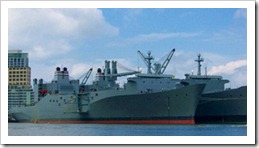
In my last article about our May east coast sailing adventure, we were staying in a delightful marina in Baltimore. We woke to clear skies, enjoyed our usual breakfast of cereal and bananas, coiled our lines, and then eased out of the slip. As we sailed out of Baltimore Inner Harbor, we enjoyed seeing the many cargo ships, waiting to be unloaded and loaded.

Because it was Sunday, there were few boats on the water and little activity on the shore. As the wind picked up, we raised our sails and tacked back-and-forth, and then circled around the Baltimore Lighthouse several times, trying to peek inside through the tattered curtains.

A few days later, Rich purchased a small watercolor of the lighthouse at an art gallery in Annapolis. The painting now hangs in his office, next to his many other sea-themed paintings.

That evening, we dropped anchor by Dobbins Island, a small, kidney-shaped island in the Magothy River, which is a popular for partying, water-skiing, and hanging out in the calm and shallow water. When we arrived, quite a few boats were anchored, and many small boats and dinghies dotted the shore with people in bathing suits, sun-tanning, drinking libations, and talking loudly.

Across from the island, was a large house, which had a sizable replica of a lighthouse, complete with a bright light on the top. The house, built on Little Dobbins Island is very controversial because it was constructed without permits. In 2005, the county ordered the lighthouse, pool, and gazebo be torn down. Fortunately, for us, the lighthouse stood and was operational, six year later.

We enjoyed a pleasant dinner and evening, reading and planning the next leg of our trip. Around 10 p.m., we decided to call it a night. Rich checked his GPS one last time to make sure our anchor was holding. It hadn’t!

We threw on warm clothes, started the engine, pulled up the anchor, and circled around to find a good place to once again anchor. After two attempts, the anchor held when the engine was revved up in reverse. Rich reset the GPS to track a circle around the anchor, and we once again got ready for bed.

Throughout the night, Rich woke briefly to check the GPS. If our boat started to drift, the GPS was supposed to sound an alarm. Around 3 a.m., Rich woke and thought the water breaking against the boat sounded funny. He flicked on a flashlight, picked up the GPS, and screamed, “We’re dragging anchor! Get dressed!”

Rich threw on some clothes, started the engine, and pulled up the anchor. I was a bit slower and more thoughtful, flipping on the “instruments switch” in the control panel, and popping off the cover of the depth meter as I scrambled onto the deck.
It was pitch black outside, but I could see three things: The anchor lights on top of the masts of the two sailboats by Dobbins Island, and the light in the mini lighthouse on Little Dobbins Island. The latter was maybe 100 feet away, which meant, we drifted across the Magothy River and were dangerously close to grounding the boat.

When we studied the GPS track, days later, there was no doubt that we’d grounded the boat, but it’d miraculously rocked off the sand and was “floating” when we discovered we were no longer anchored.

With the depth meter, we could navigate into the deeper areas of the Magothy so we had a least a few feet of water beneath our keel. To make matters worse, it was rainy, windy, and cold outside. Barefoot with rain gear, I tried to discern where Rich wanted me to drop the anchor, but was often drown out by the wind or the anchor would hit bottom within a few second, but not catch and the boat would quickly drift from where he wanted to anchor. Our first three attempts were failures. One attempt was perfect, but as the boat started to spin around, we noticed we were within a foot of a channel marker.

Another attempted seemed to hold, allowing us time to dry off and make some coffee. But after watching the GPS for an hour, we saw once again, we were dragging. Throughout the ordeal, words were exchanged until we came to our senses and realized screaming at each other wasn’t going to make the anchor hold.

For our final attempt, around 5 a.m., we decided to drive away from the island and the other sailboats to deeper (20 feet) water. The anchor held, but with an hour until daybreak, we opted to have another pot of coffee, catch a few winks while sitting up in the galley, and then, sail to Annapolis.

Tired, but relieved we didn’t have to call a towboat, we pulled up anchor as the sun started to rise. The anchor as surprisingly heavy, and as it got towards the top, I noticed a red string tangled in the chain. At the end of a string was a brick. The extra weight of the brick may have been enough to set the anchor! The boat, a 32-foot Hunter, had only a light anchor, ten feet of chain, and the rest was line (rope). There probably wasn’t enough weight to hold the boat in windy weather, especially on a sandy bottom.

The morning was drippy and very windy. We raised the sails and Rich let me take the wheel. We flew down the Chesapeake at up to 7 knots! It was some of the most accelerating and fun sailing I’d ever done. I stood up, feet wide apart, hands gripping the wheel as the boat skimmed across the waves.

Rich took over as we approached Annapolis so I could research the marinas in the area. There are a lot of marinas and not finding the Annapolis City Marina, we called the harbormaster. We were looking in the wrong place! Plus, the lack of sleep had caught up with us.

The harbormaster, recognizing we hadn’t the foggiest idea what we were doing, asked if we wanted to stay along the seawall. “Sure, why not? What’s the seawall?”

We were directed down a narrow channel, smack dab in the middle of downtown Annapolis. Because it was mid-morning, we got a perfect spot and didn’t have to negotiate, thankfully, around many boats.

Unfortunately, Rich, unlike me who’d tied off the boat and was walking back-and-forth on top of the seawall, didn’t realize the sidewalk was a few feet beneath the seawall. As he stepped off the boat, he stumbled and fell off the seawall. I thought he’d broken something. The harbormaster wanted him checked out by a paramedic.

Annapolis, however, proved to be lucky place for us. After a few days of taking Advil and a little hobbling, Rich was back to normal with nothing more serious than a few bumps and bruises.
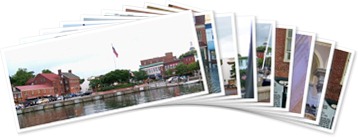
After eating lunch, we walked a few blocks to the United States Naval Academy. After having our ID checked, we waltzed over the visitor’s center to watch a short flick and then take a formal tour of the campus. I didn’t know what to expect because visiting a military academy isn’t high on my list. However, I was enraptured with the architecture, size of the buildings, and the physical, mental, and emotional rigors cadets must undergo during their four years at the academy.

The tour guide’s husband and son had both gone through the academy so she could relay first-hand the challenge of the Plebe Summer and the first and subsequent years in a cadet’s life. Plebe Summer is “designed to turn [1,200] civilians into midshipmen.” It’s seven weeks in length with each day beginning at dawn with rigorous exercise (in Maryland humid heat) and ending at dawn. There’s no television, leisure time or movies.

Those who survive Plebe Summer, return home for a few weeks before starting their first year, which is equally regimented with midshipmen earning more privileges and freedoms as they complete each of their four years at the academy. A typical schedule is:

  • 5:30: Arise for personal fitness workout (optional)
  • 6:30: Reveille (all hands out of bed)
  • 6:30-7:00: Special instruction period for plebes
  • 7:00: Morning meal formation
  • 7:10: Breakfast
  • 7:55-11:45: Four class periods, one hour each (midshipmen can choose to earn one of 22 majors that lead to a Bachelor of Science degree)
  • 12:05: Noon meal formation
  • 12:15: Noon meal for all midshipmen
  • 12:40-1:20: Company training time
  • 1:30-3:30: Fifth and sixth class periods
  • 3:30-6:00: Varsity and intramural athletics, extracurricular and personal activities; drill and parades twice weekly in the fall and spring
  • 5:00-7:00: Supper
  • 7:30-11: Study period for all midshipmen
  • 11:00: Lights out for plebes
  • Midnight: Taps for upper-class

Midshipmen are issued several different uniforms and hats, which they must keep in regulation condition and wear for almost everything they do from attending classes (khaki pants and blue shirt) to working out (blue shorts and white tee-shirts or fatigues for military exercises) to getting an ice cream in downtown Annapolis (white pants, shirts, and shoes). They march to meals, are expected to keep their rooms ready for military inspection, and are required to be in their rooms, studying for several hours per night. They are also issued a cap, which they wear for four years, and then ceremonially throw up in the air upon graduation.

Since 1845 more than 60,000 young men and women have graduated from the academy, served in the military, and then gone onto various careers, including President and nearly-President of the United States (Jimmy Carter and John McCain). Click hereto see the photos on the academy’s site.

Once accepted into the academy, everything is paid for including tuition, housing, food, books, computers, uniforms, dry cleaning of uniforms, athletic gear, and personal toiletries. Plus, midshipmen are given a monthly allowance for extras they may want to buy!

I recall the tour guide saying it costs around $350,000 per cadet over a four-year period. Do the math. To graduate 1,200 midshipmen costs $420 million!

The entire 338-acre campus of the Naval Academy is a National Historical Landmark. Founded in 1845, the academy is home to numerous magnificent Beaux-Arts style buildings built by Ernest Flagg, a brilliant architect. The largest is Bancroft Hall, which is the largest college dormitory in the world with 1,700 rooms, 4.8 miles of corridors and 33 acres of floor space. The central rotunda and first two wings were built in 1901-1906. It later was expanded to encompass eight wings on five floors.
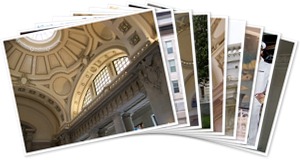
The Hall has its own zip code. It houses midshipmen, has offices for officers and chaplains, a barbershop, bank, travel office, small restaurant, textbook store, laundromat, uniform store, cobbler shop, post office, gymnasium, full medical and dental clinics, and optometry and orthopedic clinics.

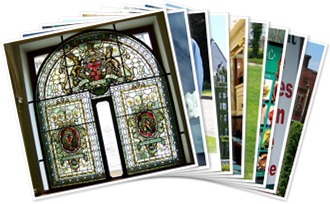
The next stop in our tour was the Naval Academy Chapel, which had dramatic stained glass windows and a serene ambiance. In the crypt beneath the chapel is John Paul Jones, America’s first naval hero who exclaimed “I have not yet begun to flight,” when the ship he was on, the Bonhomme Richard, was confronted by the British frigate HMS Serapis. After heavy fighting and extensive damage to both ships, Captain Pearson of the Serapis surrendered. A few days later, the severely damaged Bonhomme Richard was sunk.

As a side note: Yesterday, for Seattle’s Seafair, Rich and I were on the USS Bonhomme Richard. We’d applied and been accepted to take an all-day trip on a military vessel, but didn’t know whether we’d end up on a Canadian ship, U.S. Destroyer, U.S. Coast Guard ship, or the Bonhomme Richard. A few days before, I was writing about John Paul Jones and when I learned he’d commanded the Bonhomme Richard, I tracked down Rich and announced I knew which ship we’d be on. Sure enough, I was right!

The massive marble and bronze sarcophagusin which Jones’s body is interred is a bit creepy. My imagination doesn’t allow me to get past the vision of a skeleton with bits of putrefied flesh, yellowed teeth, tangled hair, disintegrated clothing, and tarnished war metals.

After visiting the chapel, we scurried to Preble Hall, where the U.S. Naval Academy Museum is located. We found this exhibits so interesting we returned the next day. I was enthralled by the Class of 1951 Gallery of Ships, one of the world’s finest collections of warship models from the 17thcentury to modern times. The ships, made of wood and bone, were built to show what the actual ship would look like when completed. The detail of the ships is extraordinary.

By the time we left the museum, Rich was in a lot of pain from his fall earlier in the day. We returned to the boat so Rich could lay-down while I busied myself by cleaning the outside of the boat with buckets of water (from the river), white-wall cleaner, and a sponge. It kinda’ fun… if you only do it once or twice a year during a charter.

As the day drew to a close, groups of midshipmen started to emerge from the Academy to enjoy the cool evening, frequent restaurants, shops for stuff, visit with other midshipmen, etc. They wore white pants or skirts, white shirts, white hats, and white shoes. They walked with confidence and civility, and most likely, relief with the end of the school year drawing to a close. Many were probably days away from graduating and getting assigned to a ship or other role within the Navy.

The streets were also filled up with local folks: Couples on dates, parents with young children, pierced and tattooed teens with their skateboards, senior citizens holding hands, and boat-owners, like Rich and I. It was a perfect evening for strolling, bopping into the many small shops that line the narrow streets, people- and cadet-watching, and of course, tracking down and eating ice cream (our priority).

Downtown Annapolis is picture-perfect with historical brick buildings, including the capital buildings, charming restaurants and shops, ornate early American churches, boutique inns, and extraordinary row houses from the simple to ornate. I loved walking around Annapolis!

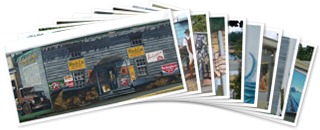
The next day, we awoke to flooding. Unusually high tides combined with unusually large amount of rain resulted in water seeping through the seawall and covering the parking lot and bricked plaza with a foot or so of water. Most of the water didn’t reach the nearby buildings, but did make a mess of the recycling and trash that’d been left out for garbage pick-up. Check out the pictures in the slide show.

Within a few hours the water receded, and life returned to normal. We chose to further explore Annapolis, taking a bridge across Spa Creek to an older part of town where a small maritime museum was located. Unfortunately, when we arrived, there was a cadre of teachers and parents waiting for bus-loads of children. We opted to skip the museum, in spite of the occasional dribble turning into a full-blown downpour. By the time we got back to the boat, we were soaked!

We spent the rest of the day ditching raindrops as we toured the Maryland State Buildings (Annapolis is the capital of Maryland), St. Anne’s Church (each kneeling bench was covered with a unique needlepoint pillows, which must have taken the members years to create), Banneker-Douglass Museum, and the Annapolis National Historical District, which has more than 1,500 restored and preserved buildings and houses.

That evening, we once enjoyed the ambiance… and I worked up the courage to stop a group of midshipmen and ask whether they’d pose with me for a picture. They were very polite and patiently answering my numerous questions.

We spent the rest of the evening, sitting in the cockpit of our boat, marveling at the city and its residents until our eyelids grew heavy. Sadly, we climbed into the galley, falling asleep listening to the voices outside. The next morning brought clear skies as we pushed off the seawall and headed to our next destination.
Splendid Get-Away

A few weeks ago, to celebrate our 9th “civil” wedding anniversary, Rich and I spent a few days in Victoria, British Columbia, Canada. Months earlier, Rich had purchased discount tickets, through Groupon, for Victoria Clipper, a high-speed passenger ferry that whisks you from downtown Seattle to Victoria’s Inner Harbor in less than three hours.

We started our trip at around 4:3 a.m. on Friday morning. After making sure the birds and cats had plenty of food and water, and all six of the four-footed, sneaky, furry brats(cats) were accounted for ─ and not locked in a room or closet ─ we headed to a neighborhood McDonald’s for a light breakfast. I opted for their fruit and yogurt cup. Rich choose his usual Sausage McMuffin and was surprised when they had a buy one get one free deal.

It took us scarcely half an hour to drive downtown, and then zip into a parking garage. The entire time, I kept wondering why Rich felt it was necessary to arrive two hours before the boat left. However, as we approached the dock, we could see long lines of people waiting to drop off their luggage, buy tickets, and have their passports checked. I was glad we arrived early. Unfortunately, we weren’t early enough to get “low” ticket numbers.

The boat is loaded in groups of fifty based on your ticket number. With ticket numbers 177 and 178, we had to wait until at least 150 people boarded before we were able to find a seat. Happily, we found two seats next to each other, towards the back of the boat.

We had a pleasant trip, reading, nibbling on snacks, talking to the people across from us (plump Floridian’s from Tallahassee who were in Seattle to attend their son’s graduation from Seattle University), staring out the large windows, and walking onto the deck to marvel at the massive water jets that enabled the boat to go 30 knots (really fast).

After arriving in Victoria, we thought we could waltz off the boat. Not so. We spent at least an hour in line to get our luggage (actually, just Rich’s suitcase since I crammed my stuff into a gym bag), and go through Canadian customs.

Rich had made reservations at the Fairmont Empress Hotel(part of the Victoria Clipper offer), which was a short walk away. I couldn’t believe we were really staying at the Empress!!! Not only is the hotel considered one of the best in the world, but it’s gorgeous. Built in 1908, it has accommodated Rita Hayward, Jack Benny, Douglas Fairbanks, Katherine Hepburn, Bob Hope… Bing Crosby, Tallulah Bankhead, Shirley Temple, Barbra Streisand, and a host of kings, queens, movie stars, and other VIPs.

After checking in, and leaving our luggage with the porter (it was not even noon so our room wasn’t ready), we hit the streets. Our first stop was a scooter rental shop, to put a reservation on a two-person scooter for the following day. I had my doubts whether both of us could fit on a scooter, but seeing it — a Yamaha BW — I realized it’s built for two and considerably larger and more powerful than a Vespa (my vision of a scooter).

Our next, and very important stop, was Chinatown for dim sum. Yummy, yummy dim sum! Burp!

With the weather absolutely perfect, and our stomach full, we started walking and taking pictures. Victoria is a very beautiful and historical city that wraps around the picturesque Inner Harbor. Our feet took us along blocks of elegant buildings from the late 1800’s; past artists displaying their work along the waterfront; by dozens of sailboats with colorful pennants, commemorating the races they’ve been in; to my posing with Plasterman who whispered funny things in my ear as Rich took my picture with him; around open squares with people sitting outside, eating, talking, and enjoying the sunshine; and finally to the BC Parliament Building.

Because it was weekday afternoon, I assumed the parliament building would be open… and I was correct.

It’s an exquisite building that’s been enlarged and remodeled several times to add modern amenities and accommodate more employees, yet retain its historical characteristics, such carved woodwork, stained glass windows, and breathtaking rotunda. Check out the pictures in the slide show accompanying this article.

After dawdling a little longer, we returned to the Empress to check into our room. The room was on the fifth floor, down a long, hallway, covered with elegant, patterned wallpaper. Off this hallway were larger hallways, which were also wallpapers and decorated with antique chairs, table, dressers, writing desk, and large framed pictures of women who must have had some significance to the hotel or area.

The queen-sized bed in our petite room took up most of the space. You could open the door and barely take two steps before bumping into it. The room, however, was beautifully decorated with elegant curtains, gold-framed pictures of botanical prints, cream-colored walls, two cozy upholstered chairs, cherry-wood furniture, and a spacious bathroom. We opened the windows, took off our shoes, and took a short nap while the cool breeze wafting over us.

Refreshed, we headed for a local pub for an early dinner – fish and chips for Rich, and a burrito stuffed with roasted vegetables and black beans for me. Afterwards, we revved up our feet, and walked along the waterfront. Check out the pictures of the cruise ships and me standing on a sea wall. The ships are huge! One had a giant movie screen on the top deck so you could watch Titanic while the ship moseys through the Gulf Islands.

It was dark when we returned to our room, but still a reasonable hour so we grabbed our bathing suits, and headed to the indoor pool and Jacuzzi. Our muscles soothed, we watched a little TV and then conked out.

The following day was overcast so Rich got up early, snuck down to a computer in the lobby and made arrangements to rent a car. Amazingly, it was cheaper to rent a car than a scooter, and we’d be able to go a heck of a lot further and enjoy padded seats, satellite radio, moon roof and other amenities like a heater and windshield wipers.

Breakfast was Starbucks coffee and cranberry scones. After reviewing tourist brochures and maps, we hit the road, traveling along the coast, north to Sidney. As we drove, we thanked our lucky stars for pointing us towards renting a car rather than trying to read maps and communicate with each other as we negotiated narrow side streets, and climbed hills on a low-powered scooter.

Sidney-by-the-Sea, or as it’s commonly called, Sidney is preserved in time with a population of just 11,000. Lining main street and along the waterfront are charming shops, public art, and walking trails. As we approached the car – a cute, black Ford Focus – we saw an older couple checking it out. They were Canadians and interested in getting a fuel-efficient commuter car. We started a conversation, and they explained no “box” stores are allowed in Sidney.

I hope to visit Sidney this September when we charter a tugboat. It would be fun to leisurely wander through the shops.

From Sidney, with no way to go any further north, unless we boarded a ferry, we head south to Cowichan Bay, a small fishing village, which draws boatloads of tourist. We’d visited this town last year when we chartered a sailboat and had one of our worst un-docking adventures. We’ve since hard-wired in our brains the proper procedure for leaving a windy marina when you’re wedged between two boats… use your bow line and forward throttle to push the stern off the dock, and then release the line!

We weren’t impressed with Cowichan when we visited last year, and our opinion didn’t change this visit. While the Maritime Centre and Cowichan Wooden Boat Societyare very interesting with great exhibits and an unusual collection of buildings or galleries that stretch across a long dock, after you’ve seen the Centre once or twice, there’s little need to go back.

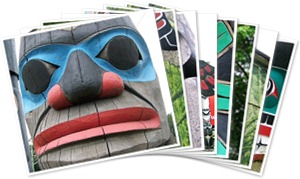
Referring to our handy-dandy tourist brochures, our next stop was Duncan, City of Totems. The town, one of the largest in British Columbia, is home to the Cowichan Tribe of the Coast Salish Nation. Throughout the downtown are over 30 totem poles, most carved in the area and some donated from other cultures, such as Polynesia.

I’ve always been fond of Salish designs and imagery. The totem poles are strangely comforting with dramatic colors, and abstract carvings of orca whales, ravens, seals, otters, eagles, beavers (humorous with giant teeth) people, and mystical creatures.

It was fun to follow the footsteps painted on the sidewalks and streets, to each totem pole. You never knew where they’d lead you, such as between two buildings which were painted with forest and coastal scenes.

The couple we meet in Sidney said we should visit Chemainus. Their website says it’s “so quaint and quiet, you will not want to leave.” I can’t wait to return to Chemainus in September!

Chemainus is a Norman Rockwell-perfect little town, which is made even more wonderful by the 37 murals painted on houses and buildings. Before I write about the murals, you need to understand the vision and fortitude of Chemainus residents.

With a single major employer in the area – a wood mill – Chemainus’ economy was tied to the fluctuating success of the mill and availability of timber. In addition, the town is located off the main highway so it couldn’t rely on tourists driving by, stopping, and spending money.

In 1981, when British Columbia was in the midst of a recession, Bill Vander Zalm, the Premier of British Columbia developed community initiative grants to aid towns in revitalization projects. Chemainus took up his challenge and their outdoor gallery of murals was started.

The 37 murals are spectacular, familiarizing you to the people, stories, and natural resources in the area. Unlike many murals, they’re meticulously painted. You’re compelled to walk up close to study the details, and then step back to take in the entire picture. It’s impossible to stand in one place. You want to move around, seeing how the murals appear from different angles.

Some of the murals meld in the architectural details of the “canvases” on which they’re painted. A window or door becomes part of a street scene, such as “The Lumber Barons” by Constance Greig-Manning.

See and read about all of the murals Note: It can take a little while to load each page, but it’s worth the wait.

After being mentally refreshed in Chemainus, we head south to Sooke, which was supposed to have nice beached. We had some map challenges and basically ended up driving through the area without stopping. By then, it was nearly 8 o’clock at night and our stomachs were aching for food.

We returned to Victoria, and used the GPS to pinpoint the nearest gas stations so we could fill-up, return the rental car, and secure food. To Rich delight, there was a Red Robin two blocks from a gas station.

After a tasty meal and chatting with the server about our day, we dropped off the car… and deposited the key in the rental car box. I then turned to Rich and asked, “Where’s your BVI [British Virgin Islands] baseball hat?”

The next ten minutes was a blur of activity, consummating in our donning warm clothing, and walking two miles back to Red Robin to retrieve Rich’s hat. It was around 11:30 when we got back to the Empress… time to slip on our bathing suits.

We had planning on sitting in the hot tub for a few minutes and then returning to our room, but we got in a conversation with a couple about sailing, places to visit, life in Canada, and other miscellaneous topics. The entire time, we were sitting in or by the hot tub — a perfect breeding ground for cooties.

During the night, my throat got scratchy and I started tossing and turning. By morning, I wanted to be put out of my misery. Nevertheless, I put on a brave face, slurped a large glass of orange juice from McDonald’s, and walked around the town for an hour or so with Rich, before returning to the Empress, slinging my duffle bag over my shoulder, and walking to the Clipper.

Once again, it took over an hour to get through customs, and wait in line to board the boat. This time, we got seats near a window. We shared the “booth” with two other couples. Nearest the window was a couple from Seattle who were adamant Republicans. They lamented the drop in government funding to a nursing home for which the man was on the board of directors, while crowing about the virtues of Rich Perry, the current government of Texas who’s aiming to be president of the United States. Actually, according to a recent statement from Perry, he like George W. Bush, has been chosen by God to become president. Yeah.

The other couple – Sam and Cynthia — was delightful, intelligent, retired professionals from Toronto. Sam, a dentist, had worked in public health, and Cynthia had been a commercial realtor. They had been on an Alaskan cruise, and before returning to Toronto, decided to zip over to Seattle for a few days. Rich and I thoroughly enjoyed talking to them and learning more about Canada.

After departing the boat and once again going through customs, we headed home, refreshed from a splendid get-away.

As for my cold, I purchased a generic version of Musinex (booger de-gunker) and was amazed how quickly it worked. Within a day, most of my cold symptoms disappeared!!!

Rachel and the Squirts

Last week, Rachel finally showed us her “squirts.” We thought she had two babies, but they kept arrived on our back deck. One baby is smaller than the other three (she’s standing on the lower deck behind Rachel, the larger raccoon in the middle of the picture), but appears hRachel and the Squirtsealthy.

Last weekend, we observed how the babies get into our yard from the neighbor’s (we think they split their time between living under our neighbor’s shed and under our lower deck). They climb on our wisteria trellis, which is attached to our fence. They use the trellis like a ladder.

On Sunday afternoon, we saw three of the babies in one of our trees. They were practicing their climbing skills. The fourth baby was on the fence and must have jumped (or fallen) off the fence because Rachel abandoned the three babies in the tree to investigate.

Where Our Forefathers Walked

(Continuation of our east coast adventure in early May) After a restful sleep and shower at the Day’s Inn in Arlington, Virginia, we hit the road for Alexandria, and once again thanked our “lucky stars” for helping us to get a rental car the night before, following our late arrival in Washington D.C.

With the heat and high humidity, Virginia is verdant and beautiful with green deciduous trees, flowering bushes, and emerald green lawns. We passed street-after-street of beautiful historical houses surrounded by blooming peonies, azaleas, rhododendrons, wisteria, lilacs, morning glories, hydrangea, honeysuckle, and ornamental grasses. Virginia makes my heart pitter-patter even if I keep hearing the voice of people I know who’ve lived in the South, and speak fervently about the dreaded humidity and heat of Virginia summers.

We had no problem finding parking a parking spot in downtown Alexandria, across from the Stabler-Leadbeater Apothecary Museum, a retailer, wholesaler, and manufacturer of herbal botanicals, which was founded in 1792. After feeding the parking meter, with a tour map in hand, we set out along the narrow, occasionally cobblestoned streets to seek out and snap pictures of historical shops, houses, and taverns.

Because much of downtown Alexandria has been gentrified with the historical buildings restored rather than taken down, on nearly every block a building or street is listed on the National Register of Historical Places. I was in awe of the ornate, Georgian row houses with tall rectangular windows, shutters painted in contrasting colors, pretty entryways, low picket or metal fences, and tall brick chimneys.

I immediately longed to move from our suburban home with a big yard to a cute little row house. Then it occurred to me, these houses were building in the 1700’s when plumbing consisted of a pitcher and washbasin for a sink, and a chamber pot for a commode. In addition, the kitchens were probably small, requiring a table for preparing foods, shelves for dishes, and a fireplace for cooking. Accommodating a modern kitchen with a stove, oven, dishwasher, double-sink, refrigerator, and cupboards, would require major remodeling, electrical, and plumbing, and most likely, the need to expand into another room.

In addition, the only light that comes into a row house (unless located at the end of a row) is through the windows in the front and rear of the house… and if your house is on the National Register, you need to keep the original windows. The most difficult aspect – at least for me – would be the proximity to the street. The front doors of the row houses we saw were a handful of steps from the edge of the sidewalk. Pedestrians walk within a few feet (or inches) of your front windows and doors. Closing your drapes doesn’t become a choice, but a necessity.

Okay. Skip living in a historical row house in an east coast city!

After an hour or so, we decided to duck into The Lyceum, a grand hall, built by the Alexandria Lyceum and the Alexandria Library Company in 1839 for lectures, scientific experiments, and “quiet reading.” The building was later used as a Civil War hospital, private home, office building, nation’s first Bicentennial Center, and currently Alexandria’s History Museum. While small, the museum provided information about the area, founding of the United States, and of course, the Civil War.

Also of interest was the Gadsby Tavern, built in 1785. The tavern and associated hotel became the center of Alexandria’s economic, political and social live in the late 18th and 19thcenturies. Visitors included George Washington, Thomas Jefferson, John Adams, James Madison, and James Monroe.

Recently, a portion of the tavern’s basement was restored. From the sidewalk, you can walk down a small flight of stairs to a large window, which allows you to look down into a cistern, for storing water, and also a portion of the basement for cold storage. Food was kept cold by storing below ground.

Nestled among the houses was Christ Church, the first Episcopal Church in Alexandria. Completed in 1773 by Scottish merchant John Carlyle, the church was regularly attended by George Washington and Robert E. Lee.

I was too short to look inside the church, but Rich said there were “gated” sections of pews, which were assigned to local families for their use.

The churchyard, surrounding the church had dozens of worn gravestones, which had been moved throughout the decades for construction and during the Civil War, when they had been stacked against the parish walls. From the late 1700’s to 1809, it’s estimated around 1,000 people, including eleven African-Americans were interred in the scarcely half-acre churchyard.

Located in the center of Alexandria is Market Square, one of the oldest continuous operating farmers’ markets in the nation where local farmers, including George Washington (who owned five farms in Mount Vernon) used to sell their crops.

The square was also used for public meetings and military operations. According to a website on historical Alexandria, “In 1755, Gov. Robert Dinwiddie designated George Washington (age 23) colonel and commander-in-chief of all Virginia forces; and Washington is known to have reviewed and possibly drilled the local Fairfax County militia and the militias of four other counties in Market Square. Later, as the colonies prepared for the Revolution, George Washington was appointed commander of the Fairfax independent militia companies, and he reviewed the militia troops in Alexandria’s Market Square in early January 1775. On June l5, 1775, the Second Continental Congress selected George Washington as commander-in-chief of the Continental Armies.”

After wandering through historical Alexandria for a few hours, and seeing that our parking meter needed to be feed, we drove to a few miles to the Torpedo Factory Art Center. I was super excited about seeing the factory because I’d read about it in advance and knew it has become one of the largest visual art centers in the country with 82 artist studios, six galleries, an art school, and the Alexandria Archaeology Museum.

The multi-building complex was built after World War I by the U.S. Navy to manufacture torpedoes. Production continued until 1945 when the buildings were used for a government storage facility. Years later, the city of Alexandria renovated the building into working studio spaces for artists and craftspeople.

Rather than look at art, our goal for visit the Factory was to grab a quick lunch, and then head to Mount Vernon.

The Factory beaconed us and we ended up spending over an hour quickly walking through the three floors of extraordinary art from paintings to photography, jewelry, ceramics, sculpture, beadwork, lithography and prints (they have a larger area filled with art presses), and glasses. I could have spent all day casually wandering through the galleries.

Finding something decent to eat for lunch was a different matter with three to four fast food joints in the Factory’s food court. We settled on splitting a plate of dreadful Chinese fried noodles, mystery meat, and vegetables (primarily cabbage). Nauseated, but our stomachs full, we set out for Fort Ward.

Located a short drive from downtown Alexandria, Fort Wardis the best preserved of the Union forts and batteries built to protect Washington D.C. during the Civil War. Today, it looks like a giant park with a handful of canons and signs, pointing out how the site was used. The latter isn’t readily obvious mainly because warfare wasn’t overly sophisticated during the Civil War. Essentially, battalions of men would race up hills, over berms, and around other obstacles. The battalion in the most strategic location or with canons would kill most of the men in the other battalion; thereby becoming the winners.

Thousands upon thousands of men would be killed in a single day, left to rot on the battlefield their single-shot muskets at their sides. It was a macabre and horrible war. It’s estimated 620,000 Americans died from battle deaths or disease during the war.

After visiting Fort Ward, we drove to Mount Vernon, passing the George Washington Masonic National Memorial. This colossal memorial and museum sit on top of a hill, overlooking downtown Alexandria. Running short on time, we skipped seeing it, which in retrospect was wise.

I was expecting the Mount Vernon Estate and Gardensto take an hour or two to tour. Ha!

The estate and associated visitor centers, gardens, and buildings are extensive, and if you dawdled, could take all day to visit. Along with buying a ticket to see Washington’s house, we decided to go on a 45-minute cruise of the Potomac River, which runs along the back of the estate. Unfortunately, the gloom of the day didn’t lift so the cruise wasn’t overly scenic, but it was a nice opportunity to sit down, relax, and nibble on popcorn as we viewed the shoreline.

This slideshow requires JavaScript.

Prior to getting on the boat, we zoomed by Washington’s tomb, which I found creepy. The burial vault, which also houses Martha and other members of the Washington family, is quite sizable. In the middle is Washington’s ossuary, no doubt, containing not much more than his bones, dentures made from hippopotamus teeth, and war medals, which unlike flesh and clothing, taking longer to disintegrate.

Following the boat ride, we visit the pioneer farmer site, which was representative of Washington’s farming operations on his plantations. People in period clothing were on hand to elaborate on farming techniques, the “joys” of being a slave, and the operation of his innovative 16-sided barn.

Yes, unlike what Michele Bachman believes, the founding fathers may have expressed a dislike for slavery, but weren’t hesitant to use them to boost their personal fortunes. In the case of Washington, there were 316 slaves at Mount Vernon, including 123 owned by Washington, 40 leased from a neighbor, and 152 dower slaves, which were part of his wife Martha’s first husband’s estate.

Wikipedia notes, “As on other plantations during that era, his [Washington’s] slaves worked from dawn until dusk unless injured or ill and they were whipped for running away or for other infractions. They were fed, clothed, and housed as inexpensively as possible, in conditions that were probably quite meager. Visitors recorded contradictory impressions of slave life at Mount Vernon: one visitor in 1798 wrote that Washington treated his slaves “with more severity” than his neighbors, while another around the same time stated that ‘Washington treat[ed] his slaves far more humanely than did his fellow citizens of Virginia.’ Washington’s writings show that he had a low opinion of the honesty and willingness to work of his slaves, as well as of the ability of his overseers to control them. The overseers were given written authorization to whip those slaves he considered to be in need of such ‘correction,’ including female slaves.”

Although, Washington was the only prominent, slaveholding Founding Father to emancipate his slaves, which he did following his and his wife’s death.

As noted previously, Rich and I must have been asleep through American history, because neither one of us knew that Washington had slaves. And discovering he was an enthusiastic slave-owner sored much of our visit to Mount Vernon.

We rambled across the estate, interpreting everything we saw with a bias. “Gee, could Washington had accumulated and worked 8,000 acres of fruit and vegetables, formal gardens, nurseries and greenhouse for propagating new plant and seed varieties, and an extensive fishing operation if he to pay for labor versus working slaves from dawn to dusk, six days a week?”

Plus, George and Martha extensively entertained, keeping the domestic slaves hopping from slaughtering animals and preparing meals to laundering and ironing clothes and linens, cleaning the mansion, and doing what’s necessary to ensure horses and carriages were ready at a moment’s notice.

Not only did slaves have to do all of the work around the estate, but they had to make their own clothes and shoes, grow and prepare their own food, and somehow care for their children and personal needs.

Okay, looking past the slavery issues, there were many innovations on the estate, which were noteworthy. There were small outdoor privies or toilets called necessaries with drawers in the bottom to collect human waste. This waste, along with that of farm animals was placed in the dung repositoryto decompose and be turned into fertilizer for crops.

Washington inherited the mansion from his father and expanded and remodeled it several times. To create a stone-like exterior, the walls were sprayed with a mixture of paint and sand. The interior is surprisingly ornate with marble fireplaces, baroque ceilings and carved molding, rich wood paneling, large oil paintings, and elegant drapery and furniture. Check out a virtual tourof the mansion.

Hands down, our favorite part of the estate was visiting with Martha Washington. We were about ready to leave and saw a building, which we hadn’t gone into. The attendant at the door told us to enter quietly because “she had guests.”

Inside were rows of chairs with a small stage with period furniture and knick-knacks. Seated on an upholstered chair was Martha Washington in an ornate dress, talking about her life at Mount Vernon. The woman playing Martha was extraordinary. You could ask her any question and in a conversational tone she’d respond, speaking as if it was still the 1700’s.

Rich and I were mesmerized. She talked about how various politicians didn’t support Washington, creating strife and questioning his ethics. One politician she refused to name. I believe she was referring to Patrick Henry who opposed the United States Constitution and refused to attend the Constitutional Convention of 1787, claiming he “smelt a rat in Philadelphia.”

If you closed your eyes, it sounded as if she was talking about the mendacity and “terrorist tactics” of today’s Republicans who refuse to support anything President Obama proposes!

Running out of time, and needing to get to Rock Hall, Maryland to get on the boat we were chartering, we had to zoom through the Ford Orientation Center and Donald W. Reynolds Museum and Education Center, two large complexes with fascinating exhibits and educational galleries and theaters. If we visit the east coast again, we’ll have to visit Mount Vernon once again.

Favorite Pictures (so far) from Victoria

Yesterday afternoon, we got back from a whirlwind, three-day trip to Victoria, B.C. by Victoria Clipper, a high-speed (30 knots) jet boat. I just downloaded the 167 pictures we took. Here are a few of my favorites… Rich pretending to be a water can and me getting friendly with Plaster Man, Parliament Building, Market Square, and the favorite of cuisines at a local restaurant (never heard of Canadian cuisine):

P/V Goldfish

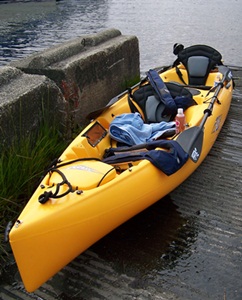
On Memorial Day, after much planning, we launched the P/V Goldfish in Lake Sammamish in Redmond. Our 16-foot, two-person Hobby-Cat kayak was named the following day when we placed her in Lake Union, near the University of Washington.

Hobby-Cat P/V Goldfish

P/V Goldfish before we snapped in the pedals. Even though the boat is long, it fits on the top of Rich's Honda Insight

We were pedaling by several crab fishing boats, including the Wizard (featured in the TV show “Deadliest Catch”) when I noticed preceding the initials “F/V” proceeded the names on the boats. Rich commented it meant “fishing vessel.”

A lightbulb simultaneously went off in our heads. We should identify our kayak as P/V, meaning “Pedal Vessel.” For the next hour or so, we brainstormed on names potential names when it dawned on me, the color of the kayak was that of a goldfish.

Behold the P/V Goldfish!

Hobby-cat P/V Goldfish

Pedaling leaves my hands free to wave at people on the shore!

What makes the boat special is that you pedal instead of paddle. It’s much, much easier to pedal and you can go much, much faster! We zoomed across Lake Union without breaking a sweat. Here’s a picture of my feet, helping propel the P/V Goldfish under one of the bridges leading to the Ballard Locks.

While on Lake Sammamish, and the following day on Lake Union, we received many comments and applause from people on shore and in other boats. The P/V Goldfish is both fun to pedal and attracts lots of attention.

We can’t wait to plunk in her other lakes, rivers, and even the Puget Sound… and put on the “turbo” flippers, which are supposed to be more difficult to pedal, but will allow us to go faster. And we have a small sail that can be placed in the center of the boat to capture wind and further increase our speed.

Car Success Bolstered Trip

Traveling, especially across country, in today’s topsy-turvy environment of terrorist threats, exacting TSA requirements, and unpredictable weather is tentative at best. Adding to the uncertainty, are unforeseen consequences, such as landing at Chicago O’Hare and taxing for seemingly half the length of the flight – across runways, over freeways, by scores of lumbering planes, past several terminals, and around a flock of wandering Canadian geese and their goslings.

While we thought we had over an hour between our connecting flights from O’Hare to Reagan International in Washington, D.C., we had minutes to sprint and line up to board. So much for leisurely purchasing and eating one of Chicago’s famous hotdogs with screaming yellow mustard, relish, onions, pickle spears, tomatoes, and a dash of celery salt!

Then again, the start of our trip wasn’t particularly relaxed.

We had decided to take an afternoon flight the day before our sailboat charter so we we’d have a full day to drive to Rock Hall, Maryland where we were chartering a 32-foot Hunter sailboat, called Carol Cattie. It was a good plan. We’d have Thursday morning to finish packing, tidying up the house, and getting everything ready for the pet-sitter – a necessity with six cats and four birds.

The morning started with my checking my work emails and then dashing to the dentist to have my retainer tighten, a dreaded device meant to straighten my bottom teeth. When I got home, after a quick check of my work emails, I dove into packing, cursing at myself for having not started sooner. I’d amassed a pile of clothes and necessities on the bed, which Rich was supposed to cram into one of two huge canvas Army duffle bags. Having traditional suitcases on a boat takes up unnecessary space.

As expected, my desire to have 1.5 outfits for every day of our vacation wasn’t a workable plan, given the limitations of the duffle bags. Rich proceeded to have me choose which pink shirt of the two I wanted to bring. Did I really need four pairs of shoes for ten days? And why was I taking three bathing suits?” There was actually only two bathing suits, but Rich counted the top and bottom of one suit as two suits. Men!

Heated discussions ensued as we debated whether to pack light with shorts and short-sleeved shirts (the last time we chartered in the Chesapeake, it was scorching hot) or bring heavier clothing, which was more in line with weather forecasts. Adding to the uncertainty was a co-worker’s comment that 80-degrees in Virginia with 90% humidity feels like 100-degrees.

Along with having to cram our clothes into the duffle bags, we had electronic and sailing gear (two GPS’s, VHF radio, walkie-talkies, binoculars, camera, camcorder, and chargers), non-perishable food, French coffee press (charter boats typically have substandard percolators), reading materials, maps, toiletry, pills, sunblock and sunburn goo, three sheets, two pillow cases, towels, and “handy-dandy stuff” like rubber bands, paper clips, twist ties, baggies, wet wipes, and pepper grinder.

Once the duffle bags had been packed and re-packed, we set to work with the household chores of cleaning kitty litter boxes, taking out the trash, closing up rooms (and ensuring no cats were hiding in them), and watering the indoor and outdoor plants.

Finally, ready to go, we hopped in the car, took a deep breathe, headed down the street, went back to the house to make sure the garage door was shut (it was), and then confidently zoomed down the freeway to the airport. We arrived seemly hours before our flight, but time zipped by and before we knew it, we were buckling up our seatbelts and stowing our carrying-on bags under our seats.

Because we planned to have a famous Chicago-style hotdog at O’Hare, we only brought nibbles for the flight. The latter proved to be our only substance until 1:30 a.m. when we visited a 24-hour McDonald’s across the street from our motel in Arlington, Virginia… more about this adventure later in my convoluted tale.

With clear weather, we had an uneventful flight to O’Hare, reading and nibbling on Jellie Bellies, dried fruit and nuts, packaged crackers and peanut butter, two cookies, and two bags of mixed mysteries, which were distributed with our Dixie cups of soda.

When we finally got off the plane – after nearly 45-minutes of taxiing everywhere, but our gate – we had no choice, but to sprint to our Washington D.C. flight. Our delight of getting on the plane was quickly replaced by concerns the car rental company would probably close before we touched down. Our concern rapidly eroded into a reality as we waited to take-off… and fumed over the missed opportunity to have a Chicago hotdog!

Rich meanwhile, frantically called the car company. We were expected to land around midnight. The car company, which was several miles from the airport, closed at 12:30 a.m. Their advice, “Get on the shuttle bus once you land.”

And that’s what we did. We landed at around 12:20 a.m., and Rich, with the bag of electronics, sprinted across the airport while I leisurely made my way to the luggage carousels, wondering how I was going to carry over 80-pounds of duffle bags plus my carry-on bag, and my trusty netbook, Sputnik.

Miracles happen.

Rich made it to the car company seconds before they locked the doors. I retrieved our bags, putting the heavier bag over my shoulder along with my carry-on and Sputnik. I then lifted/dragged the other duffle bag, pausing every thirty feet or so until I made my way out the terminal and across the street to where Rich picked me up.

Once settled in the car – and figuring out all the buttons and switches – Rich booted up the GPS he brought and we were on our way…kinda’. Rich was very tired and kept taking the wrong exit. When the “helpful voice” on the GPS said “turn…” Rich would turn before he heard the rest of the instructions. The “voice” would promptly respond, “re-calculating!” Granted, D.C. isn’t the easiest city to negotiate with many freeways and large, fenced and guarded complexes, necessitating going “around” instead of “through.”

We finally reached the Days Inn in Arlington, Virginia, which was two motels melded into one: A three-story, blocky building with a Thai restaurant on the bottom floor and a handful of rooms on each floor located off a central hallway, and a traditional, L-shaped two-story building with rooms accessible from the outside. We had the last room on the second story of the blocky building. Before we lugged up our duffle bags, we checked out the room…Arlington motel room

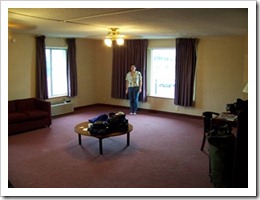
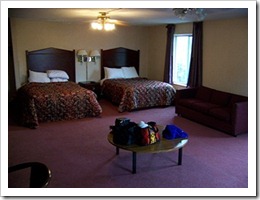
Bizarre is the word that came to mind. It was a huge room with two fans lazily spinning on the ceiling. Taking up about a quarter of the room was two queen-sized beds with attractive bedspreads and fluffy pillows. On the wall, where the door was located, was a rickety, pressboard entertainment center with a television. Several inches below the top of the entertainment center was the switch for the fan and lights. Rich found it by following the electrical cord from the fan, across the ceiling and down the wall!

Next to the entertainment center was a small desk with a chair and lamp. Across from the door was a worn sofa. And in the middle of the room was a low, circular coffee table. Check out the picture to the right.

Arlington motel room_2Concerned about cooties, bed bugs, and other critters, I insisted that our luggage be confined to the middle of the room, preferably on the circular table.

At one time, I suspect the building was a small apartment complex, which was why the room was so large. In spite of the room having a strange aura, we were happy to have a place to sleep!

Our final to-do for the day was to fill our stomachs, which were on west coast time and demanded attention even though it was 1:30 a.m. Amazingly, across the street from the motel, several fast food restaurants were still open. We opted for McDonald’s. Rich had a hamburger and fries while I opted for their snack size fruit and walnut salad. Very tasty!

Carol Catie: Not perfect, but Darn Good

Note: I’ve decided to write about our recent East coast trip out of order so if it sounds disjointed, you’re probably correct!

After visiting Alexandra,Virginia and George Washington’s estate in Mount Vernon on Friday, the first full-day of our east coast adventure, we headed 2.5 hours north to Rock Hall, Maryland. Seven years ago, we chartered from the same company so we knew what to expect and how long to plan for the drive. Inside Carol Cattie after the rain

Nevertheless, we didn’t anticipate grocery-shopping challenges. Rich had plotted on his GPS the location of a Wal-Mart, which he believed would have the best prices and food selection. I’m anti Wal-Mart and normally refuse to shopat one; but knowing we had limited time to get food for seven days of sailing and remembering there are few cities on our drive to Rock Hall, I relented.

As we approached the designated Wal-Mart, I began having doubts. It was in a rundown area and while it might be politically incorrect to say, Rich and I were two of the very few white people we saw out-and-about, and in cars. Nevertheless, after parking, we grabbed our shopping list and headed inside.

Rich taking photosThere was a small food section, a very small section with mostly packed and canned goods, and no fresh produce, meat or diary. Not good.
We hit the road again, this time, stopping at a Kmart because Rich thought it would be a Super Kmart with a variety of foods at amazing prices. I have a hypothesis. Anything that ends with “mart” is probably not comparable to store dedicated to selling groceries!

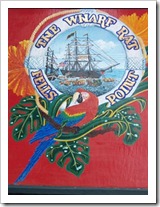
Quickly realizing the moderate-sized Kmart in Stevensville, Maryland (population 5,880) didn’t contain much food, we headed a few blocks to a LARGE grocery store. An hour later, we had what we needed: Milk, cereal, ham for sandwiches, chips, fig newtons, produce, fruit, frozen vegetables, pasta and sauce, frozen fish, crackers, cheese, coffee, and four gallons of water. The Wharf Rat_Fell's Point

With darkness quickly ascending and Rock Hall at least an hour away, we opted to eat at Cracker Barrel. These often very busy establishments typically dot main freeways in southern states, and are notorious for large portions of country fare at modest prices. Associated with each restaurant is a country store, which stocks everything from large rocking chairs to packaged foods and candy, dishes, towels, books, CDs, home furnishing, silly toys and novelty items. The stores are fun to browse, and even though you realize everything is overpriced, it’s hard to resist not buying something, especially when you’re waiting to be seated in the restaurant.

clip_image001

With a Cracker Barrel only a few miles from our house in Austin, Texas, we went there a few times for breakfast. I had no idea what they offered for dinner, until we visited the Cracker Barrel in Stevensville, Maryland. I quickly discovered most of the entrees come with your choice of two to three “country vegetables,” including corn, green beans, baby carrots, fried apples, apple sauce, macaroni and cheese, cole slaw, steak fries, mashed potatoes, pinto beans, turnip greens, breaded fried okra, dumplings, and hash brown casserole. I don’t know about you, but I wouldn’t categorize most of these items under the label “vegetable.”

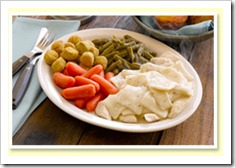
Out of curiosity and hunger, I opted for “homemade chicken n’ dumplings” with two “country vegetables.” A few minutes later, the server plopped in front of me a beige plate with a pile of white blobs over a slice of tasteless chicken, and another pile of macaroni cheese. In a small beige bowl was a heap of overcooked, dull green turnip greens with specks of ham. Check out the plate above from the Cracker Barrel site, which shows their ghastly chicken and dumplings, baby carrots, breaded fried okra, and overcooked string beans.

Rich opted for a slice of pot roast with drippy cole slaw, canned corn, and a baked potato (he got three “country vegetables”). The dinner also came with four, soggy buttermilk biscuits with pats of butter and packets of honey.

I’m thrilled we won’t have any urge to visit a Cracker Barrel in the next five to ten years!

Burping and fighting indigestion, we headed to Rock Hall and were pleased when we arrived and took an initial tour of Carol Catie, a 32-foot Hunter sailboat. After chatting with a couple from New Jersey, we loaded our clothes, sailing gear, food, and linens onto the boat, unpacked, and flopped down on the bed in the aft berth. It was close to midnight when we flipped off the lights. Door in Fell's Point

The next morning was rainy, which was a bit discouraging, but after pulling on rain gear and getting the “okay” to leave, we carefully backed out of the slip and started down the channel. I was driving and was told to hug the green buoys – closest to the shore — because the water was deeper there. Even though I thought I was getting chummy with these buoys, I must not have been close enough because at one point the depth was 5.5 feet and Carol Catie has a 5-foot keel. According to Rich, we “kissed the bottom” before we reached deeper water.

Fortunately, unlike the knot and wind speed meters, which didn’t work on Carol Catie, the depth meter worked perfectly, and throughout our trip, kept us off sand shoals and other shallow spots.

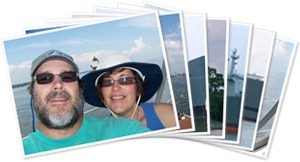
That night, we anchored in a quiet bay. You can see me sitting in the galley of Carol Catie at the top of this article. Notice the large books of “waterproof” maps of the Chesapeake drying out on the navigation station behind my head.  Meanwhile, Rich was above deck, taking pictures and pretending he wasn’t going to be expected to eat a “Julie first,” baked pasta:

Mix together a box of pasta, jar of spicy spaghetti sauce; one can of each of corn, mushrooms, and olives, and enough water to hopefully cook the pasta. Plunk in a baking pan. Cover with foil. Bake until pasta is soft. Pretend it tastes good. Liberally cover with ground pepper and other spices. Continue eating and then cover with additional foil, and hide in refrigerator until you run out of food or until the last day of trip. Toss in garbage can. Giant ships in Baltimore harbor

Early Saturday morning, half asleep, but needing to pee, I crawled over Rich, tripped over the door ledge, and skidded across the kitchen floor, creating a deep gouge in the top of head. This injury paled in comparison to Rich clunking his head numerous times on the v-berth door, and swan diving off the sea wall in Annapolis, Virginia. You’ll have to wait to hear about the latter.

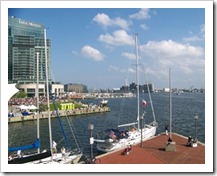
Around noon, we arrived in Baltimore harbor. The weather was splendid and I was giddy with excitement. Rich chose to stay at the city docks, which have first class amenities, and are steps from everything we wanted to see in downtown Baltimore. Inner Harbor_Baltimore

Our first stop was Whole Foods… for more food. Personally, I hate Whole Foods. By the time we left, Rich did too! The store didn’t have what we needed (i.e. powdered, low-calorie drink mix, etc.), and was pretentious, particular, and overpriced… and not as good as what we can buy in the Pacific Northwest like Dave’s Bread!

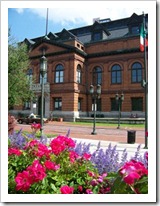
A bitty cranky after our unsuccessful shopping experience, we set out for Fell’s Point, a funky area, founded in 1730, which is best known for its shipbuilding history, including the construction of the USS Constellation in 1797. The neighborhood reminds me of the Lower East Side of Manhattan where waves of immigrants have lived, and then generations later, moved to better areas. Along the waterfrontFell's Point art are original cobblestone streets and row houses, now housing several blocks of small pubs and shops… and an old police station where the television series “Homicide: Life on the Streets” was filmed in the late 1990’s.
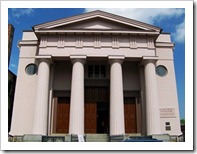
Walking west, away from the waterfront, we passed by row houses and shops, now occupied by people from Central and South America, the Caribbean, and Asia. In the past, this area welcomed immigrants from Europe, including an influx of Jews in the late 1800’s who worshipped at Lloyd Street Synagogue, the third oldest synagogue in the nation. Built in 1845, the synagogue is now owned by the Jewish Museum of Baltimore. To the right is a picture of the synagogue. Lloyd Street Synagogue_Fell's Point

After Fell’s Point, we headed back towards downtown, past run-down areas, abandoned buildings, and several schools. A few decades ago, these schools were probably the pride-and-joy of residents, but are now akin to mini prisons with bars on the windows, boarded-up doors, and heavy fencing around the grimy walls and unkempt playgrounds.

Rich commented, “What’s happened to America?”

Baltimore, like Detroit, Chicago, Pittsburgh, Washington D.C. (which we saw a week later), and other industrial cities is suffering from urban blight. The American dream is eroding into despair with access to healthcare, quality education, safe housing, and even fresh fruits and vegetables out-of-reach for those in impoverished areas. Water Works Museum_Baltimore

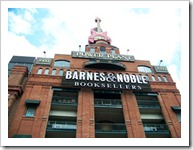
One ethnic group that has remained in Fell’s Point is the Italians who live in and around Little Italy. I was hoping to spot a small Italian café for a cooling Italian soda on a warm day, but we only passed full-service restaurants on our trek to Inner Harbor. The latter was super busy with a music festival underway, crowds outside the National Aquarium and associated ships (i.e. submarine, Coast Guard cutter, etc.), surrounding restaurants (such as Hard Rock Café) and shops (such as Barnes and Noble), and numerous boats tied up to the seawall with partiers hopping from boat-to-boat. Barnes&Noble_

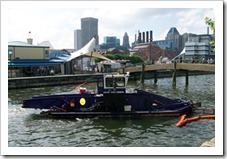
When it rains in Baltimore, trash from sewers and creek-beds must wash down into the Inner Harbor. We watched an unusual trash skimmer boatsweep up hundreds of plastic and Styrofoam bottles, jugs, and cups, and other riff-raff. It has giant jaws that open and funnel the trash onto a conveyer belt, and then into a collection bin. It was fascinating to watch the skimmer below.

We enjoyed the festivities for an hour or so and then retreated back to Carol Catie to make dinner, wait out a dramatic thunder/lightening/torrential rain storm, which last about an hour, and then darting between the lingering rain drops to the marina office where we took take long, hot, sudsy showers and once again laud our good fortune of having enjoyed a great day in Baltimore. Garbage slurping machine_Baltimore

The only outstanding issue was the need for ice cream. Refreshed, we grabbed our coats and headed back to Inner Harbor. Unfortunately, it was getting late and every time we spotted an ice cream shop it was closed! Exasperated, we put our heads together and remembered there was a CVS drugstore a short walk away.

We were on a mission!Tormenting cows in Mount Vernon

And fifteen minutes later, our mission was achieved: A pint of raspberry sherbet for me and a pint of decadent caramel-spiked ice cream for Rich. We tripped over each other racing back to the boat, scampering into the galley, and grabbing two tablespoons.

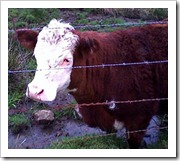
Oh, the picture to the right is me tormenting a bull at George Washington’s Mount Vernon estate. I couldn’t resist touching it’s horn, which was wonderfully warm on a cool day.

Crying Behind the Smiles

Last weekend, I went to the Temple B’nai Temple Sisterhood Retreat at Camp Brotherhood in Mount Vernon. I debated for weeks about attending, reasoning I knew only one person – Shana Aucsmith, the first vice-president on the temple’s board of directors. A few weeks before the event, however, following a performance at the synagogue by Vagabond Opera, I walked into the Judaic Shop.

While browsing the shelves, and wondering whether I should buy Rich his own Hanukah menorah so I wouldn’t be competing with him to light the candles on mine, I was unexpectedly inspired to ask the women in the shop about the retreat. I had no idea whether they’d ever attended, let alone knew about it.

I can still visualize, Norma, who I later met at the retreat, smiling and explaining it’s an amazing experience and I should go. I was intrigued by Norma. Her bright smile, laughter, and cool earrings. I also noticed her cane, and sensed she may have difficulties walking long distances.

Learning from Norma that around fifty women would be attending the retreat, I concluded I could easily hide if I didn’t feel comfortable spending a weekend with women I didn’t know.

On Friday, I started to wonder why I’d signed up to attend the retreat. The weather was going to be splendid and I felt an obligation to help Rich set up our raised vegetable beds in Mount Vernon. Plus, Rich is my rock and anchor. He makes me strong and keeps me focused on what I need to achieve. Without him, I’m lost, aimlessly drifting through life, doing what’s necessary without any direction.

Before I married Rich, I lived day-to-day, convinced my life was little more than going to work, occasionally going to social events, and catering to my mother’s perpetual needs. I had many acquaintances, but few friends, having consumed decades of weekends doing what my mother wanted instead of creating a life for myself.

To a certain extent, I’m in the same mindset so when Rich dropped me off at Camp Brotherhood, late Friday afternoon, my overriding aim was simply, “get through the day.”Cow_cropped

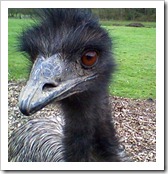
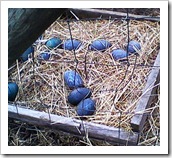
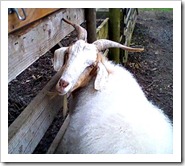
After getting my packet, with the key to my room, I quickly dropped off my bag, and raced down to the see the farm animals; it was less intimidating than going into the dining hall and introducing myself to others at the retreat. As expected, I was enraptured with the animals: Four curious emus that grabbed at my rings, several bossy geese, dozen or so cows including calves, several sheep and two alpacas that had no interest in interacting with a human, three miniatures horses, one mule, and a magnificent ivory-colored angora goat who welcomed being caressed. And at one end of the pen where the emus were kept was a box of bright blue-green eggs. Emu_cropped

After enjoying the animals, I wandered up to the dining hall and was greeted by Julie M (also attending the retreat was Julie K, and I, Julie L.). Not knowing who she was, I rambled about my background and how I was surprised when during Friday night services the rabbi started accompanying the pianist and singer… his wife…

“Wait,” I suddenly thought. The rabbi’s wife is name Julie… ummm… Julie M… Muriel!

“Jeepers, how will I ever extract my foot from my mouth,” I regrettably pondered. There was nothing to be done aside from take a deep breath and excuse myself to meeting another person and once again commit a faux paux.

Dinner was pleasant with many charismatic women who shared humorous stories about their travels – our assignment to share later that evening. Energized and satiated from dinner, we walked up to the camp’s chapel, a simple, yet spiritual building with tall windows that look out onto the forest below. Emu eggs_cropped

Our chairs in a circle, we started the Shabbat services, specifically written for that evening with passages of importance to women. Were also given a pen with one word on it, meant to signify our focus for the weekend. Mine said “cherut,” which means freedom in English.

Using our pens, we were asked to write our autobiography in six words. I wrote, “Stopped breathing. Rescued. Now breathing freedom.”

Those six words were all it took to plunge me into a downward torrid of tears. Towards the end of the service, when we were asked to stand and create a healing circle, I was too overcome with emotion to continue. I rushed outside and cried, and cried, and cried.

Goat_croppedI cried because I miss my dear grandmother, Rose, who comforted, encouraged, and love me after my father died. As a sensitive nine-year old, who dissuaded from spending time with friends, I was constantly berated and belittled by my narcissistic mother who half the time saw me as an inconvenience, and the other, as a minion to cook, clean, garden, and cater to her escapades.

My earliest memories were of being scolded, told to stop crying, and then passing out because in an effort to curtail my crying, my tongue would curl back in my throat cutting off my breathing. It happened many times until I learned to put my hand in my mouth to prevent my tongue from cutting off my breath.

“Stopped breathing.”

Whoa. I can’t believe what I just wrote. I hadn’t thought about cutting off my breath for so long… I need to resume writing about the retreat at another time. The emotions it aroused are still too fresh.