Twenty One Hour Day

Rather than write about the start of our recent sailing adventure in the British Virgin Islands (BVI), I decided to provide the ending first. It’s like flipping to the back of a novel when you can’t decide whether it’s worth the time and effort to wade through the rest of the pages.

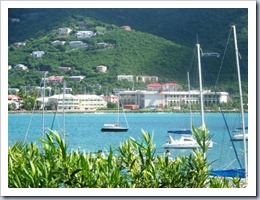
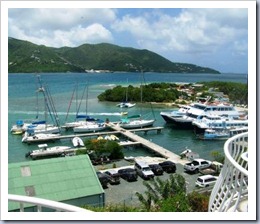
Our final day in BVI was spent at the historical Fort Burt Hotel, which was built in 1666 by the Dutch. In the 1950’s it was turned into a hotel. We were thrilled with our room, which provided a view of the marina, Road Town, and the surrounding hills. Three of the pictures in this blog were taken from our room’s balcony. The pool was a short walk away. View from Fort BurtHaving slept nine night in a v-berth on a thin mattress with a cranky sun-burned wife, Rich claimed the king-sized bed made him feel like a cherry resting on fluffy cream cheese icing, slathered on a carrot cake.
After a glorious day recharging our batteries, we finished packing our bags, turned out the lights, and slept soundly until the alarm went off at 4:45 a.m. Thirty minutes later a taxi whisked us towards the airport.

Because there is no public transportation in BVI and relatively few cars, it’s common for people to hitchhike. And in the seven years since we visited, everyone seems to have acquired a cell phone, which is permanently affixed to their ear. Given these facts, it was no surprise that our taxi driver received a call, and on the way to the airport, he took a side street to a slummy area to pick up a mystery package from a supposed friend. He then returned to the main road, and a few minutes later, gave a lift to a women who needed to go to the airport. We were the only people, however, who had to pay the fare.

In spite of the early hour, there was a lengthy line in front of the American Airlines window. We were unruffled, though, knowing we’d left plenty of time to check our luggage, go through security, and get on the plane. Rich was pleased that he’d carefully packaged our bags. The bottles of water, cans of soda, and a bottle of rum from the boat were in our carry-on bags; snorkel and fins, clothing, and sailing gear in two large Army duffle bags; and my beloved netbook, Sputnik, with pictures and notes from the trip, secured in a satchel and slung over my shoulder.

If you read the paragraph above carefully, you would have realized we were moments away from committing the first of the day’s many mistakes and SNAFUS. You can’t have containers with more than 2 ounces of liquid in your carry-ons. The bottle of rum had to go. And the sodas and waters either drunk or poured out.

Fortunately, the ticket agent was thinking clearly and offered to place the rum in one of our duffle bags, which of course, had already been tossed onto a conveyor belt and zipped outside to be placed on the plane. And unbeknownst to us, she checked both of our duffle bags under Rich’s name. She also recommended that we hurriedly drink the sodas before going through security.View 2 from Fort Burt
While chug-a-lugging the sodas, Rich decided to dump out the water. I recommended that he pour it on some plants. He returned moments later, a smile from ear-to-ear, with two empty water bottles and a cream-colored cat in the crook of his arm. There are many stray cats in BVI who are receptive to petting and nuzzling for food scraps. So in a sense, it wasn’t remarkable to find a cat lounging just inside the airport. The cat was a nice distraction and we hoped a good omen for the long trip home.

We were wrong on all accounts.

After handing my boarding pass to the screener, I was told to step aside, where I was searched from head to toe, and everything in my carry-on bag was taken out while I was questioned about my visit to BVI. Finally, I was told why my luggage and I were subject to such a thorough examination. An “SSSS” (Secondary Security Screening Selection) appeared on the top of my boarding pass, which required an enemy-of-the-state-level of scrutiny. The inspectors even walked onto the tarmac to track down and search my luggage before it was loaded onto the plane.

They were in for a surprise. There was NO luggage for ”Julie Lary” because the agent had checked both bags under Rich’s name! Had this not been the case, we would most assuredly have missed our plane.

But, the fun was not yet over, my carry on luggage and I were re-inspected once again at the gate, making Rich and I the last people to get on the plane.

The forty-five minute flight to Puerto Rico was blissfully uneventful as was our trip through customs and immigration. Once again, however, with an “SSSS” on my boarding pass, I was thoroughly inspected, and my carry-on bag and Sputnik unpackaged and swabbed for explosive residues. They also decided to inspect Rich and his large bag full of sailing gear. We now know that there are no explosive materials on his binoculars, GPS, video camera, digital camera, sailing books, empty water bottle , and wallet.Pool at Fort Burt

After getting cups of coffee and Cinnabons, we waited to board a 7.5 hour flight to Los Angeles. Just as they were boarding the first class passengers, Rich was paged. He was informed that we’d failed to claim our luggage at customs. Rich grabbed our boarding pass out of his backpack and with an American Airlines agent in tow, sprinted back to customs.

The bags were by the baggage carousel so it was just a matter of Rich grabbing them. With the help of the agent, he was able to cut to the front of the line and whoosh through customs. The next challenge was getting through the screeners, which immediately presented a problem because Rich had inadvertently grabbed our tickets for the Los Angeles to Seattle flight instead of the ones for Puerto Rico to Los Angeles.

Fortunately, the agent directed him to the American Airlines help desk, which reissued the Puerto Rico tickets. Aside from being thoroughly searched again, he was able to race back to the board area – shoes in hand and breathing hard – to join me in getting on the plane. Fortunately, we had exit row seats that were in back of first class. We simply needed to make it through the door, cross the aisle, and flop down on our seats.

Prior to the custom’s commotion, I’d purchased what I hoped was an engaging book to read, Relentless by Dean Koontz. I started the 7.5 hour flight by finishing up a magazine and the newspapers we’d brought. I then dove into the novel. By the time we got back to Seattle, I’d nearly finished the book. Dean Koontz is a fabulous writer! Funny! Suspenseful! Innovative!

Since the food selection at the Puerto Rico airport was awful, I recommended to Rich that we buy food on the plane. I’d read that the package meals on the plane are usually very good and inexpensive. Sure enough, when the cart came around, they had a nice selection, at a premium price of course.
Night view Fort BurtRich handed them his credit card and ordered two Boston Market grinder sandwiches with chips, a cheese, dried fruit, and cracker plate, and a large cookie. Leftover from sailing, we had a package of Japanese crackers, some Costco dried fruit and nut mix, and Jelly Belly jelly beans. I recommended to Rich that we space out the food over the 7.5 hour flight. Every half hour or so, he informed me how close we were getting to our next food indulgence.

Eating makes flying much more pleasurable!

Los Angeles was smoggy-foggy when we landed. We were optimistic that our luggage had also landed and wasn’t saturated with rum from a broken bottle inside. Putting our concerns aside, we got on a shuttle bus to the Alaska/Horizon terminal. Three minutes on the bus, Rich jumped up and exclaimed that he left his wallet on the plane.

I’m not making this up!

The shuttle driver turned around and barely came to a stop before Rich jumped of the bus and raced for the door. We scrambled across the busy American Airlines terminal and Rich ran down towards the plane we’d left ten minutes earlier.

Writing this, I can’t believe that he wasn’t stopped by some security officer! Undeterred by his lunacy, he ran back onto the plane and looked around our seats. No wallet. He then frantically searched through his backpack. Vola! Wallet!

Back to the shuttle bus. By the time we reached the Alaska/Horizon terminal, my patience was thread-thin. When Rich started scurrying around looking for the gate, I went the opposite direction and found the “departure and arrival” board, which confirmed I was in the right place to get on the flight back to Seattle.

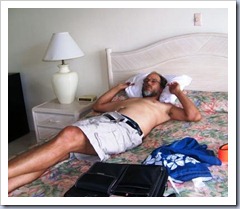
Of course, Rich was furious when he found me and decided to quench his fury by buying more food. His choice was a Burger King “Bessie Cow” burger with French fries and a large root beer. To appease me, he bought from Starbucks a tasty turkey and cheese sandwich on chewy bread. Rich at Fort Burt
Listen. You’re a hostage in an airport. You might as well eat.

The flight to Seattle was nearly three hours, which gave me plenty of time to read Relentless. In the row in front of us were two little kids who were ricocheting off the ceiling before we took off. They proved to be little angels for the entire flight and were kept engaged by their mother.

The monsters in the row behind us were another story. Nevertheless, we were relieved that nearly 18 hours of flying and being at airports was coming to a thankful end. We arrived at the BVI airport at 6 a.m. (3 a.m. pacific time) and landed in Seattle at around 9 p.m.

When we got home, we were too wired to sleep so we unpacked our bags, conversed with the cats, inspected our plants by flashlight, and then watched some TV before crawling into bed, twenty one hours after we’d gotten up at the Fort Burt Hotel in BVI.

And our luggage. It was waiting for us in Seattle. The bottle of rum didn’t break and neither did the two small conch shells we’d packed.

Garden Planted!

Between the raindrops on Saturday, Rich and I put in the plants that we’d bought at the Washington Technical College several weeks ago along with bitty seed starts that we’d been coddling indoors for the past few months. The latter has proven very frustrating. The only seeds that have grown with any success has been pea pods, peas, cilantro, and lettuce. Although, the latter die as soon as we put them outdoors.

Our raised beds — in Mount Vernon — now feature five types of tomatoes, three types of broccoli, two artichokes, celery, two types of peppers, peas, pea pods, several types of lettuces (from the technical college), spinach basil, thyme, cilantro, and mystery seed starts… and may be beans if they ever do us the honor of popping out the ground.

We still need to plant squash, cucumbers, bell peppers, and Japanese or Thai eggplant. Oh, and radishes. And tomatillos would be great.

Even though Zephyra isn’t a vegetable or herb, she felt her picture should be posted for everyone to admire. Zephyra thinks the world is a beautiful place with squirrels to chase, fences to climb, plants to hide among, catnip to sniff, and raccoon water to drink.

The picture to the right was taken in Kirkland. As soon as Rich stains the deck, we’ll put the pots (background) on the deck. The pots contain blueberries, raspberries, orange rhododendron, mock orange, apple tree, and baby trees and lilacs. We’ll also be creating pots of lettuce, basil, tomatoes, and pea pods for weekly consumption while in Kirkland.

Frisky Llama on a Dribbly Day

Yesterday, we had a full day planned from riding around the tulip fields in Mount Vernon to gardening. The weather, however, had other plans.

With optimism, comfy clothes (no skintight bike shorts and matching shirts for us since we need to keep up our bumpkin image), and our bikes secured to the bike rack on Rich’s truck, we set out for a community park near the Skagit Airport. The weather was iffy with dark skies and an occasional raindrop. Nevertheless, we headed east on a country road.

It was a pleasant 15 minutes of pedaling, looking at tractors and farm hands busy in the fields; tidy houses with mowed lawns, flower beds, and vegetables gardens waiting to be planting; and a few horses, cows, and sheep.

Noticing a white llama, Rich shouted at me to stop. I rode over to a fenced field and watched the llama gallop to the fence, followed by two large, un-sheared sheep. Llamas are herd animals and no doubt, the sheep were part of his flock.

This was an extraordinary llama. Not only was he very curious, but frisky – running up to us, snorting, then bounding away only to sprint back to us a moment later. Sporadically, one of the sheep would get into the action, running after the llama.

The llama was particularly intrigued by my white helmet and couldn’t resist eating grass from Rich’s hand.

After getting our fill of the llama, we jumped back on our bikes, just in time for the rain to start. We pedaled madly back to the truck then waited, hoping the storm would pass. After the drops slowed, we decided to bike the opposite direction. After a few minutes, it became clear, however, that a few raindrops become many when you’re biking. In addition, wet clothes aren’t comfortable.

Once we got back to Mount Vernon, we changed our clothes and launched into the project-of-the-day, planting the High Country Xeric Aroma Garden in our front side yard. I’ve spent the 4-5 weeks clearing two layers of impermeable black plastic landscape fabric, ivy, junipers, weeds, and rocks from this area. Underneath the plastic was mazes of tunnels, dug by moles. While the plastic kept the moles dry and insulated, it prevented anything from putting out deep roots. The few plants that were growing had long roots that stretched across horizontally outward from the plant instead of straight down.

You can see the garden to the right, moments after we put in the last of the plants. The one remaining plant, the large azalea with the red flowers, should start to do better (i.e. it’s leaves will be more green then greenish yellow) now that it’s roots can grow down instead of across the plastic. In the foreground is one of our fabulous, 30-year old rhododendrons.

We also planted the pea pods and peas we’ve been growing from seed in our new raised beds. This week, we’ll be getting vegetable starts from a local community college, which has a horticulture program.

And we’re pleased to see that our potatoes are sprouting in our potato bin. It’s so easy and fulfilling to plant potatoes. You simply buy the potato starts from a local feed/country store. A day or two before you plan on planting, you cut the potatoes into large chunks, leaving an eye or two in each chunk. You then create layers of soil, mulch (can even be shredded newspaper) and the potatoes chunks. I have 7-8 layers of potatoes in my bin.

You then keep the bin moist. The potatoes will put out green shoots that pop out of the holes in the bin and from the top. After several months, you can start to harvest the potatoes (new potatoes) or wait until last summer (August/September) when you open the bin (it’s held together with bolts and wingnuts) and harvest a bounty of larger potatoes.

I planted six varieties of potatoes… and no, you’re not supposed to cram so many potatoes into one bin, but I got carried away!

Day at the Seattle Museum of Flight

Saturday, March 27th, was my birthday (29 again) and an excuse to have some fun. Rich planned out the day, starting with breakfast at IHOP (spinach, mushroom omelet with fruit) then as visit to the Museum of Flight at Boeing Field, south of downtown Seattle.

We anticipated spending only a few hours at the museum, however, it proved very interesting and too large to suitably see in a day. We’re definitely going to visit the museum again to both see the exhibits that we missed and spend more time on the ones that we breezed through. Here are some of the highlights from our trip.

We initially walked through the space exhibit, which detailed the development of rockets and space exploration in popular culture. I lingered over as display case that featured Buck Rogers memorabilia and a children’s kit for making and painting lead figurines. It had a little ladle in which to melt the lead then pour into casts. I kept staring at the kit, thinking “Isn’t lead dangerous?”

With today’s neurosis on toy safety, it seemed inconceivable that at one time lead was a common material in children’s toy and that a toy manufacturer thought it was okay for a child to melt lead over a burner!

Rich and I laughed when we looked at the historical pictures of NASA engineers in white shirts and slim ties. At the time, they probably felt that their computer systems were the pinnacle of technological innovations. Today, they look like something for a 1960’s movie.

The space exhibit also featured several space crafts, including the North American Block 1 Apollo Command Module, serial #007, which was very small, considering two men fit inside and were supposed to whirl around the earth for several days. This capsule was once identical to the module in which Gus Grissom, Ed White, and Roger Chaffee died in a fire in 1967.

You could also walk in a mock-up of the International Space Station Destiny Laboratory. Because you lose muscle density when in an environment with no gravity, the space station has a treadmill that folds down from the ceiling on which astronauts can run on to maintain muscle tone.

The Great Gallery is six stories in height with dozens of small and medium-sized airplanes hung from the ceiling, and larger planes on the ground. One of the first vehicles we encountered was the humorous Taylor Aerocar III (below), a combination car/airplane with a 190-foot wingspan and cruise speed of 135 miles per hour. When in the car mode, the wings and tail can be towed like a trailer or left at the airport. Of course, I was drawn to it because of its shiny red paint and the chic 1960-era mannequins inside.

Everywhere you looked, there are planes in the Great Gallery. One plane, however, dominated the floor; it is the Lockheed M21 Blackbird with a Lockheed M-21B Drone on top. The picture below doesn’t do justice to the size of this futuristic plane that flies at a supersonic Mach 3.2 (New York to London in less than two hours) and can go 2,955 nautical miles without refueling.

Its engines are so powerful that they can drive gigantic ocean liners. To withstand the Mach speeds, 90% of the planes airframe is made of titanium composite. Its tires are filled with nitrogen and impregnated with aluminum. Even though this plane looks very futuristic, it was built in 1963 to do “reconnaissance missions deep into enemy airspace.”

The D-12 drone on top of the M21 was designed to be launched from the “mother ship” then follow a pre-programmed path where it would capture clandestine images using a high-resolution camera. The camera would then be released into the air where it would be retrieved after the drone self-destructed.

Spooky spy stuff.

When I started writing this article, I was going to express my astonishment (and delight) at the two large fighter jets in the gallery: the McDonnell F-4 Phantom II and the Micoyan-Gurevich MiG-21PFM. However, we watched the movie “We Were Soldiers” and the glamour of war machines wore off. The movie was about the Battle of la Drang in November 1965, the first major engagement of the United States military forces in Vietnam. Although, the movie did showcase the maneuverability of UH-1 Heuy helicopters along with the F-100 Super Sabre jets that flew at supersonic speeds and dropped napalm and bombs.

In spite of the horror wrought by these military jets, I was captivated by their size. The MiG looks like a rocket with wings and just enough room for two pilots. The Phantom is larger and can fly at higher altitudes.

The museum had the cockpits from two jets in which you could sit inside and have your picture taken. Here’s me in a SR-71A Blackbird and Rich in a full-scale mock-up of a McDonnell Douglas F/A-18L Hornet fighter jet. Don’t we look thrilled?

My next favorite plane, which I took many pictures of, was the 1940 Alaska Airlines Douglas DC-3 (below). This was one of the largest planes in the gallery with a 95 foot wing span and 65 feet in length. I was intrigued by the underside, below, which had thousands of rivets and pieces of metals that formed the sleek silver underside. It was very beautiful.

Unlike many museums where you can’t get up close to the displays, the Museum of Flight lets you walk within a foot or two of many of the planes. Being this close puts into perspective the perils of early aviators because their planes were super small and didn’t look overly sturdy. The Granville Brothers Gee Bee Z “City of Springfield” was just seven feet high and fifteen feet long, yet it could fly up to 270 miles per hour!

Also surprisingly small was the Mikoyan-Gurevich MiG-15, which was developed by the Soviet Union and initially flown by Soviet pilots over North Korea in November 1950. At the time, four MiG-15s took part in the world’s first jet-versus-jet dogfight against four Lockheed F-80s. Over 16,000 MiG-15s were produced and flown by pilots in over fifty countries including China, North Korea, Afghanistan, Iraq, Libya, North Vietnam, Vietnam, Albania, Cuba, Czechoslovakia, East Germany, Egypt, Hungary, Finland, Somalia, Sudan, and even the United States (from China).

Just 33 feet long and 12 feet high with a 33-foot wingspan, the MiG-15 that is at the Museum of Flight was purchased from the Chinese People’s Liberation Army Air Force and has nine kill markings on it.

A special exhibit at the museum was “In Search of Amelia Earhart.” Most of the exhibits were black-and-white photographs, a few of Amelia’s personal items, and a model of the last airplane she flew, a Lockheed Model 10 Electra.

Below is a picture I took of one of the photographs. I spent several minutes staring at it because it summed up an era. ALL of the women are aviators. Amelia is third from the left, holding the bouquet of flowers. Most of the women wore proper mid-calf skirts, high-heels, hats, and even gloves.

In the exhibit, there’s a nurse dress that Amelia wore during World War I. She was very slender and fine-boned. And before a school girl commented that she didn’t look like an aviator, she had long, wavy blonde hair. Her striking figure and pretty face made her the perfect choice to appear in ads and endorse Lucky Strike cigarettes, malted milk, and luggage. In addition, she designed clothes that were sold exclusively at thirty department stores throughout the United States.

In the photographs on display, the only woman who never appeared in women clothing was Florence Lowe “Pancho” Barnes. She’s the woman on the left, wearing chaps, a leather jacket, white shirt, and slender tie. Amelia was a very colorful and adventures person, but nothing compared to Pancho.

Born into a wealthy family in Pasadena, California, Pancho learned from her father how to hunt, fish, and camp. From her mother, she was encouraged to toe-the-line and be a society lady. To help curb her tomboy tendencies, she was married to a reverend when she was eighteen years old. They had one son, William E. Barnes.

Five years later, after her mother passed away, she reverted to her flamboyant and headstrong way, going so far as to disguise herself as a man and stowing away on a freighter to Mexico. When she returned home, four months later, she became enamored with flying and after six hours of formal instructions, she flew solo. At the time, she was one of only two dozen aviatrixes in the United States.

Her inheritance gave her the freedom to pursue flying, resulting in her breaking Amelia’s world women’s speed record in 1930 with a speed of 196.19 miles per hour. Along with running a barnstorming show and competing in air races, she became a stunt pilot in Hollywood, and built the famed Happy Bottom Riding Club on the current day Edwards Air Force Base in southern California. She rubbed shoulders with test pilots Chuck Yeager and Buzz Alrin, went horseback riding with the young George S. Patton, Jr., and no doubt made her grandfather, Thaddeus S. C. Lowe, proud. For Professor Lowe pioneered American aviation with the establishment of the Union Army Balloon Corps during the American Civil War.

With an hour and a half before my birthday helicopter ride, Rich and I quickly walked through the William E. Boeing Red Barn exhibit, which featured the birth of aviation and start of Boeing. We then scurried across the covered walkway to airpark to walk through two airplanes: The first “Air Force One” and an Aerospatiale/BAC Concorde.

Below, you can see Rich standing in front of the Boeing VC-137B, which was originally built for President Eisenhower and used by Presidents Kennedy, Johnson, and Nixon. Presidential airplanes are known as “Special Air Mission.” Once a current president steps aboard, however, it becomes “Air Force One.”

It was a treat to walk aboard the plane and see what was at the time, state-of-the-art electronics and communications equipment. In the door of the “presidential” bathroom was a small doggie door, no doubt for one of President Johnson’s beagles. There was also a special rack for his Stetson.

I never expected to be on a Concorde, especially with only twenty built between 1966 and 1979. Capable of flying at two times the speed of sound, the aircraft could go from London to New York and back in the time it took a conventional plane to go one way.

The plane is equally sleek inside as outside with spacious, two across, sapphire blue upholstered seats and overhead bins that conform to the low, rounded ceiling. It must have felt like sitting in a small tunnel because it’s very long and not particularly wide!

With just 35 minutes to spare, we hustled to our car and drove a few miles to Classic Helicopters where I enjoyed an amazing 30-minute flight around Bellevue and Seattle. See the article below.

Spring in Mount Vernon

After a week of rain and cold, Saturday erupted in color with my  tulips, jonquils, and daffodils bursting open; rhododendrons starting to bloom (salmon flowers below); green azaleas turning into bursts of bright red and pink; sprays of fragrant lilacs opening (right), and fragile pale pink blossoms covering the branches of our two apple trees (below).

With the colors of spring in full force, it’s hard not to rush to nearest garden store and buy every plants in sight. But, selling and not necessarily keeping plants alive is how nurseries make a profit. With super low temperatures last week, many of the flowering plants that are now for sale were in warm, protective greenhouses or barns just a weeks ago. They would have sustained frozen damage if they’d been placed in the ground!

Along with admiring the colors of our gardens in Mount Vernon and Kirkland, we got fill soil for the two raised beds were put in a couple of weeks ago. We’ll be planting a variety of vegetables along with herbs, lettuce, and spinach in pots on the deck of our Kirkland house. While most of our vegetable gardening (squash, broccoli, beefsteak tomatoes, beans, radishes, and Thai eggplants) will be done in Mount Vernon, Rich will be putting up a couple of terraces in Kirkland for "most-have" vegetables for daily salads. These include cherry and Italian tomatoes, pea pods and peppers.

Towards the back of our Mount Vernon house is a large fir tree. I happened to look up and see something extraordinary — tiny pink baby pinecones. They were the size of plump raisins and were on the tips of most of the branches on the 30-foot tree. I’m going to pay attention in the coming weeks as to how fast these pinecones start to open and turn brown.

This weekend, we also finished clearing a large area in Mount Vernon for planting a xeriscape garden. The plants in this area had always looked kinda’ sickly and the only thing that seemed to grow was thick, invasive ivy. Once, I started hacking at the ivy, I discovered the issue. Under six inches of bark chips and loose soil was thick plastic plastic AND under this layer of plastic was a few inches of soil with another layer of plastic! For three weekends, I’ve been removing the plastic, which was slowed by decades of ivy that had grown over the plastic, creating a jumble of roots and stems that needed to be meticulously cut apart, unwound and removed.

Under the last layer of plastic, was a maze of mole burrows. Rich now knows why it has been so difficult to remove the moles because they had insulated homes under the plastic!

Plus, there were two giant juniper bushes that needed to be cut into sections and removed. We ended up taking two trailer loads of junipers and ivy (roots, branches, leaves) to the recycling center.

Next weekend, I can begin planting my xeriscape plants, which arrived in late March from High Country Gardens in New Mexico.

Seattle from High Above

For my birthday, Rich arranged for us to take a 30-minute helicopter ride over Seattle through Classic Helicopters. I didn’t know what to expect, but was surprisingly calm about going up in a small mosquito of a helicopter with a front windshield that provided a greater than 180-degree view from top-to-bottom, and side-to-side.

Because Rich had been in a helicopter before, he wanted me to sit in the front seat with the pilot. With two cameras in hand, we gently lifted off the ground and hovered for a few minutes before getting clearance from Boeing Field air traffic control.

The word that keeps coming to mind when I think about the ride is "floating." Aside from moving across the horizon, which my eyes perceived, there was virtually no movement. It was this glorious floating sensation that allowed me to look down at awe at Seattle and the surrounding landscape and many waterways, including Lake Washington, Lake Union, and the Puget Sound.

I was Peter Pan’s Wendy for 30-minutes drinking in the sites and occasionally snapping a picture. Fortunately, Rich was more composed and snapped most of the nearly 100 pictures that we took. Here are some of my favorites.

BellevueThis is downtown Bellevue with Interstate 405 to the right. I work in the Bravern I tower, which is the first building, across from the circular cloverleaf with a tree in the middle.

Bellevue is a few miles from the Microsoft main campus in Redmond.

Mercer Island

 Mercer Island is in Lake Washington. A bridge connects the "east side" to this island and then continues west to Seattle. Rich and I have sailed on this lake many times.

From a helicopter, you can see how much water surrounds the area.


Montlake CutThe Montlake Cut connects Lake Washington to Lake Union and Seattle. To the right is the University of Washington campus. North, through Lake Union, you can see the houseboat where "Sleepless in Seattle" was filmed along with several of the boats from the series "Deadliest Catch."


So many housesSeattle is a BIG city with over 600,000 people and over 3,340,000 in the metro area. No wander why traffic is so bad. Between the number of people and constraints imposed by the waterways, traffic is terrible!


Space Needle

The Space Needle was built for the 1962 World’s Fair The quirky blue, burgundy and silver structure to the left is the Experience Music Project, built by Paul Allen.

This area has been attractions and parks that were originally built for the fair. 


Space Needle_2Here’s another view of the Space Needle, which is 605 feet tall and 138 feet wide. It can also withstand winds up to 200 miles per hour along with earthquakes up to 9.1 magnitude.

At the top is an observation deck and restaurant; neither one we’ve been too.

Towards the top of the picture, you can see two "bridge-like" structures. This is the roof of Safeco Field, which can be opened during fair weather. Microsoft holds their annual company meeting at Safeco Field. Dozens of buses transport tens of thousands of employees.


Safeco FieldThe helicopter pilot banked over Safeco Field so we could snap a few pictures.

The grass is very green as is the landscape around the area. Seattle is called the Emerald City because of its lush vegetation… and because it’s truly a magical place to live (or visit).


WaterfrontSeattle’s waterfront host vehicles of all sizes from huge cruise ships coming and going to Canada and Alaska to ferries, tour boats, barges, tug boats, commercial ships (notice the cranes for loading and unloading ships), and of course yachts, sailboats, and motor boats. The tall buildings are downtown.

Marina

This is the popular Shilshole Bay Marina, north of downtown Seattle. Most of the marina is comprised of sailboats, which enables direct access to the Puget Sound and smooth sailing to the San Juan Islands up to Canada and Alaska.

There’s a large sailing school at this marina.


Coming into Boeing Field Rich snapped a shot of me as we returned to Boeing Field. Below is Interstate 5 along with a railroad corridor. This corridor is also where the helicopter fly to keep out of the way of commercial and private planes going to and from Boeing Field, and the main airport for the area, SeaTac. The latter is halfway between Seattle and Tacoma, hence the name.

While we were in the air for just 30 minutes, the experience and the sites will last a lifetime.


Vegetable Garden Progressing

For the past few weekends, Rich has been planning and building two 5×8 foot raised planter boxes for our Mount Vernon house. This weekend, he dug holes in the ground and sunk them. In the middle is heavy plastic mesh to keep critters from burrowing up into the garden with a layer of landscape fabric on top. Raised bedsAround the edges and in the post holes is gravel to prevent the wood from rotting.

Next weekend, we’ll get top soil, which we’ll supplement with bags of steer manure, bone meal, and other soil amendments, which are currently in the back of Rich truck.

For the past month, I’ve been starting herb, lettuce, pea, and string bean seeds in the house. The lettuce sprouted very quickly so I had to move them into a larger pot where they’ll hopefully get stronger so they can be planted outside.

It’s still very early to start planting, but we wanted to get the boxes completely so we could pop in seeds or starts when the weather gets warmer.

While Rich was building planter boxes, I was busy tearing out sections of ivy to plant a xeriscape garden with lavenders, salvia, thyme, and other drought tolerant plants. We planted similar plants into Texas (in place of grass). Once they took hold, after watering them for two years, they required very little maintenance or water.

Garage Gets a Make-Over

Several weeks ago, we went to the Seattle Home Show, which featured merchants offering everything from resurfacing bathtubs and counters to landscaping materials, roofing, replacement windows, hot tubs, and garage doors.

Oh, garage doors!

Our stunning 1970’s house in Kirkland came with hunks of warped plywood, inset with amber glass windows, that swung up when opened, clobbering anything in their path. To say that I hated these garage doors would be an understatement. Although, in the grand scheme of necessary home improvements, replacing the garage doors wasn’t high on the list.

One vendor at the Seattle Home Show must have said "something" that compelled Rich to explore the garage doors that he was touting. His prices were very reasonable and the NEXT week, Rich called for a quote. A few weeks later, our hateful garage doors were sawed in half and replaced with fabulous, almond-colored doors with elegant windows.

Check out the before and after pictures. Note, the barfy brown shutters were removed from the front windows when they were replaced last year with double-pane windows. This summer we’re having our house painted in a pale almond with moss green trim. And the shutters, they’re history!

Plus, we’ll be axing the front door and replacing it with a pretty wooden door with inset panels of rectangular glass. I’ve scoped out the door several times at Home Depot several times!

Visit Down Memory Lane

Last weekend, we visited Portland, Oregon. Rich attended a fireworks certification class so he can retain his Oregon Pyrotechnician license. He’ll be firing a show for the Portland Rose Festival in late May to fulfill the other requirements of the license.

Meanwhile, I visited my mother in Sherwood, Oregon.. She’d recently hurt her leg and needed help with housecleaning, grocery shopping, laundry, and other tasks. We had an enjoyable lunch at Sushi Land and that evening, Rich joined us at the Sherwood McMenniman’s, a community tavern where Rich and I initially met after corresponding for a few weeks on Matchmaker.com.

Sunday morning, we headed to southeast to Milwaukie (SE Portland) to purchase Dave’s Killer Bread at their bakery/store. After serving 15 years in prison, "Dave," decided to start making outrageously nutritious and tasty breads. Today, he offers over a dozen breads, cookies, and a wickedly delicious cinnamon roll called a Killer Sin Dawg

The problem with the breads is that once you’ve eaten them, other breads are… boring. His breads are liberally sprinkled with a variety of seeds and made with whole grains.

At any rate, we planned on purchasing a dozen breads, giving nine to Rich’s son, Chris, and keeping three four ourselves… along with a Killer Sin Dawg, and a Peace Bomb Mini-Baguette.

On the way to the bakery, Rich drove through Milwaukie and areas of southeast Portland where he used to live. He also stopped at the Historical Broetje House, where we got married in September 2002. The house was originally owned by a horticulturist who had lavish plantings, including towering Sequoia Redwoods. Above is the front of the house along with its water tower.

The next photo is part of the garden. Towards the back is a white gazebo where we exchanged vows. I had Rich pose in the gazebo to re-enact the event. He looked much more dashing during our wedding in a black tuxedo with a ivory rose boutonniere.

I’d also decorated the gazebo with ivory and floral patterned ribbons, ivory toile, and ivory and moss green flowers.

The guest sat on white chairs on the lawn. A bagpiper (Rich is half Scotch) played as we walked from the bed and breakfast portion of the Broetje House to the gazebo.

Afterwards, we greeted guests in the reception area before we proceeded to the ornate banquet room.

It was fabulous to once again walk around the Broetje House and remember our special day.